Showing posts with label TV Specials. Show all posts

Friday, June 29, 2018

TV Detour #6 - Herbie's Adventures in Television

When we last saw Herbie - the plucky little Volkswagen with a mind of his own - he’d been run ragged and stunk of rotten fruit following the release of the embarrassingly awful “comedy,” Herbie Goes Bananas. By the dawn of the 1980s, the franchise had clearly been run without a tune-up for too long. Much like the once-sprightly “love bug” himself, the series was in need of a rest before returning to the silver screen. Rather than letting Herbie drive off into the sunset of nostalgia, however, Disney would put their vehicular mascot to work on the small screen; Herbie would therefore be called upon to front a pair of television productions aired some 15 years apart. So before Herbie takes his final lap, let’s take a look at his adventures in television.


Groovy...

Herbie’s first foray into television, as we’ve discussed previously, came back in 1971 when he was featured in The Grand Opening of Walt Disney World TV special. Appearing alongside his Love Bug co-star Buddy Hackett, the duo faced off against a handful of genuine race car drivers at the Magic Kingdom’s Grand Prix Raceway attraction. This infamous bit is memorable for seeing Hackett use a giant wind-up key to start Herbie - because apparently nobody associated with that program had ever seen The Love Bug (or seemed to know what the hell was going on in general.)

'Memba TV Guide?

Herbie’s big break into broadcast TV would come a decade later, in the form of a full-on TV series. Herbie, The Love Bug was a mid-season replacement which ran on the CBS network for 5 episodes in March and April of 1982. Starring Dean Jones as Herbie’s on-again/off-again friend and driver, Jim Douglas, the show followed the retired racing star as he meets and becomes engaged to divorcée and mother-of-three Susan MacLane (played by Patricia Harty) - with a little help from Herbie, of course. Attempting to sabotage the couple’s courtship is Susan’s jealous ex-fiancé, Randy, played with ineffectual bluster by M*A*S*H’s Larry Linville. The cast is rounded out by Richard Paul as the prerequisite goofy mechanic pal, Bo (sort of a low-rent substitute for both Hackett and Don Knotts), and Susan’s three kids: oldest daughter Julie (a pre-Back to the Future Claudia Wells,) middle son Matthew (Nicky Katt) and edge-of-precocious Robbie (Douglas Emerson.) Actress Natalie Core also appears as the ex- fiancé’s mother, Mrs. Bigelow, so that we can get someone who says “Randy, why are you still obsessing over that woman?” in every episode.

Keeping up with the Joneses...

Though officially categorized as a sitcom, I have trouble describing the show as such, since it neither looks nor feels like contemporary sitcoms such as Taxi or Too Close For Comfort (why did I choose those two examples? Well, if you must know: Taxi has cars in it, and I freaking love Too Close For Comfort - so there.) Instead, Herbie, The Love Bug fits into that particular sub-genre that viewers (and reviewers) can’t seem to decide should be dubbed “comedy-drama” or simply “hour-long comedy.” Herbie, in fact, seems to be better bed-fellows with such contemporaneous programs as The Love Boat and Fantasy Island - or such current quirky favorites as Jane the Virgin and Crazy Ex-Girlfriend. While the show has plenty of wacky antics (mostly focused on Herbie consistently foiling Randy’s attempts at sabotage,) the show mostly revolves around Jim and Susan coming to terms with integrating their relationship into her family life. Closer to a light-hearted domestic drama than a knockabout comedy, coming into this show straight off the strained goofiness of Herbie Goes Bananas came as something of a respite for this blogger.

Fun fact: The jauntily corny theme song, entitled “Herbie, My Best Friend,” was actually performed by Dean Jones himself - presumably in character. Here it is, for your Summer listening pleasure:


The pilot episode - in which Jim and Susan meet after Herbie helps to foil a robbery at her bank - was helmed by veteran TV director Charles S. Dubin, and establishes the show’s premise and main cast well. The following four episodes find directing duties rotating between returning series director Vincent McEveety and Bill Bixby (best remembered as Dr. Banner in TV’s Incredible Hulk, but also a prolific director and producer.) Episodes 2 and 3 cover the troubled road to Jim and Susan’s wedding, which itself occurs in episode 4. The 5th episode almost seems out-of-place, detailing the day-to-day struggles of the newlyweds adjusting to married (and extended family) life. Perhaps this final installment was a window into what a continuing series would’ve looked like, had it been renewed?

Domesticated Herbie...

All episodes save for one (more on this in a moment) were written by Arthur Alsberg and Don Nelson, the sitcom-writing duo responsible for Herbie Goes to Monte Carlo. Alsberg and Nelson wisely ignore the events of Herbie Goes Bananas, establishing Jim and Herbie as ongoing friends and partners who set up a driving school following their retirement from racing. Their “Famous Driving School” seems to cater exclusively to kindly old ladies (a nod, perhaps, to Herbie Rides Again) - whom Herbie is able to assist when they fail to notice the occasional STOP sign or missed turn. Another main storyline focuses on Susan’s opposition to auto racing, since her first husband abandoned the family to become a racecar driver. Therefore the series ends up featuring only a couple of racing scenes. However, unlike previous film entries in which Herbie did not race, it makes sense within the established story. But despite this lack of racing scenes (and the fact that Herbie himself features less than most of the human cast,) Herbie, The Love Bug actually does feel like a continuation of the film series - certainly more so than the most recent sequel did.

Now cut that out!

While the show is an inoffensively pleasant, fairly breezy affair, I have to admit that the best episode by a long mile is episode 3. This installment heavily references the events of Herbie Goes to Monte Carlo, and features the return of Jim’s love interest from that film, Diane Darcy (played here by Andrea Howard, replacing Julie Sommars for some reason) - whom is invited to Jim’s bachelor party in an attempt by Randy to make Susan jealous. Oddly enough, despite extensively referencing the third film, as noted above this is the only episode that wasn’t penned by the writers of that movie; instead this episode was scribed by Herbie Goes Bananas screenwriter Don Tait. Despite the ire flung at him in my review for that movie, I must admit that his teleplay here - a somewhat wackier installment than the surrounding four episodes - entertains thoroughly. Perhaps more at home with writing for television, or working better within another writer’s framework, Tait’s work here - his very last screenplay, as of this writing - is fun and efficient in it's on-point comedy.

Herbie gets 'em to the church on time...

While the show’s brief run seemingly signaled the end of Herbie’s adventures, Disney wouldn’t let the little Bug disappear entirely. Besides keeping his memory alive through televised repeats and home video releases of his theatrical films, Herbie became a rare but consistent mainstay at Disney’s theme parks - but we’ll go into that in a future "Theme Park Rundown," of course. (No, we won’t.)

And then, fifteen years after the conclusion of his short-lived TV series, Herbie suddenly returned to the small screen in the form of a made-for-TV movie. Titled The Love Bug (usually referred to as The Love Bug ‘97 or “The TV Movie” to differentiate it from the 1968 original,) this rarely-seen Herbie adventure aired on ABC’s version of The Wonderful World of Disney on November 30, 1997. It was directed by Peyton Reed, who two years prior had overseen a Kirk Cameron-starring TV-remake of The Computer Wore Tennis Shoes, and would go on to direct Bring It On three years later (before taking the reigns of Marvel’s Ant-Man franchise starting in 2015.)

Okay, now a silly one you guys!

Hovering somewhere between a remake, reboot and continuation, the film sees Herbie worn-out but back on the racing circuit, under the drivership of an arrogant Scottish racer named Simon Moore III (played by John Hannah, familiar from the Mummy films and Starz’ Spartacus series.) After Moore dismissively gives Herbie up for scrap, he is rescued after being put into a “junk-car race.” There, small-time racer and mechanic Hank Cooper (the one-and-only Bruce Campbell) repairs and races Herbie, ending up the winner. One of the judges of the event is Alex Davis (Alexandra Wentworth) - an automotive magazine reporter and, naturally, Hank’s ex-girlfriend - so you can see where this is heading from the get-go.

By the way, as a fan of the Evil Dead series it came as quite a kick for me to see Bruce Campbell (“Ash” himself) appearing here - the first in a handful of appearances the quintessential B-movie star would make for Disney. Campbell is in “average Joe” mode here, however, playing a nondescript “vanilla” hero rather than the chainsaw-wielding badass familiar to the Fangoria set.

Good, bad - I'm the guy with the Bug...

Much of what occurs in this version of The Love Bug follows the original film (and it’s follow-ups to some degree): we have Herbie playing matchmaker to his driver and an initially reluctant love interest; an eccentric buddy (Kevin J. O'Connor as Roddy, a sculptor like Tennessee Steinmetz) whom early-on realizes the car’s sentience; a scene in which an emotional lead character realizes that Herbie has feelings; and a wacky climactic race. Really the only factor that doesn’t make this a remake is the mid-movie arrival of good ol’ Dean Jones as Jim Douglas, who arrives following Herbie’s destruction (SPOILERS!) to assist in rebuilding him. Jones, noticeably older by this point (the wide-shouldered business suits he wears here making his head look positively puny,) offers a few tidbits to the new characters about Herbie’s background, as well as the sole reference to the 1982 TV series to be found in any “Herbie” production, mentioning that Herbie helped him “meet his wife.” Jones also provides a brief narration at the start of he film, which significantly contextualizes Herbie’s rise to fame within the zeitgeist of the late ‘60s “love generation.”

What those familiar with the previous “Herbie” films may not see coming, however, is that this Love Bug goes somewhere unexpected and not entirely warranted: into an origin story. You see, once Herbie inevitably starts helping Hank win more races, a jealous Moore (slightly more crazy than most of Herbie’s previous nemeses) seeks to discover what makes the little VW Bug so special. He soon digs up one Dr. Gustav Stumpfel (Harold Gould,) the heretofore unheard of German scientist who, when tasked with creating a “people’s car” that would become the Volkswagen Beetle, inadvertently created a sentient “Love Bug” after a picture of his beloved wife accidentally fell into the vat of special metal he was brewing to make into the car. WHAA!?!

Mein Gott! Das auto!

This reveal is … odd, to put it one way. Ignoring the fact that the screenwriter (Ryan Rowe) chose to link Herbie's origin to a quasi-historical/fictional context (essentially making Herbie the progenitor of the entire VW Beetle "race",) it also shifts the core concept of the character. That Herbie, previously portrayed as a car that obtained consciousness through love, is now revealed to be the result of a “mad scientist” trope is fairly disappointing. This story reframes the image of Herbie as a byproduct of alchemy rather than a child of mysticism - a “happy accident” of human invention, rather than one bourne from pure thought. While the idea that Dr. Stumpfel’s love for his wife brought about emotional awareness within his creation is an interesting one, it somehow doesn’t quite fit in with the Herbie we’ve been witness to before (especially when he’s acted like a little thug several times before.)

She could tell right away that I was bad to the bone...

This brings us to the part of The Love Bug ‘97 that people seem to remember most: Horace, the Hate Bug. In the film the point of Moore’s uncovering of Dr. Stumpfel is to trick the eccentric old inventor into recreating his previous experiment, and then perverting said work by tossing a picture of himself into the “magic ingredients.” The resulting creation is a jet-black, souped-up Beetle that Moore dubs “Horace.” Unlike the gentle, child-like Herbie, Horace is a machine seething with rage and possessing an instinct to destroy (and even comes equipped with James Bond-style offensive weapons.) Another intriguing idea that gets rather bungled in the execution, the idea of a hate-filled “anti-Herbie” seems like a great addition to the franchise. Unfortunately, when framed within this film’s weird science theme, any idea of a “living car without a soul” ends up functioning more like a villain’s “super weapon” than it’s own character - frowning bumper or not. And the less said about Horace’s demise (in which he crashes through the ground, literally surrounded by flaming hellfire) the better.

Horace Goes to Hell!

Despite the presence of Dean Jones, a focus on auto racing and (admittedly superficial) discussions of love and hate, there’s something about this TV rehash that somehow feels … off. Not that it’s a bad movie by any means - while not great, it’s enjoyable and even has moments of genuine wit. It’s just that there are some small, niggling issues that really prevent it from fitting in with Herbie’s other adventures. This specific situation should sound familiar to older fans of the long-running English series Doctor Who (I’m going to go off on a bit of a tangent here, so my apologies.) That show, which ran uninterrupted from 1963 to 1989 (and began airing on PBS stations in the US in the mid ‘70s) was resurrected as a made-for-TV movie in 1996 as a co-production between the BBC and the FOX network. That movie (which in fandom is usually referred to as “The TV Movie” as well,) despite a number of call-backs and continuity references, looked and felt disconnected from it’s parent franchise - just like The Love Bug. For one, both “TV Movies” featured a returning cast member to lend some credence to their existence (Dean Jones in The Love Bug, “Seventh Doctor” Sylvester McCoy in Doctor Who,) as well as out-of-place quasi-celebrity cameos in bit-parts (comedian and MadTV performer Will Sasso as a morgue attendant in Doctor Who, ex-Monkee Micky Dolenz as a cigar-chomping car dealer in The Love Bug.) Both films also feature somewhat bland music; John Debney’s Doctor Who score sounds more like selections from FOX series Sliders, and Shirley Walker’s Love Bug score is forgotten almost as soon as it’s heard. This is a real shame, since Walker's work for modern classic Batman: The Animated Series featured some of the best music on television just a few years prior. At least Debney got to use the original Doctor Who theme, whereas George Bruns’ famous “Herbie Theme” is nowhere to be heard here.

Why do I bring up Doctor Who? Well, the similarities between these two attempts at reviving a long-running franchise is too great to ignore, especially since both came out within a year of one-another. Maybe I just wanted to write an entry that referenced The Evil Dead, Doctor Who and Batman? Incidentally, both “TV Movies” also ended up being dead-ends, as Herbie’s franchise would go dormant again thereafter, and Doctor Who failed to act as a “backdoor pilot” for a revived series. It would take both franchises a few more years to return to popular culture again, and would both stage successful returns in 2005. But more on that in the next entry...
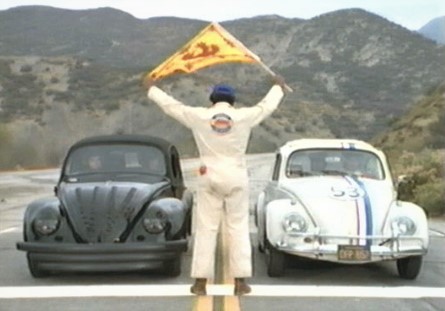
Two players. Two sides. One is light... one is dark.

As we’ve seen, Herbie may have gone through a few long periods of rest, but he never really went away. Though largely forgotten, Herbie’s adventures in television kept the little living car puttering around in the public consciousness, like a well-known acquaintance always hovering in the background. Disney, both under Ron Miller and later Michael Eisner, knew that they still had a popular character on their hands, and wouldn’t let the opportunity to use him slip by; they just needed a few small-screen pit-stops to ensure the little old car would be ready for his inevitable big-screen victory lap.

Monday, October 23, 2017

TV Detour #5 - EPCOT Center: The Opening Celebration (EPCOT Pt. 2)

“Good evening ladies and gentlemen and welcome. Welcome to a party … it’s not really a party, it’s more a celebration; a dedication, a festival and an event - also a monumental achievement all rolled into one. And it’s also a party.” Host Danny Kaye’s exuberant and confusing introduction, delivered in a segment recorded at the last minute from the pre-opening VIP celebration, sets the tone for 1982’s EPCOT Center: The Opening Celebration - Disney’s attempt to showcase it’s newest, biggest and most expensive park, as well as explain to a skeptical public what it’s all about.


Disney had it’s work cut out for it marketing their new undertaking. As noted in my previous article, the world had been hearing about Walt Disney’s great unfinished project, the Experimental Prototype Community of Tomorrow, since before his death in 1966. Since then, Walt Disney World had been operating to great success, and planning a living model “city of the future” had fallen by the wayside. In it’s place, Disney instead decided to build a second theme park within it’s Florida property, albeit one that would be aimed at a more mature audience than either the Magic Kingdom or Disneyland. Resembling a sort of permanent world’s fair, EPCOT Center was to be focused on examining real-world issues and starting conversations about the future of the human race - a far less whimsical theme than they’d ever attempted before. But how to present this concept to the world? The route Disney chose is an interesting one - to state plainly that the new park was in fact the true culmination of their founder’s last and greatest dream. At best, one could suggest that branding EPCOT Center as Walt’s baby was somewhat problematic, and at worst say that it was an outright lie. Nevertheless, Disney’s marketing machine proudly rolled out images of a sun-drenched Spaceship Earth (the 18-story geosphere that serves as the park’s central icon - it’s castle, if you will)(and no, I will not refer to it as “that giant golf ball”) with proclamations that “Walt Disney’s EPCOT Center” would be opening soon, heralding the early beginning of the 21st century.

Say cheese! Now get back to work...

Disney’s difficult and specific task is set out in their hour-long Opening Celebration special, transmitted October 23rd, 1982 - 21 days after the official opening day, but the evening before it’s splashy dedication ceremony. Following the introduction described above, the show dives right into it’s complicated mission statement - in song form, no less! Backed by the gleaming and freshly flowered entrance plaza, Danny Kaye, arms spread wide, belts out a show-stopper entitled “Hooray for the 21st Century.” All about history being made before your eyes, and making numerous mentions of “the culmination … of one man’s imagination,” the number does some heavy lifting in relating Walt’s original “city of tomorrow” concept to the freshly-minted park previewed on-screen. Intercut with generous footage of concept art, Imagineers at work, and construction crews working feverishly to get everything completed in time (it wouldn’t be a Disney theme park if everything was quite ready for opening, after all,) it also contains a number of spoken-word asides in which Kaye specifically spells out much of what Disney wanted to emphasize about EPCOT Center. Disney has Kaye throw all of their cards on the table with the following proclamation:
“Just so there’s no confusion: EPCOT Center is located in the center of EPCOT. And EPCOT Center is made up of two parts, which is Future World and The World Showcase. It's 2.5 miles from The Magic Kingdom, which is also part of EPCOT, which is what the entire 2,700 acre area known as the Experimental Prototype Community of Tomorrow, or EPCOT, or Walt Disney World is called - hehe ... just so there's no confusion!"
So there you have it - Disney enlists a beloved celebrity to break the news that Walt’s E.P.C.O.T. already exists to a national viewing audience - half as a state of mind, half as the already-functioning “Vacation Kingdom” in which their new park, EPCOT Center, is located at the center of. Even 35 years after the fact, this zig-zagging bit of spin gives me a headache.

I want YOU to listen to me sing a lot!

Following this dizzying start, Kaye is seen walking across an expanse of lawn (EPCOT Center’s numerous lawn and garden spaces resembling nothing less than an extremely well-maintained college campus) under the shadow of Spaceship Earth. He’s soon joined by astronaut Alan Shepard, and the two settle upon a bench to discuss mankind’s possible future out in space. This special is wasting no time in getting into the nitty-gritty of EPCOT’s futurism. After Shepard says farewell, his spot on the bench is immediately filled by 7 year-old Drew Barrymore (“one of the first actresses to meet E.T. personally, and a national delight,” Kaye informs us,) decked out in pink Osh-Kosh overalls and matching hair-ribbons. After some “adorable” back-and-forth about what it’ll be like to live in the future (Kaye: “In the future, you might be going to Mars high school!” Barrymore: “Do they give homework?”,) we are treated to another musical interlude, this song all about Future World - and the hopes and dreams of the past that can be played out in the future.

The cuteness!

Like many of the montages in this special, clips from several different pavilions and attractions are shown all at once, without context as to what we’re being shown. However, unlike 1971’s Grand Opening of Walt Disney World (where previews of Magic Kingdom’s attractions were sidelined for variety show-style musical routines,) Disney’s goal here is to portray the concepts of EPCOT Center, rather than preview it’s rides specifically.

We have a T-Rex!

The closest we get to a straight-ahead preview is when country singer Roy Clark is recruited to give a quick rundown of the trio of attractions featured in the Kraft-sponsored Land pavilion (the Listen to the Land boat ride, Kitchen Kabaret animatronic revue, and a dull-as-paint film titled Symbiosis,) before serenading a boat-full of backup singers to a twangy rendition of “This Land is Your Land.” Clark is also introduced to Dr. Carl Hodges, director of the environmental research lab at the University of Arizona and consultant to the agriculture-based pavilion, who regales viewers with a brief summary of all the under-utilized foodstuffs available on Earth that could aid in vanquishing world hunger. Clark replies by asking the “Doc” if it’s possible to grow an olive with the martini already inside. Yuk yuk.

Roy Clark and the Mom-Jeans Gang

The tone of this program is somewhat more serious than previous specials (Kaye and Clark’s rib-ticklers notwithstanding,) but that’s not to say that it’s without it’s fair share of whimsy - far from it, actually. While Mickey, Goofy and their pals are nowhere to be seen (something that would be utterly unthinkable to today’s Disney company,) Kaye and Barrymore are briefly introduced to EPCOT’s pair of specially-created mascots, the jolly ginger-bearded Dreamfinder and his little purple dragon, Figment. Though their attraction, Journey Into Imagination, wouldn't be open until early the next year (Imagineers, led by living legend Tony Baxter, couldn’t quite get the complex attraction working in time for opening day, natch,) we are given a taste of the fanciful attraction which would go on to be one of the most popular, if not the single most popular, attraction in the park (before it was unceremoniously removed in 1998.)

35 Years and still moving t-shirts, baby!

We're also introduced to a talking robot named SICO (pronounced ‘say-ko’, like the watch,) who is seen trundling through the Communicore pavilion (the “Comm” was supposed to stand for COMMunity or COMMunication, but the pavilion is mostly recalled for it's look at COMputers) and flirting with another talking automaton, the fondly remembered SMRT-1 (pronounced ‘smart one’ - geddit?) A brief excerpt:

      “Hi cutie ...” SICO blurps as he rolls up to the squat purple SMRT-1, “do you live around here?”
      “Sure do!” SMRT-1 chirps back, “Work here, too! Right in the Communicore!”
      “Wow. Isn’t that kind of a big job for such a little robot?” SICO intones, condescendingly.
      “I take a very short lunch hour.” SMRT-1 zings back.

After more of this robotic “Hepburn and Tracy” banter, our look at Future World is wrapped up with a montage showcasing the “computer magic” used to run the park. This brief sequence, accompanied by a memorably sprightly synthesizer score, is absolutely wonderful. A blur of blinking lights, spinning dials, speeding monorail trains and gleaming EPCOT Center buildings, it was later isolated and ran during commercial breaks on The Disney Channel, enchanting a generation of ‘80s kids who had no idea it originally came from a television special (I've linked it here, in case you don't want to sit through the entire special.)

SMRT-1 Joins the growing list of robots alleging harassment by SICO

Next up is a look at the back-half of the park, the food-and-drink-heavy World Showcase. In what I can only describe as an astoundingly good bit of camera work on the part of the TV crew, the shot pans along with Danny Kaye as he departs Future World, Spaceship Earth already tiny behind him, and approaches the World Showcase lagoon. From this viewpoint, the lagoon (and the park itself) seems to stretch on for miles. In no other film, video or photographic record have I seen the incredible scale of EPCOT captured as well as it was in this one incidental shot, so I couldn’t help but mention it here.

Where's the bathroom!?

Anyhow, Kaye introduces several of the young members of Disney’s International Fellowship Program in a silly pre-recorded bit where they mistake him for a baggage-handler at Orlando International Airport. Naturally this features a tie-in with Eastern Airlines, the now-defunct “official airline of Walt Disney World.” Another musical number, extolling the virtues of the “world showcase of the fellowship of man” follows, in which quick scenes are presented of the various nation-pavilions (Mexico, China, Germany, Italy, Japan, the US, France, the United Kingdom and Canada - Morocco and Norway are still a few years off,) along with an appearance by the “World Showcase Dolls.” These original walk-around characters, essentially scaled-up, big-headed “dollies” decked out in the traditional dress of multiple countries, were adapted from similar characters that featured on floats in Magic Kingdom’s bicentennial parade a few years earlier. While I can go along with just about any of the eccentricities from EPCOT’s early years, these dead-eyed giants are just a tad too creepy for me. I’d say future guests were better off being photographed with “Kimono Minnie” and “Royal Mountie Pooh.”

Danny Kaye flees the Valley of the Dolls

Following a quick look at The American Adventure (the “host nation” of the World Showcase and a massive Animatronic and large-format film extravaganza that has surprisingly never received the attention it deserves,) Kaye touches base with Roots author Alex Haley. Haley, who’s encountered while randomly standing in the middle of the promenade, shows off a model of the Equatorial Africa pavilion “coming next year." It would’ve featured performers and cuisines from several African nations, as well as something referred to as a “sound safari.” This exhibit, along with other promised pavilions such as Spain and Israel, sadly never came to be. Perhaps it’s just as well in this case since, following the opening of Animal Kingdom in 1998, any other representation of an African township likely would've paled in comparison.

Anyone wanna play with my model? Hellooo?

Singer and apparent Aqua Net addict Marie Osmond then treats us to some behind-the-scenes footage of Disney film crews hauling their Circle-Vision cameras throughout China, as they are granted access to many never-before-caught-on-western-film locations (such as Beijing’s Forbidden City) for the Wonders of China presentation. But not before we are treated to yet another musical number!

Ch-Ch-Ch-China!

Osmond belts out a medley of songs that begins with Tim Hardin’s “Sing a Simple Song of Freedom” (or as she sings it, “Freeeeheeeheeeheeheeheeeeeeheeedom”) and just gets brassier from there. Though the program is stuffed with songs, this in the only one that I felt was out of place, or at least served little purpose beyond a bit of “variety show” distraction. It’s almost as if World Showcase’s purpose (to give a small sampling of other cultures - not, as cynics have suggested, to replace actual world travel) was much simpler to get across than that of Future World, and so this portion of the show had to be padded out more. I guess it should be no surprise at this point that this special was produced by Smith-Hemion Productions, who were behind 1971’s Grand Opening of Walt Disney World and several far worse Disney specials we’ll get around to in the future (and, as I failed to point out in that article, they were also the production company behind the beyond-infamous Star Wars Holiday Special from 1978 - yep, that's right.) All things considered, then, this combination of Disney's aspirations of futurism and Smith-Hemion's more frivolous tendencies result in what may be their best partnership.

A little bit country? Now that's a country I'd like to visit - am I right fellas? Huh? 

As night falls on EPCOT Center, Danny Kaye returns to his park bench below a now colorfully illuminated Spaceship Earth, for a discussion with author and journalist Eric Sevareid. Sevareid takes the opportunity to read an excerpt from his touching memorial to Walt Disney, originally read as part of his CBS newscast on December 15, 1966 (“He was an original - not just an American original, but an original, period. He was a happy accident, one of the happiest this century has experienced…”) to further tie the ghost of Walt to this massive new enterprise. Sevareid continues with his observations of EPCOT Center itself, noting that it’s “designed as information, instruction and inspiration … a permanent, tangible monument to real life and humanity.” These may be the best and most succinct words I’ve heard used to describe the magnificent achievement Disney managed to create within it’s swampy municipality.

Entertain, Inform, and Inspire

In our third and final article on EPCOT Center, we’ll take a look at the legacy this wholly unique place has left, and how it’s successes and failures lead Disney (and perhaps popular culture itself) into unexpected new directions. Until then, as Danny Kaye conducts the All-American College Band and the West Point Choir in a stirring medley of “My Country, ‘Tis of Thee” and “This Is My Country” against the shimmering backdrop of the Fountain of Nations, let us look back in admiration at the creation of a place so forward-looking that once, however briefly, held enough mythic power to begin the 21st century 18 years ahead of schedule.


Sunday, October 1, 2017

TV Detour #4 - The Grand Opening of Walt Disney World

Imagine, if you will, turning on your television set and encountering the following: slow, contemplative images of the sun rising above large, majestic clouds. The gentle strumming of an acoustic guitar serves as a serene sonic backdrop to slowly-panning shots of the morning sky, languidly giving way to sweeping views of tranquil woods and grasslands. After a few moments, the velvety voice of Country singer Glen Campbell gently joins in, singing the poetic lyrics of "Today Is Mine," a forgotten little ballad from his 1971 album The Last Time I Saw Her:

     When the sun came up this morning I took the time to watch it rise
     And as its beauty struck the darkness from the sky
     I thought how small and unimportant all my troubles seem to be
     And how lucky another day belongs to me

Before long, our gently gliding camera locates the singer himself, decked out in denim and casually making his way along a small dirt road amidst this tranquil wilderness, picking his guitar as he croons. By this point, you may wonder exactly what it is that you’re watching. Until Campbell ambled on-screen, one might think they were watching one of those “tranquil morning scene” programs that used to air early mornings on PBS stations. Could this be an old music video, or some promotional film for Campbell’s album? Or perhaps a segment from his CBS variety show, The Glen Campbell Goodtime Hour? The answer becomes startlingly clear when, following more shots of the wandering minstrel making his way through the backwoods, the camera stops and pans with Campbell as he walks across a sunny expanse of grass … and right under a monorail beam. The song concludes as he looks skyward, just in time to witness a sleek white and blue monorail train zooming by overhead.


So begins The Grand Opening of Walt Disney World, a 90-minute special which originally aired on October 29th, 1971 - a full 28 days after the gates were officially opened to Disney’s 43 square-mile “Vacation Kingdom” outside the small town of Orlando, Florida. Following the disastrous live airing of Disneyland’s opening day in 1955, Walt Disney Productions vowed to never again allow chance (or missing microphones) spoil their carefully crafted public image. Over the following 15 years, the studio perfected how they further presented Walt’s park in such slickly-produced specials as 1962’s Disneyland After Dark and 1965’s Disneyland’s 10th Anniversary. Through such specials, Disney also hit upon a workable formula in which to best present their theme park to the general public: present Disneyland as a pleasant place to spend a day through copious use of pre-filmed footage, interspersed with musical numbers - some part of the daily park experience (such as parades or band concerts,) others presented solely for the television cameras (such as Louis Armstrong playing on the deck of the Mark Twain Riverboat.) Peppered throughout would be segments previewing new or upcoming attractions, as well as a few warm words from Walt himself (sometimes shown to be speaking from inside the park - through the magic of rear-projection.)

The Grand Opening of Walt Disney World, on the other hand, takes this formula and twists it. A harbinger of some truly awful (or at least awfully cheesy) specials to come throughout the ‘70s and early ‘80s, it’s here where Disney begins to present the parks more like a backdrop for musical numbers, comedy skits and sitcom-like storylines involving celebrity guest-stars. Much of this new direction can be attributed to the outsourced production company, Smith-Hemion Productions, who produced a multitude of popular television specials from the ‘60s through the ‘90s, but whose particular brand of polyester-clad razzle-dazzle has aged about as well as a bowl of cottage cheese in direct sunlight. The Grand Opening of Walt Disney World isn’t their worst offense to Disney nostalgia, serving as something of a bridge between the more informative specials of the ‘60s and the cringe-inducing ones to come (1975’s Welcome to the World and 1981’s Kraft Salutes Walt Disney World’s 10th Anniversary spring to mind - we may get to those someday.) It does, however, contain a number of bizarre sequences, some of which cause one to wonder if they were even attempting to lure potential guests to their new vacation destination at all.

Following the almost religious reveal of the monorail leaving Glen Campbell to fend for himself in the swamp, host Julie Andrews (7 years since Mary Poppins and looking very much like a demure Disney public relations hostess in her knee-length skirt and piped blazer) appears, stating that she is very glad to be here “for the opening of the Walt Disney World.” Traveling first by monorail, then ferry boat, and finally by crossfade, she makes her way across the Seven Seas Lagoon and onto Main Street, wistfully singing “When You Wish Upon A Star” to a mostly deserted Magic Kingdom (crowds of pre-opening cast members and their guests can be seen on the fringes of the screen, straining to peek past the just out-of-sight security guards.) Making her way inside the Main Street Cinema (since replaced by - what else - a gift shop,) she is soon joined by the costumed Goofy, Pluto and Pinocchio characters, who march down the sidewalk while a funky, electric clavinet-heavy rendition of “Zip-a-Dee-Doo-Dah” plays. As Andrews takes up lead vocal, she’s joined by a group of energetic young performers (the “Kids of the Kingdom,”) who, in their white bell-bottoms, bright colored sweaters and wide-collared shirts, look like back-up dancers from The Brady Bunch Variety Hour.

The hills are aliiiiiiive ... oh, wait ...

Following their show-stopping dance toward Cinderella Castle, we get the first of our comedic skits, in which a big family arrives by car at the Fort Wilderness campground. This bit (which continues later in the program) is mostly a showcase for comedian Jonathan Winters, who plays the overbearing family patriarch that spends endless minutes berating his poor wife with one unfunny line after another. His stream-of-conscious diatribe to his silently terrified spouse is nothing short of astonishing, in that it goes on and on and on without even once steering anywhere close to funny. I only managed to write down a few seconds for your reading pleasure, in which Winters growls out the following to his mute wife from the passenger-side seat: “Well Margaret, it wasn’t too bad a drive, after all it was only two days and two nights from Fort Smith ... I didn’t bug you too much. Well what about me sitting in this side all the time going bumpety bumpety bumpety?! Wasn’t easy for me! Why Margaret, you must’ve hit a thousand chuckholes from Fort Smith to here. Let me tell you something, we didn’t do this vacation for me or for the kids, we did this for you Margaret! So you could get out of that hot, sweaty kitchen and have the fun of your life!” And later, after wrenching Margaret’s hands from the steering wheel and getting her out of the car: “What are you doing, Margaret? What kind of a walk … huh … you’re like some kind of female Frankenstein, you’re gonna scare the kids if you don’t put your hands down, stop that … oh, you look like Smokey the Bear after he’s hit by lightning … you’re dogging it, Margaret, dogging it!”

The face that haunts my nightmares...

After this “hilarious” bit, we return to Glen Campbell, who’s thumbed a ride on a speedboat that pulls up to the dock outside the monolithic Contemporary Resort. He briefly touches on the massive scope of Disney’s new property (“when I found out that  Walt Disney World is twice as big as the isle of Manhattan, <whistle> ... I just had to stop and think about that a minute!”) before introducing Bob "ex-Mousketeer" Hope, coming to you from inside the not-quite-finished Contemporary. Delivering his short set of zingers to an atrium full of cast members, Hope’s routine has since gone down as one of the most trite, old-hat collection of strained Disney-themed jokes ever recorded. After dismissing his entourage of female tour guides (“Thank you, girls … wait for me in Adventureland <canned laughter>”,) he launches into a number of attempted rib-ticklers about the Contemporary itself (“now I know where the Goodyear blimp goes during the mating season <canned laughter>”, “it’s really two buildings leaning against each other - and I want to congratulate the architect, Dean Martin <canned laughter>”,) the Disney company (“to think it all started with a gentle mouse, a bad-tempered duck and seven mixed-up dwarfs <canned laughter>”,) and its renowned service (“I ordered lunch from room service and Snow White brought it in, and I was afraid to eat the apple <canned laughter>”, and “the bathtub I share with Donald Duck; did you ever try bathing with a duck who’s playing with his rubber man? <canned laughter>”.) Okay, that last one’s pretty funny, though for entirely unintended reasons.

Hey, isn't that wild?

After a brief musical interlude, in which Arthur Fiedler conducts a stirring orchestral performance of the finale to Ottorino Respighi’s Pines of Rome (featuring some lovely shots of the Magic Kingdom’s central hub at night, its trees alight with hundreds of twinkling fairy-lights,) a tuxedoed Glen Campbell (this guy really gets around) introduces one of the park’s new attractions, the Country Bear Jamboree. After a lengthy preview (in which all but a couple of the Bear Band's songs are played out,) Campbell pops up again on the Frontierland dock, singing his song “Wherefore And Why” while the Admiral Joe Fowler Riverboat veers dangerously close to the singer as it comes to a stop nearby (at least the telephoto lens makes it look that way.)

Look out, Glen!

This special differs from Dateline: Disneyland and many later opening-day specials in that it doesn’t touch upon many of the rides awaiting guests at the new theme park - and those that it does are notably unique to the east coast (no mention is made, for example, of the Haunted Mansion that looms in the background behind Campbell.) Thus, after taking a moment to offer some down-home thoughts on the meaning of freedom, Campbell introduces viewers to The Hall of Presidents - soon to be the park’s most popular attraction, believe it or not (now sleepy Liberty Square was quite the hot spot during the years leading up the the United States’ bicentennial celebration.) Naturally we are treated to a generous preview of the attraction’s finale in which, following a roll-call of all the US presidents, a speech is delivered by Disney’s favorite animatronic commander-in-chief, Abraham Lincoln. Until 1993 (when then-president Bill Clinton was tapped to record an additional speech for his animatronic doppelganger) the standing president did not have a speaking role in the show. Perhaps in 2017 the time has come to return the show to it’s Lincoln-centric roots, since the current president can’t seem to deliver an inspirational speech to save his life?

Come hoot n' howl n' holler from the heart...

We then return to Jonathan Winters, who gathers his family for a pow-pow after Margaret finishes setting up their huge tent. After more painful gags (including repeated instances of Mr. Winters blowing into his hand, stating he's giving mouth-to-mouth resuscitation to a gnat he insists is an injured Tinkerbell,) Margaret decides she’s had enough and makes a break for it. Winters, who at that moment was trying to convince her to partake in a game of “William Tell” (“remember that, kids, when I forgot to put the rubber tip on the arrow!? And that was some kind of headache she had!”,) then leads the gathered children in a chant of “We're gonna track down mommy!” before setting them after her. I swear I’m not making this up.

Nearing the halfway point in the show, we are treated to an all-too-brief look at the nightly luau performed on the shores of the Polynesian Village resort - which mysteriously includes the King Leonidas character from Bedknobs and Broomsticks perched on a throne at the back of stage, regally taking in the grass-skirted dancers before him. Like many of the promotional films, books and brochures released about Walt Disney World in its early years, much time is dedicated to the funky Contemporary Resort, while comparatively little attention is paid to the south seas themed Polynesian Village ... despite the fact that “the Poly” has been scientifically proven to be the greatest hotel on planet Earth. But I digress…

All hail the Polynesian. Hail! Hail!

The clean-cut “Kids of the Kingdom” soon return for a musical interlude, informing viewers that the show (and by extension Disney World itself) has “More! More! More!” to show us. They perform their routine, which was clearly filmed way ahead of the park’s opening, through a strangely barren Fantasyland (most of it's banners, signage and decorative greenery doesn’t appear to be in place yet) and a far-from finished Tomorrowland. Beyond the fact that no water runs through it's monumental entrance fountain, and that the land's focal point, the Star Jets, wouldn't open until 1974, there's also a big ugly construction wall that would run the length of the land for the rest of 1971. This was likely one of the sequences that angered Roy Disney upon transmission of the special, as he felt that showcasing an empty, uncompleted Magic Kingdom was bad for the company's image. While not the most egregious thing about this program, it does pretty much nullify the entire purpose of making a pre-recorded special in the first place.

Let's grab a Tuscan Frozen Pop after our victory lap, Herbie!

Following a brief look at the Mickey Mouse Review (a beloved animatronic musical show that was shipped to Tokyo Disneyland in 1983,) we are then treated to a skit taking place at the Grand Prix Raceway (now the Tomorrowland Speedway) - which was then, as it still is now, basically a whole lot of concrete. Legendary sportscaster “Chick” Hearn announces a few famous race car drivers, as well as comedic actor Buddy Hackett, as they each run out to grab a pint-sized car for a zip around the guide-railed track. Hackett is pushed aside, and so whistles for his Love Bug co-star, Herbie, who drives up to the starting line amid (fake) jubilant cries from the gathered spectators. “Okay Herbie, let’s go!” Hackett shouts, as he pulls a giant key from the Volkswagen's trunk and winds Herbie up like a giant toy. What the hell!? Herbie doesn’t need a wind-up key! Had anyone involved in this god-forsaken production even seen The Love Bug!?

Jonathan Winters returns one last time, but now he’s playing a different character - that of a stereotypical “swamp-folk” redneck, standing in his baggy overalls on the wooded shore of Bay Lake. He launches into an account of “some kinda crazy man” and “six to eight kids, at least that many” that’d been by looking for “his lost missus,” asking if he and his decrepit bloodhounds (“Jessie and Cudger”) were trackers. “I said, ‘if you lose’em, we get ‘um.’ Eh-hehehehehhee … that’s a, a little tracker funny that I always throw in when, when we, well shoot, any rate …” Oh Jesus. In each of the segments featuring the comedian, it seems as if the producers gave him a vague layout of the storyline they were after, said “Action!” and let him go, second takes be damned! As Winters drawled on and on, I just had to wonder who in their right mind thought this would attract anyone down to Florida for a Disney vacation? I understand that the famed funnyman had his fans, and many may even have found these sequences funny (I get a kick out of watching YouTube Poops, so who am I to judge?), but how the hell does it translate into theme park promotion? Is Joe Schmoe from Muncie going to spit out his mouthful of Schlitz and exclaim “Holy shit Ethel! Cancel the trip to the Grand Canyon, we gotta drive the Newport to Disney World next summer! Maybe some of those funny hillbillies they’ve got can wrestle a ‘gator for the kids!”?

You got a purdy mouth...

So anyway, after another musical number by Julie Andrews (an extended version of “It’s a Small World,” which I realized was written for this special after a long and fruitless internet search) and some kind words about the departed Walt Disney from Bob Hope (“Walt Disney loved America, because his dream came true in America,”) we are then treated to a lengthy recording of the actual opening-day celebrations from October 1st. The Music Man composer Meredith Wilson leads precisely 1,076 trombonists (“Seventy-Six Trombones?” We can beat that!) in a cacophonous performance of said song, as they march their way down Main Street like some brass-blowing army ready to storm Cinderella Castle. A large choir then intones a triumphant rendition of “When You Wish Upon A Star”, as thousands of multicolored balloons are released into the air - surely playing havoc with nearby Cape Kennedy’s mission control. And then … that’s it! We don’t get to hear Roy Disney’s heartfelt dedication, or any closing thoughts from Julie Andrews or the wandering Glen Campbell - hell, we never even find out if Margaret made it to Zihuatanejo or not - just some credits over still-shots of the Vacation Kingdom, surely transmitted with a voice-over recommending that viewers “Now stay tuned for Gene Kelly and special guest Alan King on The Funny Side, and then your local news.”

Look at all those tromboners!

While not a mess by any stretch (and remarkably still more focused than Dateline: Disneyland, if less historically valuable,) The Grand Opening of Walt Disney World is so full of random asides and bewildering entertainment choices that one can’t shake the feeling that Disney wanted to go to great lengths to differentiate their new entertainment complex from their little park in California. Understandable, of course - the “Florida Project” was an incredibly complex venture, in planning for nearly a decade and requiring over five years to build (and, in typical Disney fashion, still not really ready for opening day.) Besides the long and tricky process of buying up so much land from hundreds of different owners, miles and miles of natural-looking (that was one of Walt’s mandates) drainage canals were built in order to evenly distribute the swampy waters and make the land habitable (and to set up a number of nature preservation spaces, so as to affect the ecosystem as little as possible - in late ‘60s terms, anyway.) In addition to it’s own internal network of roads, the 200-acre Seven Seas Lagoon was created adjacent to Bay Lake, just so that the Magic Kingdom could be fronted by a lovely lake instead of a parking lot. This excavation revealed pristine white sand underneath the marsh, that was then utilized to construct beaches at the Contemporary and Polynesian Village resorts, as well as for Fort Wilderness. These hotels, built using a unique modular construction technique (rooms were built and furnished offsite, then trucked in and slid into a pre-built framework,) represented a whole new enterprise for Walt Disney Productions, who now found themselves in the hospitality and lodging industry, in addition to theme parks, consumer products, music, movie and television production. Incredibly, these projects making up “Phase 1” of the Walt Disney World development took up only a small portion of Disney’s total acreage, giving credence to Walt’s oft-quoted line that “there’s enough land here to hold all the ideas and plans we can possibly imagine.” It was (and remains) a truly monumental undertaking.

Fiedler, Fifer, and Practical

So why was none of this ever mentioned in their “Grand Opening” television extravaganza!?! If much was made of Walt’s achievement in opening Disneyland back in 1955, surely a project over 54 times larger would warrant some attention to a national viewing audience? The sheer scope of the project may have possibly interested those not inclined to care about a theme park or a family vacation. Why are we instead treated to so many humorless skits and tedious musical numbers? While most of Disney’s other specials made it a point to show off as much of their parks as possible, The Grand Opening of Walt Disney World seems to play it coy much of the time. We are offered a number of nice aerial shots of Magic Kingdom and the surrounding waterways, but never with any explanation of exactly what we’re seeing. Heck, if Disney really wanted to differentiate their new property from Disneyland, they could’ve emphasized the recreation and amenities of the entire resort, including the hotels and lakes, instead of sidelining both in favor of random “variety show” fodder.

Well, I guess it's either this or The Chicago Teddy Bears...

Reading this, one might think that I really dislike the program. Oh how little you know me! While this isn't my favorite theme park special, I honestly appreciate anything that offers a peek into these little moments in history - even when it’s wrapped in such a cheesy, Brylcreem-scented package. And, in spite of itself, there are some genuine moments of odd brilliance in this strange piece of promotional art: Campbell’s laid-back performances are right at home in the more quaint Disney World of the early ‘70s, Julie Andrews is always a joy to watch (her starry-eyed gaze as she watches clips from Snow White and Song of the South in the Cinema is a stand-out moment,) and the brief look at Arthur Fiedler’s concert really should’ve been stretched to fill an entire hour (for posterity, at least.) For me, it’s simply a shame that a marvelous achievement like Walt Disney World was given such a lame-duck presentation to the general public, when it really deserved to be held in as high esteem as it's younger sibling in California.

The world is a carousel of colors...

Monday, July 17, 2017

TV Detour #3 - Dateline: Disneyland

And suddenly, it all changed.

On the evening of Sunday July 17th, 1955, an estimated 90 million people gathered around their family television sets to watch a slap-dash live broadcast from what was, less than a year ago, an orange grove in the middle of a tiny town in California called Anaheim. Could they have known that what unfolded on that tiny black-and-white screen before them was a significant moment in history? That the labor of a small group of artists and workers would create something wholly unique that would forever alter the future of the entire entertainment industry? That one man’s desire to open a place for families to have fun that was surrounded by a railroad would change the world? Most likely not. Watching the historically significant broadcast of Dateline: Disneyland today can be bewildering and beautiful at the same time.

A source of joy and inspiration to all the world...

The previous year, Walt had made an agreement with the fledgling ABC network to broadcast a weekly anthology program, Walt Disney’s Disneyland (did ya get your name in there enough, Walt?), in exchange for help in funding the park. Every Sunday, ABC’s program provided glimpses at concept art, models and construction updates for Walt’s project, hyping up the expectations to a captive in-home audience. In a staggering feat of determination, Disney pushed the work crews and managed to just barely get his park up and running in 364 days. Additionally (and perhaps unwisely,) Disney had promised a spectacular debut for his namesake theme park, to be broadcast across the nation on live television, at the conclusion of this feverish construction. The largest live television broadcast yet attempted was put into production (involving, as host Art Linkletter put it, “literally miles and miles of cable” for everyone to trip over.) The scene at the park itself would go down in Disney history as “Black Sunday,” as the not-quite-finished Disneyland was hardly able to host the 28,000 guests that crowded the freshly-asphalted streets (double the officially invited number, thanks to a flood of easily-counterfeited tickets - never mind those who actually scaled the fences to get in.)

Well, are you better off than you were 62 years ago?

Viewers tuned in July 17th - and witnessed, for all intents and purposes, a great big mess. In his introduction, Linkletter prepares the audience for the coming difficulties, referring to their rehearsal from the previous day as “trying to film three erupting volcanoes at the same time … and you didn’t know they were going to erupt.” All throughout the chaotic production, viewers are witness to hosts running to hit their marks on time, sudden cuts to random camera feeds, and the sound jumping between live speeches, pre-recorded narration, and ghostly control-room chatter (or the occasional dead silence.) More than once, Linkletter can be seen desperately trying to locate a microphone, and co-host Bob Cummings continually missing his cues as he talks up female park-goers. The only one who seems to be on the ball in terms of timing is the third co-host, bow-tied future President Ronald Reagan - though he is also aided by a number of pre-written speeches that he carefully reads word-for-word from a large wad of paper. The others, meanwhile, are trying their best to recall what they were supposed to say as the overcrowded park falls apart around them - more often than not drifting into off-the-cuff nonsense (such as Linkletter erroneously indicating that both the Main Street buildings and the Railroad are “⅝ scale”, or Reagan noting that the horse riders heading toward Frontierland were a “part of our very historic past.”)

Disneyland is YOUR land ... but with MY name on it.
 
Who seems to be having the most fun, as he drifts in and out of the televised shenanigans, is Walt Disney himself. First appearing as he hops out of the engine of the Santa Fe & Disneyland Railroad, decked out in an Engineer’s cap and bandana, Walt excitedly tells Linkletter all about the fun he and Santa Fe railroad president Fred Gurley had been having zipping along the tracks that day. His world-famous dedication speech (commemorated, as all future theme park dedications would be, on a plaque near the park’s entrance) succinctly sums up what the entire Disneyland project was all about, and surely must’ve come as a relief to state aloud after a frantic year of planning and construction. Walt’s earnest delivery never fails to tug at the ol’ heartstrings for many a Disneyphile, even today. Following this, Walt can be seen reading off dedication plaques for each of the four remaining lands (which would end up not being placed in the park, for some reason,) his befuddlement at the televised disorder occasionally betraying his otherwise chummy demeanor. This is most clearly witnessed as his dedication of Tomorrowland, in which -  interrupted halfway through - he stares down someone off camera and bemoans “but I wa … I thought I got a signal …”

This place'll have more plaque than a dentist office!
 
Such confusion exemplifies the whole hour of Dateline: Disneyland, despite Walt and Co.’s attempts at staging a live entertainment spectacular. Following the park's dedication (which includes, incredibly, a blessing and prayer by a Chaplain,) a grand parade of bands, dancers and characters representing the various themed lands marches it’s way up Main Street, as Linkletter tries furiously to keep a running play-by-play going. Seeing the primitive costumed characters (in outfits originally designed for the Ice Capades) could potentially keep modern children (and their parents) up at night, so bizarre are such sights as a 2-person pantomime-horse style Pluto and a Dumbo with a head that looks like a massive, misshapen turnip. Evidently, not enough time was set aside to cover the entirety of the parade, and so Linkletter feverishly passes it over to Bob Cummings, who gives audiences a primer on how Disneyland’s “hub and spoke” layout works.

One, two, Dumbo's comin' for you...
 
A lot of time is dedicated to Frontierland, since the breakout success of Walt Disney’s Disneyland were it’s Davy Crockett episodes - and character-based synergy is by no means a new phenomenon in Disney’s theme parks. Riding in from the far end of Frontierland (which, thanks to wide expanses of sparse vegetation, looks more like an actual frontier town than it does today - save for the high-tension power lines visible beyond the tiny tree line,) Fess Parker and Buddy Ebsen, in character as Crockett and George Russell, lead a lengthy song-and-dance number honoring Crockett’s trusty rifle, “Ol’ Betsy” (which "Russell" says they just utilized to dispatch some “redskins ... just itching to lift our scalps.”) Following this comes Linkletter and actress Irene Dunne, christening the Mark Twain riverboat in a scene that rather perfectly encapsulates the entire day’s commotion. After commenting that the boat is “listing a little” (due to the overcrowded sternwheeler having no posted capacity limits,) Dunne calls Linkletter “Walt” and smashes a bottle upon the ship’s bitt (thanks, Google!) - as Linklater, arms spread, announces that the ship is now ready to set out across “the Rivers of the World … of America, that is!”

Mickey and Minnie flee the scene

Our drawn-out look at Frontierland concludes in front of a small sub-section at the area’s dead-end (each land was originally a cul-de-sac, only accessible from the hub,) optimistically called “New Orleans Street” - not to be confused with the brilliantly-realized New Orleans Square that was 11 years away. A rousing routine is tap-danced out in front of the pancake house (at one point a large Black dancer in a kerchief sashays out from the doorway, upon which an announcer suddenly blurts out “And here's Aunt Jemima!”) While the routine, set to brassy Dixieland jazz performed by the Firehouse Five Plus Two (a band composed of artists from Disney’s animation studio,) is certainly energetic, more poor planning meant that the performers had to squeeze between the hoards of guests fronting the restaurant and the tiny garden-fence surrounding the river. The Mardi Gras atmosphere obviously swept up Bob Cummings, as the camera catches him making out with a dancer (who makes a hasty exit as Cummings quickly tries to pass it over to "Ronnie Reegan".)

BUSTED!!

Next we take a look at the underdeveloped grouping of corporate-sponsored state fair exhibits that Disney had to pass off as Tomorrowland until the place got a proper facelift a decade later (it seems that this section of the park is in perpetual need of fixing up, unfortunately.) A view of the world from “the future year of 1986(!)," we are treated to a flag ceremony and band performance by the Boy Scouts of America, as well as a view of the hastily-prepared Phantom Boats that would ply a muddy Tomorrowland lagoon - future sight of the Submarine Voyage. Next, Cummings joins former Nazi scientist German physicist and “gentleman of great renown” Dr. Heinz Haber inside the Aluminum Hall of Fame (which would be located next to the Crane Company Bathroom of Tomorrow - seriously,) for a doomed attempt at making science fun; Haber’s son tosses a ping-pong ball onto a table topped with dozens of mousetraps, also loaded with ping-pong balls, in order to demonstrate an atomic chain-reaction. Clack! goes exactly one mousetrap, the pair of balls tapping silently to the floor. “Uhm...better try again” Haber mumbles, as a second attempt yields better, though far from stunning, results. Such was Disney’s luck that day that even physics failed to go right! Clearly, it would be a number of years until the company became adept at “edutainment.”

We don't need no stinkin' MaxPass!

A whimsical look at Fantasyland is saved for (almost) last, as the miniature drawbridge leading into Sleeping Beauty Castle is lowered for the first (of two) times in it’s history. A gathering of generic-looking fairytale characters, followed closely by hordes of unaccompanied children, stampede into the courtyard (which, at this point, looks a lot more like a plywood-constructed Renaissance fair than it would following an extensive re-design in 1983,) immediately overwhelming the waiting staff and television crews. As a medley of Disney songs blares over the soundtrack, panicked-looking cast members have to warn children to step back as King Arthur’s carrousel starts spinning, while Art Linkletter attempts to persuade Danny Thomas to ride Mr. Toad’s Wild Ride over his daughter’s shouts of “IS IT SCARY!??” At one point, Linkletter also has to ask a few kids to move out of the way of an approaching ride vehicle, before sending the camera back over to Bob Cummings. Cummings, meanwhile, is standing atop the Chicken of the Sea-sponsored Pirate Ship restaurant, chatting with an 18 year-old Bobby Driscoll while the camera focuses on an attractive blonde woman nearby. After some attempt is made to get the cameras and hosts aligned, Cummings gives up and passes it back to Linkletter, only then having to go into a play-by-play of Linkletter frantically running around the front of Mr. Toad, looking for a microphone.

Nothing says "fantasy" like a chain-link fence around a carnival ride!

The mayhem peters to an end, but not before we get an extremely brief look at Adventureland (“Didn’t we forget something?” Linkletter says to an already tired-looking Walt.) In the middle of a heaving crowd in front of The Jungle Cruise (Adventureland was, as it is now, a constantly congested bottleneck,) Cummings attempts to spout out something about the amazing journey that awaits guests seeking primitives in the wild, but is basically drowned out by crowd noise and a “jungle drums” soundtrack that is once again blasted too loudly. With mere minutes remaining in their timeslot, everyone involved seems like they just want it to end already, so no attempt is made to correct any of this. Back in front of the castle, Walt joins Linkletter (who says “Walt, you’ve made a bum out of Barnum!” as Walt laughs and looks at the ground - aww shucks,) before thanking the artists, the workers, and everybody who helped bring his dream to life. In spite of everything, Walt does seem genuinely relieved that they managed to get it open - even if there was clearly more work still to be done. The two men then sign off, waving, and turn to make their way toward Fantasyland - Walt grabbing at the back of his jacket as they walk, Linkletter’s microphone cable having wrapped halfway around him - as the program fades out.

Y'know, Art, this seems like a dandy place to pop the question...

With this auspicious beginning, a brand new art form was given a difficult start in front of a live viewing audience. Looking back, it’s clear that Disneyland, an evolution of the “amusement park” but really it’s own new genre of public entertainment, would need to go through some growing pains before reaching it’s full potential. Likewise, Walt realized that leaving first impressions up to chance (especially on live TV) could end in disaster, and so never again would Disney allow a live television special to compromise its spit-shined public image. While all of it’s parks and resorts would face their own problems and opening-day issues, none of them would be allowed to so openly parade them in front of the entire world. Thus Disney would quickly learn to control and perfect how it presented Walt’s park (and its offspring) to the world, perhaps inevitably leading to more lavish and over-the-top specials in the coming decades.


The man and his moat
 
While initial reviews of both the park and the opening telecast were understandably mixed, once again Walt had a sense of what his audience wanted. Within two months, a million guests had already passed through the park’s hastily-paved main entrance. Soon, Walt Disney Productions, which up to this point had always been one of the more cash-strapped companies in Hollywood, would find perpetual financial stability through its theme park division, and a beloved but relatively small movie studio could now call itself a truly multimedia enterprise. While the artists who brought the park to life (whom Walt would soon dub his “Imagineers”) may have cut their teeth in the film industry, they would soon find themselves more often than not stretching the boundaries of urban design and entertainment technology. Those involved in its creation, as well as those who would one day work at, visit, study or dream of going to Disneyland, would never be the same again. For Walt Disney, who looked like a kid at Christmas when things were going right on opening day, his dream had actually come true - against incredible odds and an arduous birth. We who enjoy the ever-growing fruits of these labors will continue to benefit now and forever.

All aboooooooooard!!