Showing posts with label June Bugs. Show all posts

Friday, July 6, 2018

Herbie: Fully Loaded

It had been 8 years since audiences last caught sight of Herbie, the"living car turned movie star," in action (25 years if they hadn’t caught his 1997 “TV Movie”.) Quickly becoming another fondly-remembered footnote in Disney’s ever-growing history, it seemed unlikely that the Love Bug borne of the long-passed “flower power” movement would ever grace movie marquees again. Always one to defy expectations, however, Herbie came roaring back to theaters in the new millennium, introducing himself to a new generation of young moviegoers in an entertaining (though divisive) new movie. Let’s take a ride back to 2005 and join Herbie for what is - for the moment - his final lap, in the underrated Herbie: Fully Loaded.

Or: Herbie - A Girl's Best Friend

We rejoin the plucky little Bug as he is once again hauled off to a scrapyard after his racing career peters out (does no one ever think to donate him to an auto museum?). He’s soon rescued when purchased by Ray Peyton (Michael Keaton) as a college graduation gift for his daughter, former street-racer Maggie (Lindsay Lohan.) The youngest from a NASCAR family, Maggie harbors a stifled desire to return to the world of auto racing, but has been held back by her widower father following an accident years prior. Her older brother, Ray Jr. (Breckin Meyer,) is instead pushed to qualify for races despite the fact that he’s not very good. Having gained a new lease on life, Herbie soon gets up to his old tricks; he plays matchmaker for Maggie and her goofy friend, Kevin (Justin Long, whose character naturally happens to be a mechanic,) and shows off his skills as a sprightly racing car - drawing the jealous ire of an egotistical racer named Trip Murphy (played with contained bitterness by Matt Dillon.)

You can have the keys to Herbie, but not the Batmobile.

Lohan, in her fifth and so far final role for Disney (and a year after her breakthrough performance in 2004’s Mean Girls,) puts in a warm and believable (if ever-so-slightly disconnected) performance. Given her reported problems during filming (she was at one point hospitalized with a kidney infection, reportedly brought on by work-induced stress) it’s commendable that she didn’t completely “phone-in” her performance. Remember, this was still a few years before “La Lohan” became the infamous shoplifting, court-skipping, drugged-out nightclub co-owner we all know and love today. Watching the talented young actress acting alongside a cuddly living car, knowing that she would soon crash and burn so rapidly, is honestly a little bittersweet.

Lindsay and her hangover shades...

The rest of the cast put in decent performances - especially considering that only the bare minimum of acting effort is required in a film like this. Michael Keaton, a few years from his late-career comeback, fills the role of “concerned-but-proud” father reliably, his frequent bouts of frustration hinting at a deeper well of emotion than scripted. Justin Long (who, despite continuously appearing in film and television since 1999, seems to simply exist in the mid-2000s) comes off very well as the sidekick-turned-love interest. Long thankfully makes the role his own, not trying to be the comic relief and finally breaking the “Hackett/Knotts” curse. Matt Dillon, as noted above, underplays his role as a vain NASCAR driver until late in the film, thankfully forgoing the crazed villainy of such previous “Herbie” foes as Keenan Wynn and John Hannah. Also on hand is Curb Your Enthusiasm’s Cheryl Hines playing Sally, one of Team Peyton’s few remaining sponsors. Had this film not been aimed at a teenage audience, Herbie would’ve surely played cupid between Hines’ and Keaton’s characters. And Breckin Meyer is here, too … being Breckin Meyer.

Of course I'm a racer - I was in Rat Race!

Unlike the previous “Herbie” films (but like many contemporary comedies,) Herbie: Fully Loaded is … well, fully loaded with wall-to-wall music. The licensed music includes a number of well-known FM-radio staples, including Van Halen’s"Jump"(played as Herbie springs into action to save Maggie during a demolition derby) and Lionel Richie’s “Hello” (when Herbie falls for a yellow “new” VW Beetle - I guess Giselle was just a fling after all.) A number of Beach Boys songs (and other “beach music” sound-alikes) are also utilized for action on and off the race track, befitting the film’s Southern California setting and bright, sunny visuals. There are also a number of unfortunate covers featuring then-current “Disney Channel” artists, including Aly & AJ butchering Katrina and the Waves’ "Walking on Sunshine." By the way, I would encourage anyone watching this movie to switch off once the end credits start rolling, as Lindsay Lohan’s song “First” pops up to contaminate your speakers. The film’s score, composed by former DEVO member Mark Mothersbaugh, is nothing to write home about. One of Mothersbaugh’s weaker efforts (having composed music for dozens of movies and TV productions since the mid-1980s, including Pee-Wee’s Playhouse, The Royal Tenenbaums and Thor: Ragnarok,) the broadly-comic score brings to mind Bruce Broughton’s so-so work on Disney’s Honey, I Blew Up the Kid from a decade earlier. On the other hand, having George Bruns’ venerable “Herbie Theme” blast out of the soundtrack during the typical “Herbie takes new owner for a wild ride” sequence is a lovely touch.

Slug Bug!

Speaking of Herbie, the little Bug is more animated than ever thanks to a bevy of new special effects - both practical and computer-generated. Beyond his usual oil-squirting, two-wheel driving antics (as well as his signature wheelie,) Herbie pulls off several more acrobatic and downright gravity-defying stunts - including driving up on a fence to pass other drivers. While Herbie’s origins as the bi-product of a crazy science experiment are (thankfully) ignored here, we do get a bit more insight into how Herbie bonds with his human drivers. We get to see Herbie's point-of-view thanks to a number of “fisheye lens” shots, and witness a sequence in which a “spark” is shown to travel through his engine as Maggie takes the wheel. Herbie is therefore able to perform a "rail-riding" skateboard stunt during their initial street-race together - a move that Maggie later admits she’d “wished” she could do at that moment. Herbie also seems to be acting a lot more like he did back in the original film, becoming emotionally distraught when he is ignored or shunned for a newer car. Just as Jim Douglas had to rescue Herbie from attempted suicide, Maggie must convince Herbie that she really does believe in him after he willingly allows himself to be mangled in a demolition derby.

Runnin' with the devil...

While some have balked over Herbie’s new “extreme” abilities in Fully Loaded, there’s been a tradition in these films to have Herbie perform new and increasingly over-the-top stunts in each successive sequel. Honestly, is Herbie hopping onto a guardrail any more unbelievable than him driving on the ceiling in Herbie Goes to Monte Carlo, or sliding up the suspension cables of the Golden Gate Bridge in Herbie Rides Again? Besides, we’re talking about a movie starring a living car - so maybe one should think twice before picking these particular nits?

Hobo Herbie rides the rails...

I will admit, however, that there was one moment in this film when I felt the filmmakers had taken things a step too far. At one point, after Trip tries to bribe Maggie into taking a ride in his souped-up stock car, Herbie makes a mocking “crazy face” behind his back. And oh my God! Why in the hell did they make Herbie pull such a bizarre, cartoonish, badly CG-rendered expression!? Surely one of his good ol’ “hood raspberries” would’ve elicited a laugh from the kids in the audience. Why go through the trouble of making such a lousy new effect? While Herbie’s always been acrobatic, he’s never before (or at any point later in this film) been able to change the molecular structure of his own body! He’s made of metal like any other car, not rubber! This is Herbie the Love Bug, not Bennie the fucking cab! Despite liking this film overall, this one instance nearly took me out of the whole thing.

Perhaps it’s the divisive nature of Herbie: Fully Loaded that has lead to it’s low-standing in fan circles. While the film was a modest success at the box office (making back nearly triple it’s budget,) the film was critically pummeled, receiving a 40% on review-aggregator website Rotten Tomatoes - a mere 1% improvement on the score for Herbie Goes Bananas. Hell, in spite of it’s decent box office, the film’s “audience approval” index tallies an even worse 38% (again, just one point higher than the audience score for Bananas.) Frankly, I don’t see what everyone’s complaining about. While not nearly as good a film as the 1968 original, I was pleasantly surprised by Herbie: Fully Loaded. And it should go without saying that it’s by far an improvement over it’s sick-inducingly awful 1980 predecessor. Like the better films of the “Herbie” franchise, this movie kept the focus on the racing (in this case NASCAR) and the emotional arc of both Herbie and his human friends.

Did I ever tell you how close I was to winning Best Actor for Birdman?

But the fact of the matter is that by 2005 the majority of critics and audiences weren’t coming into this movie as the next in a series of films, but as a stand-alone movie. And as such, Herbie: Fully Loaded isn’t great. The plot is a predictable mish-mash of underdog sports movie (and teen movie) clichés, the characters are thinly-drawn, and director Angela Robinson (fresh off debut feature D.E.B.S.) seems to have taken the assignment simply for the paycheck. Additionally, the fact that the film was made and marketed specifically as a kid/teen movie - a departure from the older films’ more adult-oriented humor - probably put a lot of folks off. The sad fact is that by 2005, when Disney produced what they liked to call “family entertainment,” what they actually meant was “a movie for kids,” rather than something the entire family could honestly enjoy. More likely the whole family would actually be spending their movie-going money going to see PG-13 rated fare, such as the studio’s own Pirates of the Caribbean films. Or something made by Pixar.

Jeepers creepers - why the Long face?

It could also be the case that because Lohan, who was the main focus of the film’s marketing more so then her vehicular co-star, has since become a poster-child for privileged young-Hollywood excess, the movie’s ongoing reputation has suffered as a result.

Who knows? Perhaps the fact that I’ve mostly been watching Herbie movies and TV productions for over a month now has clouded my judgment. Just seeing the old Bug appear in a glossy new-ish film was, for me, a nice little reward for sitting through a few of his more disappointing adventures. Plus, as I’d said back in my first Love Bug post, Herbie’s original success was mostly a convergence of the right material being released at the right time, regardless of the film’s high quality. The fact is that, on the whole, popular entertainment has gotten steadily more sophisticated as time’s moved on (“reality TV” notwithstanding.) You couldn’t put out high-concept productions like Gilligan’s Island or (to use a more spot-on example) My Mother The Car and expect to have a long-running success in this day and age. A story focused around a sentient machine is now only acceptable as science-fiction. To put out a comedy based on such a concept to an adult audience would make you the laughing-stock of Hollywood - unless you were doing so ironically, or dressing up such a production with gross-out humor. One could imagine, for example, Family Guy and Ted creator Seth MacFarlane producing such a film - and probably voicing said car himself. For better or worse, any new movie about a living Volkswagen could really only be released as youth entertainment.

Herbie: Fully Sponsored...

As we wrap up our look at all of Herbie's adventures, we have to wonder where this leaves him? We’re currently a couple years off matching the longest gap between “Herbie” productions, which was the 15-year gap between the 1982 TV series and the “TV Movie” in ‘97. Rumors hit the internet last year that Disney was considering rebooting the franchise as a television show on their tween-oriented DisneyXD channel, and would feature either a young boy or girl as the main protagonist. Unfortunately said rumors also indicated that the "new Herbie" could be a secret government-built super-car that talks, rather than a mystical child of the love generation. So perhaps it would be best if this particular project never sees the light of day. Herbie’s not supposed to be KITT, after all.

It’s hard to imagine that Disney wouldn’t try, at some point in the future, to bring back their lovable little car in some form. Against all odds, Herbie has remained firmly entrenched as one of filmdom’s most unlikely iconic characters. Whether Disney chooses to reboot, relaunch or otherwise revisit Herbie, I don’t doubt that we will see the Love Bug ride again one day.


Friday, June 29, 2018

TV Detour #6 - Herbie's Adventures in Television

When we last saw Herbie - the plucky little Volkswagen with a mind of his own - he’d been run ragged and stunk of rotten fruit following the release of the embarrassingly awful “comedy,” Herbie Goes Bananas. By the dawn of the 1980s, the franchise had clearly been run without a tune-up for too long. Much like the once-sprightly “love bug” himself, the series was in need of a rest before returning to the silver screen. Rather than letting Herbie drive off into the sunset of nostalgia, however, Disney would put their vehicular mascot to work on the small screen; Herbie would therefore be called upon to front a pair of television productions aired some 15 years apart. So before Herbie takes his final lap, let’s take a look at his adventures in television.


Groovy...

Herbie’s first foray into television, as we’ve discussed previously, came back in 1971 when he was featured in The Grand Opening of Walt Disney World TV special. Appearing alongside his Love Bug co-star Buddy Hackett, the duo faced off against a handful of genuine race car drivers at the Magic Kingdom’s Grand Prix Raceway attraction. This infamous bit is memorable for seeing Hackett use a giant wind-up key to start Herbie - because apparently nobody associated with that program had ever seen The Love Bug (or seemed to know what the hell was going on in general.)

'Memba TV Guide?

Herbie’s big break into broadcast TV would come a decade later, in the form of a full-on TV series. Herbie, The Love Bug was a mid-season replacement which ran on the CBS network for 5 episodes in March and April of 1982. Starring Dean Jones as Herbie’s on-again/off-again friend and driver, Jim Douglas, the show followed the retired racing star as he meets and becomes engaged to divorcée and mother-of-three Susan MacLane (played by Patricia Harty) - with a little help from Herbie, of course. Attempting to sabotage the couple’s courtship is Susan’s jealous ex-fiancé, Randy, played with ineffectual bluster by M*A*S*H’s Larry Linville. The cast is rounded out by Richard Paul as the prerequisite goofy mechanic pal, Bo (sort of a low-rent substitute for both Hackett and Don Knotts), and Susan’s three kids: oldest daughter Julie (a pre-Back to the Future Claudia Wells,) middle son Matthew (Nicky Katt) and edge-of-precocious Robbie (Douglas Emerson.) Actress Natalie Core also appears as the ex- fiancé’s mother, Mrs. Bigelow, so that we can get someone who says “Randy, why are you still obsessing over that woman?” in every episode.

Keeping up with the Joneses...

Though officially categorized as a sitcom, I have trouble describing the show as such, since it neither looks nor feels like contemporary sitcoms such as Taxi or Too Close For Comfort (why did I choose those two examples? Well, if you must know: Taxi has cars in it, and I freaking love Too Close For Comfort - so there.) Instead, Herbie, The Love Bug fits into that particular sub-genre that viewers (and reviewers) can’t seem to decide should be dubbed “comedy-drama” or simply “hour-long comedy.” Herbie, in fact, seems to be better bed-fellows with such contemporaneous programs as The Love Boat and Fantasy Island - or such current quirky favorites as Jane the Virgin and Crazy Ex-Girlfriend. While the show has plenty of wacky antics (mostly focused on Herbie consistently foiling Randy’s attempts at sabotage,) the show mostly revolves around Jim and Susan coming to terms with integrating their relationship into her family life. Closer to a light-hearted domestic drama than a knockabout comedy, coming into this show straight off the strained goofiness of Herbie Goes Bananas came as something of a respite for this blogger.

Fun fact: The jauntily corny theme song, entitled “Herbie, My Best Friend,” was actually performed by Dean Jones himself - presumably in character. Here it is, for your Summer listening pleasure:


The pilot episode - in which Jim and Susan meet after Herbie helps to foil a robbery at her bank - was helmed by veteran TV director Charles S. Dubin, and establishes the show’s premise and main cast well. The following four episodes find directing duties rotating between returning series director Vincent McEveety and Bill Bixby (best remembered as Dr. Banner in TV’s Incredible Hulk, but also a prolific director and producer.) Episodes 2 and 3 cover the troubled road to Jim and Susan’s wedding, which itself occurs in episode 4. The 5th episode almost seems out-of-place, detailing the day-to-day struggles of the newlyweds adjusting to married (and extended family) life. Perhaps this final installment was a window into what a continuing series would’ve looked like, had it been renewed?

Domesticated Herbie...

All episodes save for one (more on this in a moment) were written by Arthur Alsberg and Don Nelson, the sitcom-writing duo responsible for Herbie Goes to Monte Carlo. Alsberg and Nelson wisely ignore the events of Herbie Goes Bananas, establishing Jim and Herbie as ongoing friends and partners who set up a driving school following their retirement from racing. Their “Famous Driving School” seems to cater exclusively to kindly old ladies (a nod, perhaps, to Herbie Rides Again) - whom Herbie is able to assist when they fail to notice the occasional STOP sign or missed turn. Another main storyline focuses on Susan’s opposition to auto racing, since her first husband abandoned the family to become a racecar driver. Therefore the series ends up featuring only a couple of racing scenes. However, unlike previous film entries in which Herbie did not race, it makes sense within the established story. But despite this lack of racing scenes (and the fact that Herbie himself features less than most of the human cast,) Herbie, The Love Bug actually does feel like a continuation of the film series - certainly more so than the most recent sequel did.

Now cut that out!

While the show is an inoffensively pleasant, fairly breezy affair, I have to admit that the best episode by a long mile is episode 3. This installment heavily references the events of Herbie Goes to Monte Carlo, and features the return of Jim’s love interest from that film, Diane Darcy (played here by Andrea Howard, replacing Julie Sommars for some reason) - whom is invited to Jim’s bachelor party in an attempt by Randy to make Susan jealous. Oddly enough, despite extensively referencing the third film, as noted above this is the only episode that wasn’t penned by the writers of that movie; instead this episode was scribed by Herbie Goes Bananas screenwriter Don Tait. Despite the ire flung at him in my review for that movie, I must admit that his teleplay here - a somewhat wackier installment than the surrounding four episodes - entertains thoroughly. Perhaps more at home with writing for television, or working better within another writer’s framework, Tait’s work here - his very last screenplay, as of this writing - is fun and efficient in it's on-point comedy.

Herbie gets 'em to the church on time...

While the show’s brief run seemingly signaled the end of Herbie’s adventures, Disney wouldn’t let the little Bug disappear entirely. Besides keeping his memory alive through televised repeats and home video releases of his theatrical films, Herbie became a rare but consistent mainstay at Disney’s theme parks - but we’ll go into that in a future "Theme Park Rundown," of course. (No, we won’t.)

And then, fifteen years after the conclusion of his short-lived TV series, Herbie suddenly returned to the small screen in the form of a made-for-TV movie. Titled The Love Bug (usually referred to as The Love Bug ‘97 or “The TV Movie” to differentiate it from the 1968 original,) this rarely-seen Herbie adventure aired on ABC’s version of The Wonderful World of Disney on November 30, 1997. It was directed by Peyton Reed, who two years prior had overseen a Kirk Cameron-starring TV-remake of The Computer Wore Tennis Shoes, and would go on to direct Bring It On three years later (before taking the reigns of Marvel’s Ant-Man franchise starting in 2015.)

Okay, now a silly one you guys!

Hovering somewhere between a remake, reboot and continuation, the film sees Herbie worn-out but back on the racing circuit, under the drivership of an arrogant Scottish racer named Simon Moore III (played by John Hannah, familiar from the Mummy films and Starz’ Spartacus series.) After Moore dismissively gives Herbie up for scrap, he is rescued after being put into a “junk-car race.” There, small-time racer and mechanic Hank Cooper (the one-and-only Bruce Campbell) repairs and races Herbie, ending up the winner. One of the judges of the event is Alex Davis (Alexandra Wentworth) - an automotive magazine reporter and, naturally, Hank’s ex-girlfriend - so you can see where this is heading from the get-go.

By the way, as a fan of the Evil Dead series it came as quite a kick for me to see Bruce Campbell (“Ash” himself) appearing here - the first in a handful of appearances the quintessential B-movie star would make for Disney. Campbell is in “average Joe” mode here, however, playing a nondescript “vanilla” hero rather than the chainsaw-wielding badass familiar to the Fangoria set.

Good, bad - I'm the guy with the Bug...

Much of what occurs in this version of The Love Bug follows the original film (and it’s follow-ups to some degree): we have Herbie playing matchmaker to his driver and an initially reluctant love interest; an eccentric buddy (Kevin J. O'Connor as Roddy, a sculptor like Tennessee Steinmetz) whom early-on realizes the car’s sentience; a scene in which an emotional lead character realizes that Herbie has feelings; and a wacky climactic race. Really the only factor that doesn’t make this a remake is the mid-movie arrival of good ol’ Dean Jones as Jim Douglas, who arrives following Herbie’s destruction (SPOILERS!) to assist in rebuilding him. Jones, noticeably older by this point (the wide-shouldered business suits he wears here making his head look positively puny,) offers a few tidbits to the new characters about Herbie’s background, as well as the sole reference to the 1982 TV series to be found in any “Herbie” production, mentioning that Herbie helped him “meet his wife.” Jones also provides a brief narration at the start of he film, which significantly contextualizes Herbie’s rise to fame within the zeitgeist of the late ‘60s “love generation.”

What those familiar with the previous “Herbie” films may not see coming, however, is that this Love Bug goes somewhere unexpected and not entirely warranted: into an origin story. You see, once Herbie inevitably starts helping Hank win more races, a jealous Moore (slightly more crazy than most of Herbie’s previous nemeses) seeks to discover what makes the little VW Bug so special. He soon digs up one Dr. Gustav Stumpfel (Harold Gould,) the heretofore unheard of German scientist who, when tasked with creating a “people’s car” that would become the Volkswagen Beetle, inadvertently created a sentient “Love Bug” after a picture of his beloved wife accidentally fell into the vat of special metal he was brewing to make into the car. WHAA!?!

Mein Gott! Das auto!

This reveal is … odd, to put it one way. Ignoring the fact that the screenwriter (Ryan Rowe) chose to link Herbie's origin to a quasi-historical/fictional context (essentially making Herbie the progenitor of the entire VW Beetle "race",) it also shifts the core concept of the character. That Herbie, previously portrayed as a car that obtained consciousness through love, is now revealed to be the result of a “mad scientist” trope is fairly disappointing. This story reframes the image of Herbie as a byproduct of alchemy rather than a child of mysticism - a “happy accident” of human invention, rather than one bourne from pure thought. While the idea that Dr. Stumpfel’s love for his wife brought about emotional awareness within his creation is an interesting one, it somehow doesn’t quite fit in with the Herbie we’ve been witness to before (especially when he’s acted like a little thug several times before.)

She could tell right away that I was bad to the bone...

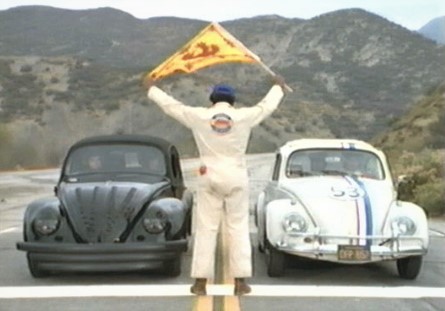
This brings us to the part of The Love Bug ‘97 that people seem to remember most: Horace, the Hate Bug. In the film the point of Moore’s uncovering of Dr. Stumpfel is to trick the eccentric old inventor into recreating his previous experiment, and then perverting said work by tossing a picture of himself into the “magic ingredients.” The resulting creation is a jet-black, souped-up Beetle that Moore dubs “Horace.” Unlike the gentle, child-like Herbie, Horace is a machine seething with rage and possessing an instinct to destroy (and even comes equipped with James Bond-style offensive weapons.) Another intriguing idea that gets rather bungled in the execution, the idea of a hate-filled “anti-Herbie” seems like a great addition to the franchise. Unfortunately, when framed within this film’s weird science theme, any idea of a “living car without a soul” ends up functioning more like a villain’s “super weapon” than it’s own character - frowning bumper or not. And the less said about Horace’s demise (in which he crashes through the ground, literally surrounded by flaming hellfire) the better.

Horace Goes to Hell!

Despite the presence of Dean Jones, a focus on auto racing and (admittedly superficial) discussions of love and hate, there’s something about this TV rehash that somehow feels … off. Not that it’s a bad movie by any means - while not great, it’s enjoyable and even has moments of genuine wit. It’s just that there are some small, niggling issues that really prevent it from fitting in with Herbie’s other adventures. This specific situation should sound familiar to older fans of the long-running English series Doctor Who (I’m going to go off on a bit of a tangent here, so my apologies.) That show, which ran uninterrupted from 1963 to 1989 (and began airing on PBS stations in the US in the mid ‘70s) was resurrected as a made-for-TV movie in 1996 as a co-production between the BBC and the FOX network. That movie (which in fandom is usually referred to as “The TV Movie” as well,) despite a number of call-backs and continuity references, looked and felt disconnected from it’s parent franchise - just like The Love Bug. For one, both “TV Movies” featured a returning cast member to lend some credence to their existence (Dean Jones in The Love Bug, “Seventh Doctor” Sylvester McCoy in Doctor Who,) as well as out-of-place quasi-celebrity cameos in bit-parts (comedian and MadTV performer Will Sasso as a morgue attendant in Doctor Who, ex-Monkee Micky Dolenz as a cigar-chomping car dealer in The Love Bug.) Both films also feature somewhat bland music; John Debney’s Doctor Who score sounds more like selections from FOX series Sliders, and Shirley Walker’s Love Bug score is forgotten almost as soon as it’s heard. This is a real shame, since Walker's work for modern classic Batman: The Animated Series featured some of the best music on television just a few years prior. At least Debney got to use the original Doctor Who theme, whereas George Bruns’ famous “Herbie Theme” is nowhere to be heard here.

Why do I bring up Doctor Who? Well, the similarities between these two attempts at reviving a long-running franchise is too great to ignore, especially since both came out within a year of one-another. Maybe I just wanted to write an entry that referenced The Evil Dead, Doctor Who and Batman? Incidentally, both “TV Movies” also ended up being dead-ends, as Herbie’s franchise would go dormant again thereafter, and Doctor Who failed to act as a “backdoor pilot” for a revived series. It would take both franchises a few more years to return to popular culture again, and would both stage successful returns in 2005. But more on that in the next entry...

Two players. Two sides. One is light... one is dark.

As we’ve seen, Herbie may have gone through a few long periods of rest, but he never really went away. Though largely forgotten, Herbie’s adventures in television kept the little living car puttering around in the public consciousness, like a well-known acquaintance always hovering in the background. Disney, both under Ron Miller and later Michael Eisner, knew that they still had a popular character on their hands, and wouldn’t let the opportunity to use him slip by; they just needed a few small-screen pit-stops to ensure the little old car would be ready for his inevitable big-screen victory lap.

Friday, June 22, 2018

Herbie Goes Bananas

Oh dear God … what happened here?! Three years after the ever-expanding Love Bug franchise seemed to return to form in Herbie Goes to Monte Carlo, director Vincent McEveety decided to take the titular little Volkswagen south of the border in 1980’s Herbie Goes Bananas. But instead of a continuation of Herbie’s adventures in the racing world, audiences were presented with yet another detour into the world of unfettered wackiness - or at least an attempt at it. The poor souls suckered into buying a movie ticket never knew what hit them.

I was forced to remove the turd I'd had here, then the rotten banana. So fuck 'em, here's a dumb poster.

Like it’s predecessor, the film opens with some rather lovely aerial photography that plays behind the opening credits. This time the sunny shores of the "Mexican Riviera" are on display, and the sandy beaches and azure waters of the Pacific are an enchanting sight to behold.

Now that we’ve covered everything good about the movie, let’s move on.

To put it simply, Herbie Goes Bananas is a rancid turd. It flat-out sucks. To call it “a disappointment” would be a laughably insufficient description; Herbie Rides Again was “a disappointment” - a slip-up by a well-meaning group of filmmakers who failed to capture the simple joys of the 1968 original. Herbie Goes Bananas, on the other hand, feels like an attempt at turning the "Herbie" series into a flaming pile of wreckage. It’s one of those films that, while watchable (in the sense that it doesn’t feel like it was made by amateurs,) makes one wonder why someone didn’t stop the production at some point and say “Something’s not working, because this is horseshit.”

The (stupid) gang's all here...

The story, such as it is, is such a mess that attempts to summarize it typically break down into a series of “then this happens, then this happens” - so let’s not even try. The script attempts to continue the narrative from the previous film, insomuch as one of our lead characters, Pete Stancheck (played with hunky blandness by Stephen W. Burns,) has inherited Herbie from his uncle, Jim Douglas (an absent Dean Jones,) who apparently ditched the little car after he stopped wanting to race. Boy, they sure try to make Douglas into a real jagoff when he’s not in the picture. The main character of the film is Paco (Joaquin Garay III,) a young orphan from Puerto Vallarta who befriends the little car and dubs him “Ocho”. In a hi-larious twist at the end, when questioned why he calls him this, Paco informs us that he was simply adding together the race numbers on Herbie’s hood: 53. That’s some real Oscar Wilde-like wit right there. There’s also a trio of crooks (John Vernon, Alex Rocco, and Richard Jaeckel) searching for a lost city or something, a cruise ship helmed by Harvey Korman (more on him in a moment,) Cloris Leachman playing yet another pathetic spinster, and Elyssa Davalos as her mousy niece, who shares a She’s All That-style romance with Stancheck that I couldn't give two shits about.

Strike up the band and make the fireflies dance silver-moon's sparkling...

Just about every decision made in the creation of this pile of garbage was a bad one, and many mistakes that had already been made in previous “Herbie” films were repeated. Once again, the story is absent any racing scenes - instead Stancheck and his pal D.J. (a completely wasted Charles Martin Smith, whom Disney owed Never Cry Wolf after this) are planning on entering Herbie into the Brazil Grand Prix, apparently after the movie’s over. Not only that, but by the film’s conclusion they’ve appointed little Paco to be their official driver, because of his bond with the car and Christ kill me now. Like the previous film, we also get another trio of hapless crooks, because the tedious shenanigans of the diamond thieves from Herbie Goes to Monte Carlo were surely the secret to it’s middling box office success. These three (who are American this time, because they wanted to cast John Vernon to please all the fans of Dean Wormer from Animal House) plan to make off with a large golden blah-blah-blah from a lost Inca city, and must be stopped because villains. To the film’s credit, the crooks here do pose a more tangible threat than the bumbling Brits from the last entry, since they seemingly transcend all laws of time and space. Paco can drive Herbie all the way from Panama to Mexico to avoid them, but they’ll already be waiting for him at a random spot along the way. As a matter of fact, every character in this film has the uncanny ability to find one another, illogically appearing all over the fucking continent no matter what distance separates them. One minute a character will be in Puerto Vallarta, and minutes later they’ve apparated somewhere hundreds of miles away to join in on some hijinks they’d have otherwise missed.

Villains, or menswear models from the 1979 Gottschalks catalog?

The cast, while made up mostly of fine actors, seems completely lost. Each actor (and therefore each character) is playing at odds to one another, as if no one told them all just what kind of movie was being shot. Stephen W. Burns has all the charisma of a handsome cardboard cut-out, and seems as though he wants the film to be a soap opera. Charles Martin Smith, tasked with a role seemingly written for Don Knotts, half-heartedly throws out goofy one-liners like a flailing stand-up comic. John Vernon seems to think he’s still in a Dirty Harry movie, and plays the villain completely straight until he finds himself slipping on banana peels in the climax. Poor Cloris Leachman was apparently doomed to keep repeating variations of her love-starved Last Picture Show character for years after, and honestly had a much more rounded character to work with in the previous years’ North Avenue Irregulars. Here her Aunt Louise character spends most of the film clumsily reacting to others’ pratfalls (a lot of the off-screen “Oh my goodness!”, “Oops!”, “My word! Are you okay?” variety,) and bewilderingly fawning over Harvey Korman’s character.


Cloris Leachman induces her gag reflex…

Which, unfortunately, brings us to Harvey Korman. I know I’m going to ruffle some feathers here, but for the life of me I’ve never understood Korman’s appeal as an actor or comedian. Perhaps best known for numerous appearances in Mel Brooks' comedies (including his turn as villainous Hedley Lamarr in the venerable Blazing Saddles,) Korman excelled in roles that required a measure of pomposity. If we’re being honest, though, playing a jackass is not difficult for any caliber of actor to pull off. One need look no further than Keenan Wynn playing the bad guy back in Herbie Rides Again for a better example of a crazed egoist; he really sold the idea of a blowhard barely keeping himself together. Korman, on the other hand, usually comes off as someone acting like a blowhard, merely playing at being unhinged. Hell, he couldn’t even pull off being a straight-man either, since he’s gone down in history as the guy who nearly pissed himself trying not to laugh at Tim Conway on The Carol Burnett Show.

However, I’m almost willing to give the guy a pass, just because he had to do this for a national TV audience in 1978's Star Wars Holiday Special:


In Herbie Goes Bananas, Korman plays the dictatorial captain of a cruise ship, named (I shit you not) Captain Blythe. Get it!? Like Captain Bligh of Mutiny on the Bounty fame, only it's Blythe!! But the word “blithe” means cheerful indifference or euphoric happiness - which describes the opposite of Korman’s character here. One could argue that they were trying to be ironic, but honestly I think it was just a stupid pun amongst innumerable other dumb jokes in this cinematic grab-bag of shitty gags. Blythe, as written and performed, is the biggest asshole on the seven seas, going off on long diatribes about the days of tall ships sailing across uncharted seas, when insubordinate crew could be punished with “lashes from the cat.” The dickhead seems to barely tolerate being the captain of a pleasure vessel, thundering angrily at passengers and crew members alike - especially ones that don’t play along with his Horatio Hornblower fantasies. While the character is clearly supposed to be a pompous ass, and suffers a number of slapstick humiliations over the course of the film, the really unfortunate thing is that we’re also supposed to find him funny. Witness a rib-tickler early in the film, when the camera cuts to the exasperated expressions of gathered passengers as Blythe admiringly recounts the following tale:
The booty was taken aboard the man-of-war, and the enemy vessel scuttled. The women were then turned over to the crew, the select ones going to the officers, naturally. The wenches were escorted below, and believe me, there was no poetry, or "by your leave," or "how lovely you look tonight". One got to the matter at hand in short order!
Grumpy Cap.

One of the biggest “I can’t believe I’m watching this shit” moments in Disney’s entire film library comes about halfway through this film, courtesy of our delusional captain. Blythe, enraged following Herbie’s wrecking of the ship’s hold (after Paco is discovered stowed away in his trunk,) abides “by the traditions of the sea” and orders the little car thrown overboard. Now up to this point, the film has been stupid, unfunny and full of lousy acting choices. But this scene, in which a Volkswagen was actually dumped off the side of a cruise ship while cameras rolled (and was never recovered afterward,) serves as a “point of no return” - the moment when the film loses all hope of redemption. Rather than “jumping the shark,” this film (and perhaps the franchise itself) has “dumped the Bug.” After this point, any attempt at making a cohesive movie falls apart, and the shit just piles up higher and higher until the credits roll. We get more of Cloris Leachman throwing herself at Captain A-hole, Herbie participating in a bullfight before driving across the country incognito under a pile of bananas (Aha! The title!), and finally using said fruit as artillery to bring down the fleeing villains (because hardened criminals with guns are no match for a car flinging bananas at them.)

Ocho swims with the fishes...

Looking over the list of the behind-the-scenes crew, it’s hard to figure out just where to place the blame for this abomination. Screenwriter Don Tait, a veteran of TV and movie writing (who’d written episodes for Maverick and The Virginian, as well as The Apple Dumpling Gang and The North Avenue Irregulars for Disney,) may’ve been past his prime by this point, though that’s hardly an excuse for a script this horrible. It’s telling, however, that this would be Tait’s final theatrical screenplay - his following pair of scripts being for TV shows broadcast in 1982. It’s also conceivable to lay some blame at the feet of returning director McEveety, as his previous Herbie film may've been the best work he did at Disney. A generally uninspired filmmaker at best, McEveety can also be credited with heading up such previous Disney-produced duds as 1973’s Superdad and 1975’s The Strongest Man in the World (the movie that killed off the "Dexter Riley" film cycle.)

I knew we should've taken that left turn at Albuquerque…

So far I’ve failed to talk about the music in the "Herbie" films, other than mentioning George Bruns’ "Herbie Theme" from the original. The Love Bug found the gifted musician in fine form, showcasing both his proficiency for jazz (in the high-spirited comedic segments) and exotica (in his eastern-tinged underscore for Tennessee Steinmetz’s philosophical musings). His score for the second film, while still enjoyable, wasn’t quite as inspired, leaning more heavily on the "Herbie Theme." Bruns was then replaced by prolific songwriter and TV theme-song writer Frank De Vol, whose credits include the music for Family Affair and The Brady Bunch. De Vol’s score for Herbie Goes to Monte Carlo was serviceable though not especially memorable, again making extensive use of a slightly-adapted "Herbie Theme." His score for Herbie Goes Bananas, on the other hand, is an ugly-sounding mélange of goofy orchestrations overdubbed with synthesized burbles and cheesy variations of "La Cucaracha" and "Jarabe Tapatio" (AKA the “Mexican Hat Dance”.) After all, this is set in Mexico, amigos!

Why grab the bull by the horns when you can just drop a car on him?

In another departure from the previous films, Herbie Goes Bananas features a pair of original songs. The first, a disco ballad entitled “Look at Me,” underscores the love scenes between Pete and Melissa, and is so breezy it barely exists. Hell, maybe it doesn’t, since I can’t seem to find any credited performers for it online, beyond a writing credit for De Vol himself. Maybe the singer wished to remain anonymous? Smart move. The second song - oh my fucking God. Also credited to De Vol, “I Found a New Friend” plays against the “heartwarming” scenes between Paco and Herbie Ocho, and in it’s entirety during a driving montage and the closing credits - so you have to hear it twice. I can’t seem to be able to express how bowel-drainingly awful this song is, so feel free to watch and listen for yourself:


So, yes - De Vol namechecks Charro in order to rhyme “tomorrow,” proving himself a true wordsmith to be reckoned with. Additionally, a new verse is added to the end of the song's reprise, in which the word “friend” is spelled out in song - only misspelled “f-r-e-n-d,” because the gods of rhythm demanded it. Already knee-deep in the waste that is this movie, it was all I could do to get through this insult to songcraft without shoving kabob skewers through my eardrums.

Here in my car, I feel safest of all...

It should come as no surprise that Herbie Goes Bananas was (and still is) the least successful film of the franchise, earning less than half of what Herbie Goes to Monte Carlo did - though I nearly spat out my coffee reading that enough people were apparently suckered into giving this dung heap $18 million. Garnering mostly bad reviews, one wonders if those few critics who gave the film any sort of plaudits are into sadomasochism or something; I honestly can't fathom how else they could've found anything to enjoy in this cinematic cluster-fuck. By this point, it was clear that Disney, in it’s current state, was no longer equipped to deliver on the franchise possibilities of the 1968 original. Thus, with Herbie left in the care of a Mexican orphan and covered with rotting banana peels, we wouldn’t be seeing the little VW Beetle with a mind of his own up on the big screen again for quite some time. Until then, the worn-out little car was in desperate need of a rest - save for a few TV appearances, of course.

Friday, June 15, 2018

Herbie Goes to Monte Carlo

First introduced in 1968’s classic The Love Bug, Herbie - the loveable little living car - had returned to theaters in a belated follow-up, 1974’s madcap Herbie Rides Again. While the film was a moderate success, it felt far-removed from the original: it lacked any car races, featured none of the original (human) characters, and was bereft of heart. Disney, obviously sensing the need for a course-correction, brought Herbie back three years later - along with a familiar friend and a story centered once again around a fast-paced auto race. But would audiences still want to follow the high-octane exploits of Herbie, or would 1977’s Herbie Goes to Monte Carlo be too little, too late?

The champagne's not Korbel!

Herbie’s latest adventure brings him and his friend Jim Douglas (a returning Dean Jones) and mechanic Wheeley Applegate (Don Knotts) to France, to participate in a cross-country race. They face stiff competition from arrogant German racers Bruno von Stickle (Eric Braeden) and Claude Gilbert (Mike Kulcsar,) who drive a souped-up Porsche 917 and a De Tomaso Pantera, respectively. Also competing (and going out of her way to prove herself) is firebrand American racer Diane Darcy (Julie Sommars,) who operates a 1976 Lancia Scorpion. While Jim and Diane share a prickly, competitive relationship (gee, I wonder if they’ll end up together?), Herbie falls head-over-tires in love with Diane’s Lancia (whom she dubs Giselle at the end of the film.) Meanwhile, a pair of inept British thieves (Roy Kinnear and Bernard Fox) manage to steal a highly valuable diamond called the Étoile de Joie, and end up hiding said gem inside Herbie’s gas tank. Under the watchful eye of their mysterious boss (who, in a “surprise twist” early in the film, turns out to be Inspector Bouchet of the Parisian police, played by Jacques Marin,) they pursue Herbie along the racecourse in an attempt to recapture the purloined diamond. Inevitably, wackiness ensues.

Clearly, Disney wanted Herbie’s third big-screen outing to be seen as a return to the charming formula of the original film, and to tone down the freewheeling silliness of the previous entry. The biggest clue here is setting the story amidst the fictional Trans-France Race, placing Herbie firmly back into the role of “living race car,” rather than the “automotive guard dog” he was portrayed as previously. Also of note is, of course, the return of Dean Jones, playing his character from The Love Bug. While Jones had been continuously cast by Disney through the mid ‘70s (most recently appearing in the previous year’s The Shaggy D.A.,) it had been almost a decade since his "heyday” at the studio, when he’d starred in six films between 1965 and 1968. Returning to what would become his most fondly-remembered role, Jones seems more than happy to get back behind Herbie’s steering wheel - safe in the knowledge that by this point he was playing second-banana to the titular car.

That awkward moment when you realize only one of you is a "Disney Legend"...

No mention is made of the events or characters from the previous film, by the way; Herbie and Jim appear as if they’ve been together since the first film. It’s actually stated that the pair of them are trying for a comeback with this race, having been some “12 years” since they last raced. Retcon or not, attempting to reconcile the film’s contemporary setting with the original’s late ’60s ethos is now rather difficult - unless this film is set a few years in the future. I’m probably overthinking things again...

For the most part, this back-to-basics approach works in the film’s favor. Even though no one could say with any authority what exactly a “Herbie Movie” should look like when the sequel rolled around, having no racing scenes whatsoever (pointless clip-montage notwithstanding) made Herbie Rides Again feel far removed from the original. But seeing the little VW Bug zipping past sleeker-looking sportscars on the racecourse, accompanied by his sprightly theme music (originally composed by studio maestro George Bruns, replaced here by Frank De Vol) just feels right. The addition of Don Knotts to the cast, clearly meant to fill in for the missing Tennessee Steinmetz (played by Buddy Hackett in the original film,) is a welcome one. While never bringing the same level of bonkers warmth as Hackett (and lacking that character’s eastern philosophical bent,) Knotts adds his usual nervous energy to an otherwise straightforward “kooky buddy” role, hitting an easy rapport with Jones.

Herbie, quit checking out that guy's butt...

Unlike the first two films (whose San Francisco setting was established mainly through the use of evocative matte paintings,) Herbie Goes to Monte Carlo was mostly shot on location throughout France and Monaco. Perhaps wishing to impress from the start, the filmmakers “put the money upfront” in an extended credits sequence featuring striking aerial photography, with sweeping vistas of the French countryside (and eventually Paris itself) - all while little Herbie is seen to drive along the winding roads below.

I’m somewhat on the fence regarding the film’s love story, to be honest. I suppose I should say love stories, since both Herbie and Jim partake in on-screen romances - although I have no qualms with the human’s storyline, despite it’s predictability. Jim and Diane’s “been there, done that” love story plays out exactly as one imagines: “tough cookie” Diane inevitably softens into a starry-eyed romantic, while Jim … you know … doesn’t really change at all. This by-the-numbers arc comes off especially false, since Diane is portrayed as fiercely independent before her sudden conversion to “affection object.” This initial characterization is played rather too on-the-nose, unfortunately, as she’s presented as a brittle shrew who continually shrieks that “everyone” wants her to fail as a racer “just because (she’s) a woman” - even though no one, including the “bad guy” drivers, ever say or act as such.

Pfft! You zink Claude and I haff any interest in ze women?

The love story between Herbie and Giselle the Lancia, on the other hand, dances a fine line between tediously silly and oddly affecting. Unlike the other “living machines” that sprang to life in the previous installment, here it appears that Giselle “awakens” at Herbie’s gentle beckoning, her pop-up headlights slowly blinking open. One catches a whiff of the old mysticism at work here, as the key to consciousness is born from love, from an emotional connection forged through feelings. After this awakening, the two cars share a near-immediate affection for each other, following a goofy-but-sweet scene in which Herbie plops a bouquet of flowers onto the Lancia’s hood (while a dumbfounded French waiter looks on, natch.) At varying points in the film, the two cars become depressed and despondent at the thought of the other driving off without them, but are quick to spring back into action when their human friends are in trouble. This is keeping in character with the Herbie from The Love Bug, a gentle soul whose emotions run deep - especially in regards to  offering and accepting love. This is not, in other words, the high-strung psychopath of the previous film.

Hubba Hubba…

On the other hand, the series of montages following the pair of loving vehicles around Paris tend to drag on too long. These stretches of dialogue-free scenes aren’t nearly as clever as the filmmakers seem to think, and quickly become repetitive.

The chuckle brothers at work...

While there is much to like in this film, unfortunately not everything works. The plot involving the diamond heist (and it's "man on the inside" twist that plays it's hand far too early) feels unnecessarily tacked-on. Apparently the filmmakers felt that a movie containing both Don Knotts and a pair of living cars wouldn’t provide enough humor, and so Roy Kinnear (familiar from his role as Veruca Salt’s father in Willy Wonka & The Chocolate Factory) and Bernard Fox (Dr. Bombay from TV’s Bewitched) are tasked with providing an endless series of “bungling burglar” gags. Since these two are portrayed as clueless from the get-go, there’s never any menace or threat against our heroes. Even when the pair’s boss (Jacques Marin’s Inspector Bouchet) steps in to help retrieve the stolen gem, he too spends the rest of the film being outsmarted by a Volkswagen. Unfortunately, just about every sequence involving these three connards stupides causes the film’s pacing to grind to a stand-still; audiences are left waiting impatiently for Herbie to return and the racing to resume.

Inspector, may I interest you in a piece of Dentyne?

Additionally, one wonders if Bernard Fox was cast as a kind of stand-in for the first film’s similarly posh-accented David Tomlinson. Is this is the case, then - with no offense meant to Fox - it’s a pretty piss-poor substitution.

On the whole, Herbie Goes to Monte Carlo feels much more like a follow-up to the 1968 original than it’s first sequel, despite a number of issues. In a way, it’s a shame that it took Disney nine years to make this film. With all due respect to director Vincent McEveety and screenwriters Arthur Alsberg and Don Nelson, you have to wonder what the same movie would’ve looked like a few years earlier, in the hands of the original filmmakers. Imagine if Love Bug director Robert Stevenson (and the rest of his crew) had been given this racing-focused story to use as the basis for their sequel - perhaps aimed for a late 1971 or early ‘72 release. Further, suppose that not only Dean Jones, but Buddy Hackett and perhaps even David Tomlinson had agreed to reprise their roles, their characters' re-match shifted to Europe. How much more interesting would the race itself have been with a pre-established rivalry to increase the stakes? And what would Hackett’s goofy, spiritually-enlightened Tennessee Steinmetz make of a love story between little Herbie and a lovely living Lancia?

C'est l'amour...

Alas, we’ll never know how differently Herbie’s future may’ve turned out had this been the case. While unlikely, it’s possible that had Disney followed up the original film with something more closely resembling a “Love Bug Goes to Monte Carlo,” the franchise may have had a longer or more prestigious run than it did. Indeed, while Herbie Goes to Monte Carlo is, for all intents and purposes, a better movie than Herbie Rides Again, it made almost $10 million less. Perhaps this is evidence that Disney had waited a little too long to give audiences the Herbie movie they really wanted to see. Of course, it should be kept in mind that the film was released about a month after the all-encompassing pop-cultural nexus that was Star Wars hit theaters - so maybe the fact that anybody bothered to see it at all should be commended.

Nevertheless, by this point younger audiences at the time of The Love Bug’s release had long since grown up, and the rest of the viewing public seemed ready to move on. With a better film now under their belt, the filmmakers would have to make a fourth adventure for the little VW Bug something special if they were going to recapture the imaginations of their audience. For if the original Love Bug had been the map drawn out for a successful franchise, then Herbie Rides Again had been a wrong turn, and Herbie Goes to Monte Carlo the shortcut back. Unfortunately, Herbie was about to be driven straight off a cliff - as the filmmakers’ next move resulted in one of the biggest, most disastrous artistic misjudgments in Disney’s entire film catalog.

Do you smell something? Smells like putrid, rotten bananas to me…

Try to land on Harvey Korman!!