Showing posts with label Holiday. Show all posts

Friday, July 13, 2018

Freaky Friday

It’s the last Friday the 13th of 2018, so let’s take this opportunity to discuss one of Disney’s more fondly-remembered films of the 1970s. Finish up your laundry and grab your water skis, as today we’ll take a frank look back at 1976’s body-swapping classic Freaky Friday.

Fill my eyes with that double vision...

Most readers are undoubtedly familiar with the film, or at least it’s central concept. Freaky Friday tells the story of young teenager Annabel Andrews (Jodie Foster) and her mother, Ellen (Barbara Harris) - a typical middle-class mother and daughter who love each other despite the fact that they barely tolerate one-another. On a particularly hectic Friday the 13th, both wish (at the exact same moment) that they could switch places with one another. Faster than you can say “Vice Versa,” their consciousnesses are swapped. Each must now deal with the other’s daily routines (well, they don’t have to, but…) and find out that living in the other’s shoes may not be as simple as they’d originally thought. Tidy life-lessons are learned by all most some.

By no means an original conceit, the hook of a mother and daughter trading places is at least an interesting one. It also seems perfectly suited for Disney, an idea rife with possibilities for humor and emotional resonance. Unfortunately, the concept gets squandered by an extremely weak script and a number of head-scratching directorial and acting choices. As I watched the film unfold, my heart sank further and further as I bore witness to one tediously unfunny gag after another. Was this really the film that many fans hold in such high esteem?

Do not touch the glass, do not approach the glass...

Let’s start with the acting. Fourteen-year old Jodie Foster, who’d wowed audiences earlier the same year in Martin Scorsese's Taxi Driver (and a year before her smirk-tastic role in good old Candleshoe,) gives a reliably smart-aleck performance as the rebellious Annabel. Even at such a young age, Foster’s acting is so natural that while viewing the film one feels less like they’re watching a performance piece than something from a documentary. Once the mind-swap occurs, Foster’s “prim and proper” routine is as funny and realistic as one could expect in such silly circumstances. Barbara Harris, while perfectly game for the physicality of the role, honestly could’ve stepped her acting game up when performing against such a young powerhouse as Foster. Her Ellen character makes little impression from the start, and once the mind-swap occurs she comes off more like she’s acting drunk than mimicking a teenager (slurring her words and loosening up her motor skills.) Granted, she seems to get better as the film rolls along - and her scenes with a young Marc McClure as Annabele's crush are some of the film’s highlights. But something still seems off in her initial performance, as if she was going for an impression of Foster that suffered because it was slightly off-the-mark.

Now here's a movie I'd like to see...

Compared to everyone else in the cast, however, Harris is freaking Laurence Olivier. Almost every other actor in this film (save the aforementioned McClure and young Sparky Marcus, playing Annabel’s younger brother, Ben) seems to be on full-tilt pantomime mode, either chomping up whatever scenery they can or acting like a complete fuck-head. In scene after scene in which either Annabel or Ellen “goofs up” something from the other’s life (and I’m talking stupid little things, like accidentally using a broken typewriter at school or asking to pay a mechanic with cash instead of a check,) the other characters gasp and gurn and guffaw and fucking trip over themselves like they’ve all got severe mental handicaps. Hell, Annabel and Ellen are the ones who’ve literally lost their minds, and they both take this fact in relative stride. Yet they’re surrounded by an entire town full of weirdos who can’t seem to function if something is slightly out of the ordinary in their routines. Witness a band teacher (Fritz Feld) who shudders furiously as Annabel falls out of step with the rest of the marching band, or Ellen’s friend Mary Kay (Karen Smith,) who won’t let up screeching at her that she wants her borrowed hair dryer back for five straight minutes. Did every adult in this town swap minds with toddlers or something?

One of us! One of us! Gooble Gobble!

It’s not all bad on the supporting character front, however. I will give props to comediennes Kaye Ballard and Ruth Buzzi as opposing field-hockey coaches, as both bring somewhat more believably dialed-up performances to their characters. These two are more understandably affected by Annabel’s sudden lack of hockey skills - Ballard, as her coach, visibly grimacing as she makes a goal for the wrong team (and Buzzi, as the opposing team’s coach, cheering her on.) Ballard and Buzzi (which sounds like a vaudeville act now that I think about it) both seem to know exactly how much energy is required for their brief appearances, and don’t go overboard with goofball comedy.

You just put your lips together, and blow...

Unfortunately, much like the presence of Harvey Korman in Disney’s later stink-nugget Herbie Goes Bananas, this film features not one, but two assholes of immense proportions. First is the Andrews’ housekeeper, Mrs. Schmauss (played by Harris’ future North Avenue Irregulars co-star Patsy Kelly.) A gruff old woman who’s bluntly hinted at being an alcoholic, Schmauss spends her entire stint at the Andrew’s household berating young Annabel’s cleaning habits and demeanor, ranting that she was “sure to be using dope” soon, and about how “the mother and father are to blame.” Sadly, it’s suggested that Ellen is used to her disrespectful griping, but has put up with her in the past. Luckily, once Annabel (in Ellen’s body) gets an earful of her bile, she sends the old bitch packing.

Cara mia...

The worse offender, however, is husband and father Bill, played by John Astin. Familiar from his role as Gomez in TV’s The Addams Family (and famed for his leering, wide-eyes grin,) Astin seems as though he’s trying his darndest to play the Andrews family patriarch as a well-meaningly overwhelmed guy; unfortunately for him, the character is a completely selfish clod. Having recruited his wife to help entertain a large group of business clients following a waterfront gala, he’s also strong-armed not only his daughter, but her entire ski club into performing an aquacade show at said gala (against the advice of his bosses, who wisely suggest that the cheapskate would've been better off hiring professional performers.) Besides loading Ellen up with an entire day of chores and errands (including “carefully” pressing his “genuine silk” shirts,) he then proceeds to demand that she prepare a “gourmet spread” (in less than 3 hours!) for his clients AFTER HE FUCKS THINGS UP with the caterers. Isn’t it wonderful when a guy puts his whole career on the shoulders of the women in his family? And, as Ellen discovers, he also has a ‘hot secretary’ at work that he never told her about. Ugh. A character seemingly stuck in the ‘50s Father Knows Best mindset, Mr. Wonderful hits bottom when, confronted with Annabel confessing that she can’t perform on water skis because she’s actually Ellen, he shoves his daughter out onto the water so as not to look bad in front of his clients. When she proceeds to accidentally cause the floating observation deck Bill and his clients occupy to sink, it’s a damn shame they don’t let the bastard drown with that big stupid smile on his face.

The joy of cooking...

I suppose I should lay some blame for these bizarre characterizations on the filmmakers rather than the actors (to spread the blame around, at least.) Author and musician Mary Rodgers adapted her own 1972 children’s novel into the screenplay - so at the very least we can say that the story was kept true to the author’s intent. Rodgers chose to incorporate large swaths of Annabel and Ellen’s thoughts in the form of voiceovers from Foster and Harris. These monotonous inner-monologues drag each scene down, as we’re left watching the characters sitting and nodding along to nothing, or silently going about their shenanigans while the other actress limply reads her lines off-screen. Rodgers also added on the water skiing/aquacade subplot, perhaps to add some theatrical pizzazz to the otherwise dull affair.

The money shot...

And of course, being a live action Disney film released in the ‘70s, a “wacky chase” must occur at some point. Here it comes near the climax, as Annabel clumsily drives Ellen’s Volkswagen across town to rescue her mother from said aquacade (seeing the red Beetle careen around made me miss Herbie already.) She ends up being pursued by police, who are naturally completely inept and end up getting out-run by a kid with no driving experience. Like many a ‘70s feature obsessed with “hilariously” destroying piles of police cars (see The Cannonball Run, Smokey and The Bandit, Diamonds Are Forever, The Dukes of Hazard, etc. etc.)(speaking of which: Sorrell “Boss Hogg” Booke plays Annabel’s principal. Coincidence!? Yes!), we bear witness to squad-cars ending up on two wheels, or being smashed out-of-shape, or splitting in two when colliding with a dividing barrier. Perhaps whatever supernatural force swapped Ellen and Annabel’s minds also let physics take the day off on this fucked-up Friday?


I'm imagining your frame, every angle and every plane...

Director Gary Nelson made only this film and 1979’s The Black Hole for Disney (which is an infamous box office bomb that I happen to adore,) and seemed more at home directing for television. For whatever reason, Nelson chooses to draw every gag out to levels of tedium - whether it’s the endless police-car chase, or a scene of Ellen over-stuffing a washing machine full of rugs and detergent. Clocking in at a fairly brief 95 minutes, one wonders how short the film would’ve ended up had each scene been edited with an eye towards decent comic-timing. Unfortunately, the fact of the matter is that Nelson did the best with what he was given - and what he was given was a lousy screenplay.

Another happy readthrough...

The main issue with the script is, bewilderingly, the absence of emotional resonance. This is very odd - not only because this is typically Disney’s bread and butter, but also since the story’s premise all but demands it. Besides the briefest of scenes at the beginning, Ellen and Annabel have no interaction on-screen until the end of the “wacky water show” climax. The two of them decide to see what the other’s life is like, but spend most of the time having to react to a world of over-the-top idiots and a demanding asshat husband. I understand that this is meant to show them that the others’ lives aren’t easy - but if the mean-spirited goofiness had let up for just one moment of reflection, this point could’ve actually come across. Besides an admittedly sweet scene in which Annabel reconciles with her adoring little brother, any emotional growth is swapped out for comedic exhaustion. By the time the mother and daughter have come together at the film’s end (back in their correct bodies,) the inevitable “I love you’s” feel hollow - an unearned emotional payoff that leaves one wondering why the story never properly got off the ground.

Time for daddy-dearest's asshole intervention...

I don’t know. I feel like I may be a bit over-negative on the film (wouldn’t be the first time,) or that I may’ve liked it more had I watched this film at another time (I had to rush to get this out by Friday the 13th.) I’d always thought that Freaky Friday was a movie held in fairly high regard amongst fans - and Disney itself, seeing as how they’ve remade it three times (a 1995 TV-movie starring Shelley Long and Gaby Hoffmann; the well-known 2003 theatrical remake with Jamie Lee Curtis and Lindsay Lohan; and a musical version with Heidi Blickenstaff and Cozi Zuehlsdorff - itself adapted from a Broadway adaptation - set to premiere on the Disney Channel later this summer.) Yet a quick perusal of the internet seems to show that I’m not alone in my consternation of the film. Besides a handful of the typically saccharine “A Family Classic!” and “Great Disney Entertainment!” comments you hear from both vacuous fansite reviews and blurb-hungry critics, many agree that the film is sadly dated, unfunny, badly written and poorly executed. Perhaps I’ll someday get around to looking at one of the other versions - which would be unusual for me, since I’ve never really been a fan of remakes. However, it’s hard to imagine Disney adapting the concept into a worse film, so maybe I’ll end up finding something to enjoy in one or more of their do-overs. After all, sometimes there’s no accounting for taste.

Friday, May 4, 2018

The Littlest Outlaw

In the long history of the Walt Disney Company, 1955 will forever be known as the year that Disneyland threw open it’s gates to an unsuspecting public. However, the studio also released a handful of well-remembered films that year. Among these are animated classic Lady and The Tramp, the first of their edited-from-television Davy Crockett features, respected "True-Life Adventure" The African Lion - and, three days before Christmas, The Littlest Outlaw. A forgotten little film following the exploits of a young Mexican boy and his fugitive horse, the film is a surprisingly well-made piece of cinema that still holds up today - with a few caveats ...


The film tells the story of a boy named Pablito (played by first-time actor Andrés Velázquez,) the son of a horse trainer named Chato (Rodolfo Acosta) who works for the respected General Torres (the great Pedro Armendáriz.) After betting money he doesn’t have on the general’s newest horse, Conquistador, in a show jumping competition, Chato resorts to cruel training techniques in order to force the poor creature into jumping taller and taller obstacles. This soon backfires, however, causing Conquistador to become afraid of jumping. When the horse’s fear causes an accident involving the general’s equestrian-loving daughter, Celita (Laila Maley,) the general orders the animal killed. Pablito, who knows the truth but fears further violence against himself and Conquistador at Chato’s hand, runs away with the horse. The pair of fugitives take flight across Mexico, running into banditos with hearts of gold (Gilberto González and José Torvay) and a kindly priest (Joseph Calleia) while evading both the general’s troops and a vengeful and desperate Chato.

I can't talk, señor - I'm a little horse today.

Unusually for a Walt Disney Productions film, The Littlest Outlaw was a Mexican-American co-production. Directed by prolific Mexican filmmaker Roberto Gavaldón, the film features an entirely bilingual cast. This led to the convenient practice of shooting each scene twice - once in English, once in Spanish - so that the film needed no re-dubbing for release in Spanish-speaking countries. The film was also shot entirely on location south of the border, lending the film a dusty authenticity that couldn’t be achieved filming in the California desert (or on a Burbank soundstage.) This also affords Gavaldón and cinematographer Alex Phillips the opportunity to shoot many evocative scenes of Pabilto and his horse making their way through desert vistas, including a number of well-thought out day-for-night shots. Of particular note is a group of shots early into the pair’s journey, in which the boy and the horse are carefully framed with a sun-bleached cross atop a hill as they stare out upon the looming desert ahead of them.

He's got shoes and a coat - why no service?

I really must applaud the young Andrés Velázquez, who brings effortless believability to the mistreated Pablito. Starting off as a cheerful (but not precocious) child, the reality of his father’s cruelty dawns upon him following Chato’s treatment of Conquistador. There is a noteworthy moment early in the film, where Pablito lies on his sleeping mat in the darkened servant’s quarters, quietly crying his eyes out. One immediately gets the heartbreaking sense of the child’s world being turned upside down, the realization of his own situation dawning on him only now. His decisive flight from the general’s estate and increasingly courageous actions through his journey stem logically from this awakening, and therefore feel natural as the film unfolds.

Pablito trains Conquistador to gallop when he whistles...

The rest of the cast is quite good as well. Pedro Armendáriz, playing General Torres, may be familiar to audiences today from his role as Kerim Bey in the 1963 James Bond film From Russia With Love (which was his last role before escaping terminal cancer with a self-inflicted gunshot to the chest.) By the time of The Littlest Outlaw, the actor already had a distinguished career spanning 20 years in Mexican, American and Italian cinema (and even had a pair of French films under his belt.) Even at the general’s most blustering, every line Armendáriz delivers is portrayed with such heart and spirit that one never feels any antagonism toward the big lug. Likewise, well-known Malta-born actor Joseph Calleia turns in a warm and sincere performance as the kind padre who helps Pablito and Conquistador during the latter part of the film. Famously remembered for his role as Pete Menzies, partner of Orson Welles’ iconic Hank Quinlan in 1958’s Touch of Evil, Calleia’s career on stage, screen and radio spanned an impressive 45 years.

Yes, Pablito, one day you may be blessed with a magnificent moustache, too...

While watching The Littlest Outlaw, I must say I was pretty impressed with the film as it went along. Besides the deft direction and strong acting, the screenplay - expanded by Bill Walsh from a story pitched by studio veteran Larry Lansburgh (who’d been a director of shorts at the studio for a decade) - is vibrant and well-structured. Unfortunately my opinion began to sour toward the end of the film.

While there is some mild animal cruelty early in the film establishing Conquistador’s suffering at the hands of the inhumane Chato (that one hopes, given the age of the film, is entirely faked,) the film is otherwise a gentle and lightly exciting tale that would be potentially great viewing for families with not-too-young children. However, once it became clear that all signs were pointing toward a climax set inside a bullfighting ring, my heart began to sink. Now, I don’t really want to get myself drawn into a discussion about cultural insensitivity or the place that bullfighting plays in Latin American tradition (otherwise we’ll be here all day - as readers of my Dumbo post will understand) - nor about the ritualistic particulars of the “sport” itself. Currently banned in many (but by no means all) countries, bullfighting remains one of the touchstones of Spanish and Latin American culture. It’s also one that springs to the gringo mind as a representative image of Latin culture ... much like wide sombrero-clad Frito banditos, Taco Bell-loving chihuahuas or the Dos Equis guy. That’s sarcasm, por supuesto.

For your viewing pleasure: a velvet bullfighting painting. Classy AF.

Though the appearance of a traditionally-garbed matador and his entourage of toreros could potentially be seen as troubling in a film that had, up to this point, largely avoided stereotypical portrayals of Mexican culture, the bigger issue that I had was having to watch the actual bullfight. Most likely a real bullfight that the film crew shot and edited, travelogue-like, into the movie, perhaps in 1955 the whole thing was thought of as local color thrown into the film - or maybe even an honest display of a proud Latin tradition. I realize that the case can be made for excusing the bullfight's inclusion by taking the time period in context, which is usually something I support when evaluating older works of art. However, watching the film now, the public display - in which bulls are taunted, stabbed with lances and barbed spears and more often than not killed in the ring (at least in the traditional Spanish style) - is not something that personally sat well with me. Call it a gut reaction, but in this case my sense of distaste overrode objectivity.

Can't sleep - too much bullshit...

While the film thankfully cuts away before the worst of the bull’s treatment is shown, we are shown one of the matadors getting bloodlessly clipped by the bull’s horn (in an uncommented upon moment of shock) before the picador stabs a pair of lances into the back of the poor creature’s neck. As the climax played out during and immediately after these displays, I found myself caring less and less about Pablito and Conquistador’s leap to freedom to escape the bullfighting ring. As the film rapidly drew to it’s predictable (though earned) happy ending, I just couldn’t get the slight sense of nausea out of my mind.

This horse is my horse - of course, of course...

The Littlest Outlaw, for most of it’s running time, is a delightful film with a number of positives going for it. However, much like last week’s Westward Ho the Wagons! (with it’s troubling, if typical, portrayal of American Indians,) there is a strongly dated element that prevents me from giving the film a recommendation - as family viewing or otherwise. This is unfortunate, as compared to that bland western, this movie is actually a well-crafted, thoughtfully-scripted and admirably directed piece of cinema. Though your own tolerance for images of animal cruelty may vary from mine, for me the whole troubling display tainted the rest of the film, a superior production when taking all other factors into consideration. For this reason alone, I have to say that I haven’t been so disappointed with a Walt Disney production ever before.

Tuesday, October 31, 2017

Hocus Pocus

Oh look, another glorious review … makes me sick! That’s right, #ChildrenOfThe90z - today we conclude our little “trilogy of terror” with a look at the surprise comeback kid of Halloween cult films: Disney’s 1993 romp Hocus Pocus!

Tickle tickle tickle!

I vividly remember the commercials for this film, running alongside my favorite Disney Afternoon and Fox Kids programming blocks (the sight of a corseted Sarah Jessica Parker hopping up and down shouting “Amok amok amok!” tends to stick with a boy.) Like most of Disney’s live action fare, however, I never bothered to catch the film until many years later, when my future wife tasked me with locating a copy on DVD for a Halloween get-together. This belated initial viewing left me shrugging, wondering what my significant other (who’d regaled me with stories of she and her brothers enjoying the film in their youth) thought was so great about this middle-of-the-road family fluff? However, as happens when a film becomes part of an annual “holiday tradition,” repeated viewings over the past decade (or so) have slowly won me over. You can now count me among those annoying Disney fans who’ll gladly drop their PSL’s and join in a chorus of the Bette Midler-fied “I Put A Spell On You” when the leaves turn orange each year.

PSL's are so last fall. This year's all about the zombie Frappuccino.

I’m obviously not alone. Much like another Disney Halloween film from 1993 (the Tim Burton produced Nightmare Before Christmas) Hocus Pocus has gotten itself firmly lodged in the minds of a growing number of fans. At first a critical and financial flop, repeated showings on The Disney Channel and eventually Disney-owned ABC Family (which is now called Freeform, apparently) helped cement the film’s status as a holiday-viewing favorite. Disney, for it's part, has sat up and taken notice of their 24 year-old comedies' phoenix-like rise from the ashes in recent years. They've wasted no time in leaping at the opportunity to grab a few nostalgia-driven dollars, further raising awareness of Hocus Pocus and it's charms to the general, non-fan public in the process. For proof just witness the recent “Villain Spectacular” shows at the Magic Kingdom’s annual Halloween parties, which are now “hosted” by a trio of actresses portraying the Sanderson sisters; as well as the bonanza of related merchandise that fills the shops up and down Main Street.

Shut up and take my money!

The indifference which met the film upon it’s original release is understandable. For one thing, the film was originally released in July, Disney most likely hoping to have the film on home video in time for October. Unfortunately, audiences didn’t exactly line up to see a Halloween-set family film in the middle of summer. As for the critics, the lukewarm response to a middling family film is typical, and not entirely unwarranted. Taking Neil Cuthbert and Mick Garris’ script at face value, there’s nothing especially memorable or clever to be found. Whether a fault of the screenplay or of editing, the film does drag throughout the middle, the pace sometimes stalling out when it feels like it should be getting going. Director Kenny Ortega, a music video director and choreographer (having been responsible for the moves seen in 1980’s Xanadu, as well as Billy Squier's infamous “Rock Me Tonight” video,) brings little in the way of style or depth to the film. That’s not to say his direction is bad - simply that there’s nothing especially cinematic about Ortega’s unshowy directorial style, which would go on to serve him better in the following decades helming television shows and made-for-TV movies (including Disney’s successful High School Musical and Descendants franchises.)

Winifred throws some shade...

The number of critics who took issue with the performances of the three leads, however, is frankly baffling. Many bemoaned the fact that “Divine Miss M” Bette Midler would slum it in a supernatural kiddie flick. Midler has since stated that filming Hocus Pocus was the most fun she’d had up to that point, and it certainly comes across in the finished film. By turns malicious and mirthful, her BOOOOOOOK-loving Winifred is a go-for-broke, thoroughly entertaining villain who livens up every scene she’s in. Midler’s performance is one of those where the line between actor and character begins to blur, so natural her own larger-than-life persona fits with the impressively-coiffed witch. By the time Winifred is bewitching an entire hall of Halloween revelers with a full-on concert performance, it seems like the most logical course of action for the blustering crone.

Sarah dear, chew with your mouth closed, please...

Equal credit should be given to Midler’s co-stars, comedic actress Kathy Najimy (as Mary) and a pre-Sex and The City Sarah Jessica Parker (as Sarah.) Najimy’s often thankless role as “the big clumsy one” finds her barking like a dog as she sniffs out children to snatch, her mouth in a permanent "derp" smirk (which couldn’t have been very comfortable to hold.) Najimy, however, rises above the necessities of the role, bringing a modicum of warmth and a number of very funny personality quirks into her performance. Her startled little “Ooohm!” as she thrusts a flying vacuum cleaner between her legs before the film’s climax always gets a laugh. Sarah Jessica Parker, meanwhile, brings an energetic physicality to her namesake character - leaping about like an excited toddler one moment and gracefully twirling like Stevie Nicks the next. The Sarah character dances a few fine lines (sometimes literally) between enthusiastic child, coy flirt, ditzy airhead and sinister siren, and Parker manages to pull all these aspects off without it coming off as disjointed.

Wait, we've got to do it over - Dani's eyes were closed...

While the Sanderson sisters (and the amazing on-screen rapport the actresses share) are the central delight of the film, much of the story naturally focuses on a gaggle of young protagonists. The central character, the virgin Max Dennison, is played with “California, laid-back, tie-dyed” attitude by Omri Katz. Handy with a Zippo lighter, Max is a lot more fun at the start of the film than he becomes over the course of his adventure. His dismissive excuse for lacking a Halloween costume (“I’m a rap singer”) and pouting bedroom-drum-kit playing is much funnier than his later heroic sacrificing. His little sister, Dani, is played with believable moxie by a pre-American Beauty Thora Birch. While a dedicated trick-or-treater, Dani leaves much to be desired as Max’s wingman, letting his crush know that “Max likes your yabbos. In fact, he loves ‘em” - a tidbit that is left awkwardly uncommented on. Said crush, Salem native Allison, is portrayed by Vinessa Shaw - who may be the best of the young actors in the film; she was apparently talented enough for Stanley Kubrick to cast her in a small but crucial role in his final film, Eyes Wide Shut, just a few years later. After repeated viewings, I’m almost convinced that Allison is the real hero of the film, since she seems to make most of the good decisions (not wanting to light the Black Flame candle, doing a little salt-dance to form a protective circle,) and is referred to as a “clever little white witch” by Winifred.

I desire to partake of chicken! I desire to partake of liver! I beseech Meow Mix to deliver!

Despite the majority of screentime being dedicated to the witches and their young enemies, it seems that the film is actually supposed to focus on the tragic tale of Thackery Binx (played by Sean Murray as a human, and voiced by Jason Marsden - aka Goofy’s son Max in A Goofy Movie.) After all, the entire first section of the film - in which we meet both Thackery and the Sanderson sisters - is a local legend being shared with Max’s class by their teacher (Kathleen Freeman.) This apparently well-known legend is as much about Thackery, his guilt over failing to save his sister, and the resulting curse as it is about the witches (hence Allison's realization, "You're Thackery Binx, aren't you!?") After our teenage protagonist returns the Sanderson sisters to life in a clumsy show of machismo (“Nice going, Max!!”), Binx catches up to the 1993-set storyline and becomes our main source of exposition. It’s through the talking black Cat that we learn about his unfortunate fate as a near-immortal stray, and all about Winifred’s dead lover, Billy Butcherson (played by Guillermo del Toro’s contortionist of choice, Doug Jones) - conveniently right before he rises from the grave as an unwilling zombie foot-soldier. Now there’s a phrase I didn’t think I'd ever use on this blog. While the film’s climax centers around the kids’ battle with the vengeful sisters, the denouement is focused squarely on Binx’s release from his curse. As the heroic music swells, Thackery and Emily are reunited as transparent spirits, and walk off together toward the rising sun and, presumably, some kind of heavenly afterlife.

"LICE" wouldn't fit...

An overlooked factor adding to this film’s status as an increasingly beloved favorite is the eccentric supporting cast. Many of Salem’s witchcraft-obsessed residents make the most of small snippets of screentime, and help create an atmosphere of quiet lunacy in which the Sanderson’s reappearance can realistically go unnoticed. Most everyone’s favorites are the hapless pair of bullies, Jay and Ernie ICE, played by Tobias Jelinek and Larry Bagby, respectively. The duo’s little impromptu “baseball” skit when Dani informs them Max is dressed as “a little leaguer” is quite impressive, suggesting that the cross-trainer thieves may have been honing their improv skills whilst hanging out in Salem’s graveyards.

Get out of my dreams, and into my bus...

My favorite Salem oddball is the world’s most romance-starved bus driver, played with clumsy charm by Don Yesso. His cheesy pick-up lines (“Bubble, bubble - I’m in trouble!”) are delivered with such conviction that one wishes Hocus Pocus had it’s own “cinematic universe,” just so we can see the “mortal bus boy” in his own spin-off romantic comedy.

Kissie face!

The film’s big cameos come in the form of Gary Marshall, playing a random guy in a devil costume, and sister Penny Marshall as his miserable wife (both uncredited.) The extended scene, in which our trio of witches mistakes the red pajama-clad suburbanite for their “master” (and his “little woman” for Medusa, thanks to her hair-curlers,) honestly slows the film down to a crawl; it’s so damn funny, though, that nobody cares. Gary Marshall’s enthusiasm at meeting what he assumes are a trio of dedicated cosplayers (“I know you! It’s the Sanda-sen sistas!”) is strangely endearing, as are his attempts to warm his chain-smoking wife to the Halloween festivities, referring to her as “pudding face” (I’m not sure that’s gonna be an effective pet-name, Mr. Devil.) Penny Marshall, meanwhile, gets some of the film’s best lines, including the one that made it into all the film’s trailers, “Aren’t you broads a little old to be trick-or-treating?” In her defense, if my spouse had just let three (very) strange women into my home I’d be a little touchy, too. I like to think that perhaps there's a story here, like “the master” was trying to throw a Halloween party that no one had shown up for.

Oh look sisters ... we're being re-cast!

Since Hocus Pocus has dragged itself up from obscurity, rumors have floated about that a sequel or some form of follow-up may be in the works. Despite the fact that the Sanderson sisters explode into dust at the film’s conclusion (SPOILERS, YA OINKER!), Midler, Najimy and Parker have all expressed interest in resurrecting the witchy sisters for another misadventure. In 2014 the internet was mildly abuzz with claims that Disney was moving forward with an “in-name-only” sequel starring Tina Fey. Such speculation was swiftly quashed by Disney, which stated that the paranormal-themed project was unrelated to Hocus Pocus. Recent signs are pointing toward a TV-movie reboot rather than a sequel. Que sera, sera; a similar 2016 Disney Channel remake of Adventures In Babysitting hasn’t damaged the 1987 original’s reputation, so more power to them. At any rate, while most audiences outside of those who grew up in the early ‘90s may not give a dead man’s chungs about the film, it remains a delightful Halloween treat for those of us who’ve fallen under it’s spell.

Big finish!

Monday, October 30, 2017

The Adventures of Ichabod and Mr. Toad

Up next in our trilogy of Halloween reviews is the last film Disney released in the lean 1940s, and a film that may be their best “package film” of the era (The Three Caballeros notwithstanding, of course.) It’s 1949's The Adventures of Ichabod and Mr. Toad!

Don't lose your head

Shortly after the release of Snow White and the Seven Dwarfs, Walt Disney was pitched a possible full-length animated film treatment of Kenneth Grahame’s 1908 story The Wind in the Willows. Despite Walt’s reservations that such a film couldn’t live up to Snow White (or the other productions in the works, Pinocchio and Fantasia,) the studio optioned the story in June of 1938, and a basic script was completed in early 1941. Though it was a budget production (like that year’s Dumbo,) Walt nevertheless had some of his best animators at work on the film. More than half an hour of animation was completed when production stalled, following the closure of overseas box-offices when World War II broke out. It was soon halted altogether, after the US military commandeered the studio following Pearl Harbor. In the following years, Disney released a series of inexpensively-produced “package films,” starting with Saludos Amigos in 1942. Already believing their Wind in the Willows adaptation to be below par, animators resumed production in 1945 with the intention of making it part of a package film. The hastily finished film was slated to be matched up with Mickey and the Beanstalk (which instead ended up in 1947’s Fun and Fancy Free) and an adaptation of Roald Dahl’s The Gremlins (which, despite being written with the intention of Disney adapting it, was soon abandoned) under the title Three Fabulous Characters.  Around the same time, work had begun on creating a full-length adaptation of Washington Irving’s short story The Legend of Sleepy Hollow, and the animators behind that production were having trouble padding the story out to fill a feature's running time. In 1947 the decision was made to pair up the two wayward productions, and the composite film was named The Adventures of Ichabod and Mr. Toad, to focus on the two central characters.

I'm cuckoo for Cocoa Puffs!

The abridged and re-arranged version of Grahame’s tale fills the first half of the composite film. It focuses on the exploits of wealthy gadabout J. Thaddeus Toad and his friend's attempts to clean up his various messes. The Mr. Toad character (voiced by prolific English character-actor Eric Blore) is one of Disney’s most memorable, though he seemingly gets by more from name recognition than anything else (and that's primarily due to the reputation of his theme park attraction, Mr. Toad’s Wild Ride - but that's an article for another day.) An irresponsible rake, Toad’s various “manias” put himself, his friends, and his fortune in constant jeopardy. Yet his unabashed zeal for adventure does begin to grow on you as the film progresses. It sometimes feels as if the filmmakers are daring us not to like their animated anti-hero, like some kind of anthropomorphic Barry Lyndon (and yes, I just related the main character from a Stanley Kubrick movie to a talking frog; that's how I roll.) By the time we’ve reached the manic brawl at Toad Hall (not to be confused with the “rumble in the jungle”,) we can’t help but root for him and his put-upon pals to win the day.

The weasels practice their synchronized swan dive...

The filmmakers’ concerns over the quality of their Wind in the Willows adaptation seems to be unfounded, as I found it to be both entertaining and extremely well made. In fact there are a handful of segments, such as the one set during a frosty Christmas Eve in a fog-drenched London, where the artwork could sit comfortably amongst some of the studio's finest output. The character animation, purposefully more cartoonish than realistic, rivals not only their ‘40s output but also much that would come in the following decade. And while the animators were obviously not going for the carefully shaded quasi-realism of Disney’s first three features, the kinetic energy on display breathes life into every character, both animal and human. Between the lively animation, frenetic pacing and a number of shared voice actors, Mr. Toad feels something like a run-up to 1951’s Alice In Wonderland (and personally, I find this to be a much more enjoyable film than that later, more fondly remembered one.)

A chill in the air...

While this first portion is an underrated gem of animation, I can’t say that I feel the same about the back half of the film (with one exception, which we’ll get to shortly.) For most of it’s running time the Ichabod section carries on in a rather pedestrian manner, as the town’s uber-lanky new schoolmaster, Ichabod Crane, avails himself of the townspeople’s goodwill and generosity (as well as much of their food.) Soon he falls for a shapely young woman named Katrina, who is the daughter of a wealthy farm-owner. His main rival for her affections is local town braggart Brom Bones (sort of a less-threatening Gaston prototype,) who is driven to jealousy by his repeated failed attempts to one up Ichabod. While it becomes fairly obvious that Katrina is playing Ichabod and Brom against one another, we are still not completely sympathetic to the schoolmaster, as his own intentions are shown to not be completely honorable, either (he has as much an eye for Katrina as he does for her father’s successful farm.) While it appears that Ichabod may end up the victor in their little contest, everything changes following the town’s annual Halloween party; there, Brom relates the local legend of the dreaded Headless Horseman that rides every year, seeking a new head to replace his missing one.

Now I ain't sayin' she's a gold digger...

Much about the “Sleepy Hollow” segment differs significantly from Mr. Toad, pointing to the stitched-together nature of the film. For one thing, Toad and his co-stars are all voiced by individual actors, whereas here the limited speaking parts are all covered by the narrator, velvet-voiced crooner Bing Crosby. Otherwise, much of the story is portrayed in pantomime. Crosby’s involvement with the film was obviously a big selling point: witness his name writ large upon the original release poster, tempting audiences to “Hear Bing Sing!” And sing he does, as Ichabod includes three Bing-belted ballads, compared to the single lightweight “Merrily On Our Way” from Mr. Toad. Crosby’s even allows to get in a few of his trademark “bah-buh-buh-buumms” during Ichabod’s singing-lessons, delivered to a group of swooning village girls. The narration itself, much like the boogie-woogie styled songs, is somewhat more laid back and of-the-moment than that from Mr. Toad (which is provided by British actor and Hollywood's preferred Sherlock Holmes, Basil Rathbone,) with Crosby referring to the main character as “ol' Ichy” a few times.

HOLY FUCKING SHIT!!

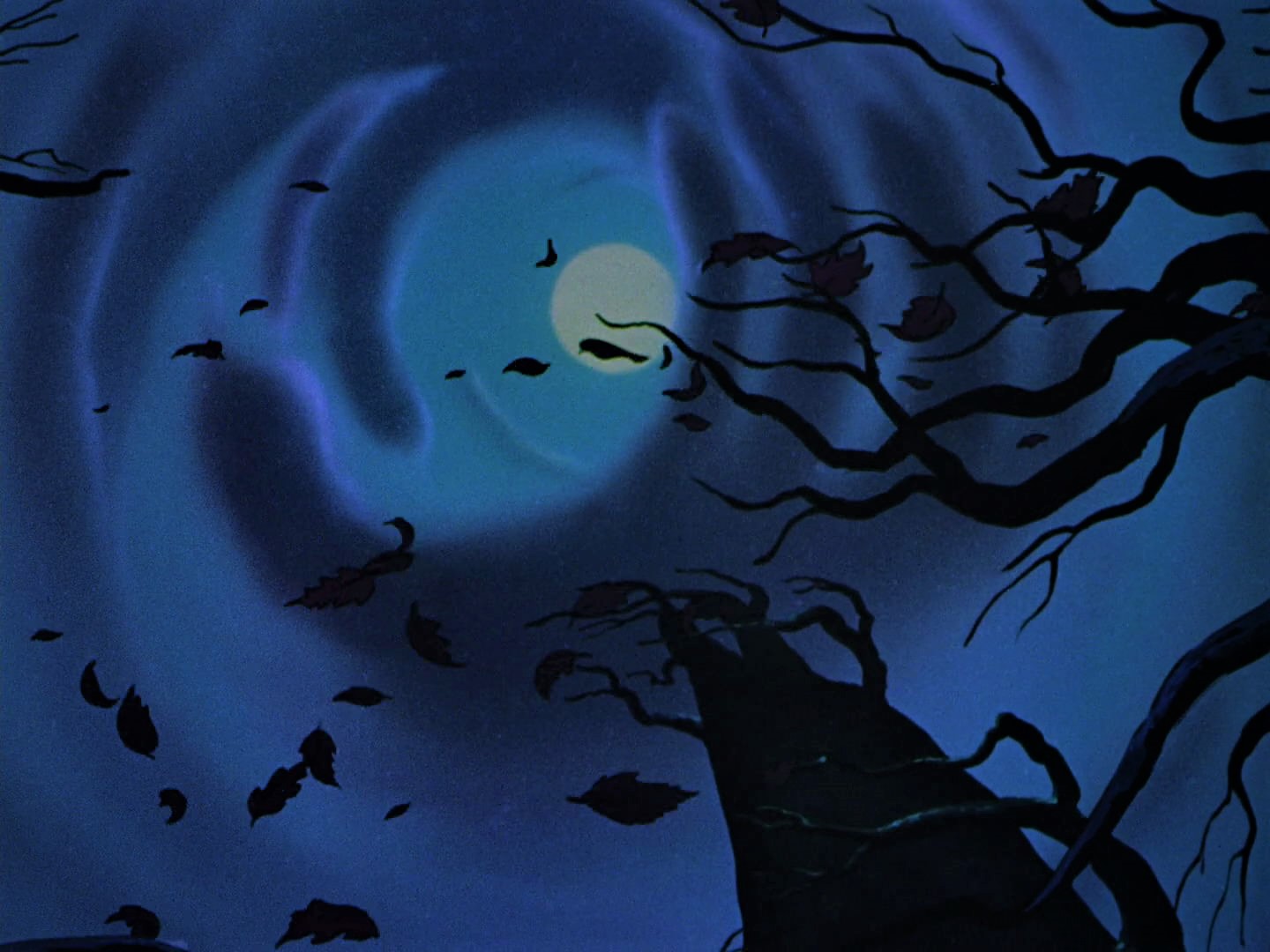
While the segment feels as if it would’ve been perfectly at home as a portion of 1948’s Melody Time (or even as an extended short-feature,) in it’s penultimate scene Ichabod suddenly elevates itself to one of the pinnacles of Disney’s early animation. The main reason The Adventures of Ichabod and Mr. Toad is remembered today (and the entire point of discussing the film right before Halloween) is for the climactic scene of Ichabod’s flight through the Hollow. Not since their 1937 Silly Symphony short “The Old Mill” have Disney’s artists been able to achieve such a sense of intangible dread as they do when Ichabod nervously makes his way home through the moonlit woods - the slow clip-clop of his horse’s hooves echoing amidst a growing chorus of nocturnal animal cries. The character’s growing unease turns to panic as every sound and shadow seems to hide unseen horrors, relief coming briefly as he realizes that what he thought was the sound of an approaching rider was merely cattails smacking against a log. Then suddenly the real Headless Horseman appears, a vision of dead-serious animation meant to scare the bejeezus out of both Ichabod and the audience. The sense of foreboding from moments ago turns to sheer terror, as Disney lets loose the closest their animated films have ever gotten to pure gothic horror. While several moments in the ensuing chase are played for laughs (mostly due to Ichabod’s frantic, bug-eyed horse,) the overall impression left by this sequence is one of edge-of-your-seat fright as Ichabod makes a desperate charge toward the covered bridge (which marks the limit of the Horseman’s haunting grounds.) The whole nail-biting sequence comes to a startling end as, upon crossing the bridge, Ichabod turns back just in time to see the Horseman’s jack-o-lantern head flying towards him (towards us!), engulfing the screen in flames as it presumably smashes against it’s target.

Pumpkin spice hype gets more aggressive every year...

The following closing scenes reveal that Brom and Katrina end up marrying each other, which seems to suggest that the Headless Horseman was actually Brom in disguise (though it's left wonderfully ambiguous.) It's also heavily implied that Ichabod survived his ordeal, likely settling down with a wealthy widow someplace - but audiences could hardly care less. The sudden and unrelenting nature of the “Headless Horseman” scene is what sticks with one the most. The sight of the terrifying rider hoisting his flaming jack-o-lantern skyward while careening through a darkened cemetery is an instantly iconic image, and has burned itself into many an impressionable young Disney fan’s mind. Thanks to repeated showings of the film around Halloween (or sections of it, since The Adventures of Ichabod and Mr. Toad was more often than not presented as two separate features until the DVD age,) including as part of perennial TV favorite Disney’s Halloween Treat, generations have been terrified by the adaptation of Irving’s short story.

A bad moon a-risin'

Though Walt Disney Productions is often remembered as going through a slump during the 1940s, it’s through memorable and masterfully-realized moments like this that the legendary animators showed what great heights their art form was still capable of achieving - even on a limited budget.

Sunday, October 29, 2017

The Devil and Max Devlin

Let’s now kick off a trio of wicked film reviews just in time for Halloween. First up is an oddity from 1981 that many readers may never have heard of. Let’s all go straight to Hell for our review of The Devil and Max Devlin.


The film stars Elliott Gould (in his second of two roles for Disney) as sleazy Los Angeles landlord Max Devlin, who - less than four minutes into the film - is hit by a bus and is sent right into perdition. There he's placed before a panel of business-suited middle-men, led by the Devil’s chief henchman, Barney Satin (played by Bill Cosby, in what was - at the time - an ironic bit of against-type casting.) When it’s decided that Max deserves an eternity in the “horrible … horrible” level 4, he’s offered a way out: get three pure-hearted youngsters to sign over their souls, and he will be spared. Max naturally agrees, and is soon introduced to his targets: Stella Summers (Julie Budd,) a 20-something wannabe soft-rock songstress with crippling stage fright; the improbably-named Nerve Nordlinger (David Knell,) a bookish teenage geek who wants to be a motocross champ; and 11-year old Toby Hart (Adam Rich,) a kid who wants nothing more than to match up his widowed mother, Penny (Susan Anspach,) with an eligible father-figure. To aid in his despicable deeds, Max is granted a few handy magical powers, including the ability to teleport between his three marks, and to grant their innermost wishes - as long as they’re within eyeshot of him.

Damn dirty deed doers.

As you can no doubt imagine, the story is one of a clod finding redemption through demonic intervention (kind of like a reverse It’s a Wonderful Life,) and for the most part it works. That being said, the three plotlines play out with varying levels of success. Nerve Nordlinger's story (jeez, what a name; did they want to have a first and last name that both sound like “nerd”?) is given the smallest amount of screentime, since it's by far the least interesting. It can be succinctly summed up thusly: nerd wants to race motorcycles, Max grants him the ability to ride motorcycles. It doesn’t help that the young character has all the personality of a cardboard box, and actor David Knell (who would go on to a career full of small television roles) doesn’t imbue any additional energy into him.

The dirt-bike kid.

Toby’s story, which ends up being the film’s central focus almost by default, misses the mark due to a number of odd choices by the filmmakers. The young boy first encounters Max at a carnival, where he accepts the middle-aged man’s offer to buy him ride tickets and snacks in exchange for letting him spend the afternoon with him. Eww. By the time Max is walking the boy home (where his mother runs an in-home daycare,) Toby is saying that his fondest wish would be for “Uncle Max” to be his new Dad. Umm … what? I guess we’re to assume that Max is using his newly-acquired magic to sway the youth, but the whole thing is still two steps beyond squicky. The ensuing love story between Max and Penny gets off to an equally weird start. Following a series of altruistic gestures on Max’s part (including buying new playground equipment for her daycare,) the two share a few fireside kisses over the sleeping form of young Toby - who discreetly awakens and offers the camera a big, toothy grin. Viewers are once again left to assume that Penny must be rapidly falling for Max due to his black magic, yet by the film’s end Max himself is confessing to her that he loves her “more than anything.” Gould's interaction with Susan Anspach is sadly free of the chemistry needed to pull off such a brief love story. And while young Adam Rich is a decent enough child actor, Gould unfortunately can’t seem to act at all natural with him, either. Even with some suspension of disbelief, this whole storyline feels insincere.

Like a "My Buddy" doll come to life...

Strangely it’s Stella’s storyline that ends up being the most affecting. While not very original, the story of a young singer/songwriter who rapidly rises to fame only to find disillusionment could’ve potentially been expanded upon to replace the other, less interesting plotlines. The success of Stella’s tale is helped by a memorably earnest acting turn by Julie Budd, as well as the pair of songs that she performs with believable gusto, written by EGOT-winning songwriter Marvin Hamlisch. The film’s finale (in which all the characters gather at Stella’s “farewell” concert) sees her plotline go out in a Star Is Born-style extravaganza of multicolored stage lights and spinning-camera shots.

For Stella, singing lessons come second after her crochet class.

I suppose I can’t proceed further without addressing the elephant in the room: that of disgraced actor and comedian Bill Cosby. As noted earlier, the casting of the I Spy actor was purposefully done to play against his amiable public persona (a stunt that would’ve been even more noteworthy following the launch of his successful sitcom, The Cosby Show, three years later.) That by 2017 audiences are keenly aware of the despicable truth behind his chummy façade, watching Cosby play an agent of the Devil doesn’t seem so unbelievable any longer. As for this film, Cosby is called upon to deliver an oddly non-comedic performance, mostly serving as straight-man to Gould’s befuddled schlub. His Barney Satin (geddit?) pops in and out of the film, visible only to Max, offering some pithy commentary (as when Max instructs Nerve to drive his motorbike “like a bat out of Hell,” to which Barney sneers, “Have you seen one of our bats?”) and mild threats to keep him focused on his cruel task. Near the film’s conclusion, when Max has his inevitable change of heart and threatens to destroy the contracts promising Barney the kids’ souls, Cosby gets his big moment to overact. Suddenly appearing amidst smoke and hellfire, Barney’s true form is revealed, in all it’s red body-paint and Halloween Devil-horned glory. Brandishing a pitchfork (or is it a trident?), Barney taunts Max with threats of eternal pain and suffering, in a loud, angry shout that sounds suspiciously like the “angry wife” voice from Cosby’s own Himself comedy routine.

Who the hell took the last Pudding Pop!?!

The Devil and Max Devlin co-exists with a small number of films that many would find it hard to believe came from “House of Mouse” Disney. Apparently this was the first film the studio released containing profanity (a couple of “damnits” and an unfinished “son of a bitch”,) and was one of the features that lead to the eventual creation of Touchstone Pictures, to help keep the Walt Disney Pictures brand clean (discussed in my review of 1983’s Never Cry Wolf.) Personally, I wouldn’t put a movie about a guy being recruited by lawyers from Hell outside the realm of possibility for Disney to produce, even discounting the studios “dark turn” in the early ‘80s. For one thing, while the film’s representation of Hell may, at first glance, seem pretty intense for the family-friendly studio, it’s stereotypical “fire and brimstone” look actually comes off rather cartoonish, and can’t hold a candle to the startlingly Hellish landscape revealed during the climax of 1979’s The Black Hole (oops, uhm … SPOILERS - we haven't gotten to that one yet, have we?) Besides, looking at the studio’s long history there were already a fair number of depictions of Hell, from the 1935 short Pluto’s Judgment Day (with an afterlife full of demonic Cats) to the “Night on Bald Mountain” segment of Fantasia. For me, Disney’s most memorable portrayal of the underworld wasn’t actually in one of their filmed productions - but we’ll save that for a future “Theme Park Rundown” article.

Oh Hell no!

What actually makes this film seem different from Disney’s other productions is a matter of aesthetics. Visually, The Devil and Max Devlin is one ugly movie. While the red-hued scenes set within Hell are fairly dynamic (and some of Stella’s concert performances throw a bit of colorful light into the mix,) much of the film exists in a world of dull grays and mushy browns. Many characters exhibit an ever-present clammy sheen, as if the production was perpetually filming on the hottest day of the year. The various settings (Max’s rundown apartment building; Nerve’s dusty, beer-belly populated motocross track; Toby’s asphalt-floored carnival; and the tacky, hot-tub adorned suites where Stella attends record-executive’s parties) seem as though they were designed to make Hell seem like a nicer place to be. Perhaps an attempt to capture a visceral realism, the look of this film is disappointing.

In spite of everything going against it, I have to admit that I was mildly amused by the picture. Of course, this may be due to my expectations being at rock-bottom going in (and having a strong drink in-hand while watching certainly didn’t hurt.) Like my beloved Condorman of the same year, there are many instances of dumb (and mildly offensive) humor which wouldn’t fly today that I couldn’t believe I was actually chuckling at. Case in point: the bus that kills Max at the film’s start is full of Hare Krishnas, who promptly begin to dance joyfully and bang their tambourines upon his apparent resurrection atop the paramedic’s stretcher. Stupid, dated, derogatory? Yes - but I just couldn’t help myself. There are also some odd moments in the film that most would say work against it, but I appreciated for their come-from-nowhere charm. These include the moments when the camera randomly pauses to admire the Converse All-Stars worn by a cello player at Max and Penny’s wedding, and the lingering shots of awkwardly Disco-dancing extras at Stella’s release party.

Just call me angel of the morning...

However, as nominally entertaining as I found the film, I couldn’t shake the feeling of unease from contemporary events surrounding Cosby - much like the sickening feeling one now gets when “The Weinstein Company” logo appears before a once-favorite movie. Watching Cosby’s sinister performance as a personification of evil, I couldn’t help but think about what the man was doing in real life, possibly around the same time this movie was filmed; about all those women he victimized, and all the poor souls taken advantage of in reality. Nowadays, envisioning the man surrounded by the flames of eternal damnation doesn’t seem far off the mark.