Showing posts with label 1980s. Show all posts

Friday, July 20, 2018

The Journey of Natty Gann

Once upon a not-too-long ago, the idea of "family fare" didn't necessarily mean "kids stuff." For many years Hollywood produced a number of films and television productions that offered high adventure and edge-of-your-seat drama, catering to both kids and adults. These adventure stories were more often than not free of the overt silliness that would come to define "family entertainment" as the 20th century wound to a close. In the mid-1980s this particular genre of "family adventure" offered Disney, a studio right in the middle of a changing-of-the-guard, a way of transitioning away from the darker fare they'd released in the previous decade and into more traditional (and more lucrative) kids entertainment. Let's take a look at Disney's gem from 1985, The Journey of Natty Gann - one of the finest examples of this lost genre.

How long were you alone with that dog?

The film tells the story of tomboy Natalie “Natty” Gann (Meredith Salenger, in her first starring role) and her widower father, Union-organizer Sol (Ray Wise.) Eking out a meager existence in Depression-era Chicago, Sol must leave Natty for a while after receiving a job offer from a lumber company in Washington. Following a run-in with the local police and threatened with being turned in as an abandoned child by her unscrupulous landlady (a harpy-like Lainie Kazan,) Natty hops a freight train heading west, hoping to find her father. Making her way across the country, she encounters both kindness and cruelty from humanity and nature alike, her courage and ingenuity put to the test with each mile traveled. Along her journey she’s joined by a wolfdog whom she rescues from a dog-fighting ring (who becomes something of a protective guardian) and an experienced drifter named Harry (a young John Cusack,) who mentors her in the rules of riding the rails.

The Journey of Natty Gann, as mentioned above, falls into a particular category of film that you don't tend to see any longer: that of the "family adventure." A familiar sub-genre to those of my generation, repeats of this film (or others like 1993's A Far Off Place, 1989's Cheetah and 1991's White Fang) or action-oriented TV shows like Canadian-import Danger Bay made up a considerable chunk of The Disney Channel's line-up from the mid '80s through the early '90s. Played as straight as a realistic period-piece, with no fantasy elements and little outright goofiness, for many these yarns felt like modern-day continuations of the "boy's adventure tales" that categorized such institutions as The Adventures of Tom Sawyer or Treasure Island. Though definitely aimed at a younger audience, the film features a number of surprisingly heavy moments that cast a grim pall over the story (including a scene in which a hitchhiking Natty escapes an attempted rape.)

'Steada treated, we get tricked...

Generally, Natty Gann holds up very well in this regard - and has earned itself something of a reputation as an underrated treasure. It's easy to see why, as everyone involved in the production seems to've brought their "A game" to this seemingly simple adventure tale. Jeremy Kagan's direction is confident and focused. An eclectic director of film and television (including successful 1977 drama Heroes and 1991's cult favorite By The Sword,) Kagan went on to become a full-tenured professor of film direction at USC. The film is bleakly gorgeous, with British cinematographer Dick Bush (a frequent collaborator with Ken Russel, of all people) finding intricate beauty in both majestic wilderness and squalid shanty-towns. Additionally, the late James Horner turns in another warm and lyrical score that supports the action and family-based drama well, sitting comfortably alongside his popular scores for 1985's Cocoon and 1988's The Land Before Time. Interestingly, Horner was brought in to re-score the film, as original composer Elmer Bernstein's more "western" styled score was deemed unsatisfactory by the filmmakers.

We have to dance for Natalie!

The acting is fantastic across the board. Meredith Salenger has a mesmerizing screen presence for such a young actress, and it's a shame that she only starred in a further four films before briefly leaving Hollywood at age 18 (though graduating from Harvard with a degree in psychology is certainly nothing to balk at.) Since the early '90s, Salenger has popped up in smaller roles in film and television, including a cameo in Disney's Race to Witch Mountain in 2009 (playing a reporter named Natalie Gann - well played, Disney.) Additionally, it's always a treat to see Twin Peaks' Ray Wise pop up, especially when he's not playing a villain or corrupted authority figure. His performance as Natty's father is at turns warm (in his scenes with Salenger) and gut-wrenching (as his character becomes cavalierly suicidal following news of Natty's supposed death.) Meanwhile, a fresh-faced John Cusack turns in a subdued performance as the worlds' cleanest young hobo, bringing a bit of teenage romance into an otherwise straight-forward adventure film.

In your eyes...

While there is much to appreciate in The Journey of Natty Gann, the film does tumble somewhat at the end, unfortunately leaving something of a bad - or at least misjudged - impression (spoilers for the climax lay ahead.) As mentioned above, Sol is under the impression that Natty is dead (her wallet being discovered at the scene of a train derailment that she'd actually escaped from,) and so takes on a series of ever-more-dangerous jobs for the lumber company. On the morning that Natalie happens to finally arrive at his jobsite, he's involved in a job in which several laborers are caught in a dynamite-blast gone wrong. I say "involved in" because Sol is not amongst the injured - though the film very briefly suggests that he was. Now my problem is not with this bit of bait-and-switch, but with the fact that between Natty's arrival at the jobsite and her eventual reunion with Sol, nothing really happens. Natty is told to wait for her father, then driven up the mountain to where he's working. Then she's driven back, but hops out of the car. Sol, meanwhile, travels down the mountain with his injured co-workers, missing Natalie, until he eventually (and confusingly) appears in the middle of the road to re-join his wayward daughter. So for the better part of 10 minutes, the film decides to stretch out a very simple game of "car-tag" because apparently the screenwriter thought that having a bit of drama at the very end was unnecessary. This was unfortunately one of those endings where I had to go back and re-watch a few times, thinking that maybe I'd missed something. Unfortunately the film then offers nothing in the way of a denouement, with Natalie and Sol warmly embracing each other on a mountain road as the credits very suddenly begin to roll.

John Cusack returns in "Better Off Dead 2: Suicidal Boogaloo"

In my Escape to Witch Mountain post I noted that the year 1975 was a diverse year for Walt Disney Productions, with that film pointing toward the darker turn Disney’s film slate would take by the end of the decade. With The Journey of Natty Gann, released a decade later, we see the pendulum begin to swing back the other way. While not every live-action film Disney released in the early ‘80s was dark or adult-oriented (awful Love Bug sequel Herbie Goes Bananas was released two months after gothic nail-biter Watcher In the Woods, for example,) the studio’s increasingly diversified slate under president Ron Miller (a former student/football star at USC and husband to Walt’s daughter, Diane) was a significant departure for the “house of mouse” and it’s squeaky-clean public image. Their attempts at a more mature tone seemingly backfired, however, as the film studio’s steady financial decline suddenly became more of a freefall. Several high-profile box office flops - including 1980’s Midnight Madness and 1982’s TRON - came to define Disney’s tarnished image to the rest of Hollywood. Then, following Miller’s ousting by Disney’s board of directors (led by Roy E. Disney, Stanley Gold and Sid Bass,) in stepped new CEO Michael Eisner in 1984. Along with his appointed film studio chief, Jeffrey Katzenberg, Eisner set about remaking the studio into a more family-oriented, money-making machine.

Some snacks aren't fit for Instagram...

Significantly, during this corporate shake-up Disney released no movies in all of 1984 - and the four it put out the following year can easily be seen as a bit of “house cleaning,” releasing the last few projects started under Miller’s tenure. This isn’t to say there weren’t other projects started under Miller that the company would later reap the benefits of - including the founding of Touchstone Pictures, courting of George Lucas, and funding upstart artist and stop-motion filmmaker Tim Burton. But I digress. Even then, 1985’s first two releases - Walter Murch’s bleak Return to Oz and animated sword-and-sorcery flop The Black Cauldron - could be seen as the “last stand” of the dark corner Disney had wandered into. Once the darkness had spread from live-action into their animated canon, clearly the edges of this particular envelope had been reached.

UnfathomablyUncomfortablyUnrealisticallyUnderwearably ...

Once the decade was officially half over, Disney wanted to make it clear that the way forward was to play on their old family-friendly image. Theatrical posters for The Journey of Natty Gann featured a big, bold tagline across the top, actually more of a corporate mission statement than an ad for the film itself: “Unforgettably, Undeniably Disney.” This attention-grabbing statement featured the Disney name in the old familiar “Walt” font, and nearly dwarfed the film's own title. There would be an even less subtle tagline attached to posters advertising the film’s home video release: “The new Disney: Contemporary films for the ‘80s family.” Indeed, while Natty Gann has a grittier and more realistic tone than modern audiences would likely expect from a PG-rated Disney movie, at the time it signaled a definite realignment of not just their film studio, but their entire corporate outlook. Hereafter, the Disney brand would once again be associated with “wholesome” entertainment the whole family could enjoy, and nostalgia would be monetized to it’s fullest.

While something of a "lost stepchild" (released as it was during the great sea change that forever altered the future of Disney and it's audience,) The Journey of Natty Gann is, in many ways, the best that the forgotten genre of "family adventure" has to offer. Full of vivid, realistic acting and nail-biting adventure, the film remains a solid nostalgic favorite of those who grew up in a time when childhood entertainment wasn't always the squeaky-clean, oftentimes vapid fare it would become.

Friday, June 29, 2018

TV Detour #6 - Herbie's Adventures in Television

When we last saw Herbie - the plucky little Volkswagen with a mind of his own - he’d been run ragged and stunk of rotten fruit following the release of the embarrassingly awful “comedy,” Herbie Goes Bananas. By the dawn of the 1980s, the franchise had clearly been run without a tune-up for too long. Much like the once-sprightly “love bug” himself, the series was in need of a rest before returning to the silver screen. Rather than letting Herbie drive off into the sunset of nostalgia, however, Disney would put their vehicular mascot to work on the small screen; Herbie would therefore be called upon to front a pair of television productions aired some 15 years apart. So before Herbie takes his final lap, let’s take a look at his adventures in television.


Groovy...

Herbie’s first foray into television, as we’ve discussed previously, came back in 1971 when he was featured in The Grand Opening of Walt Disney World TV special. Appearing alongside his Love Bug co-star Buddy Hackett, the duo faced off against a handful of genuine race car drivers at the Magic Kingdom’s Grand Prix Raceway attraction. This infamous bit is memorable for seeing Hackett use a giant wind-up key to start Herbie - because apparently nobody associated with that program had ever seen The Love Bug (or seemed to know what the hell was going on in general.)

'Memba TV Guide?

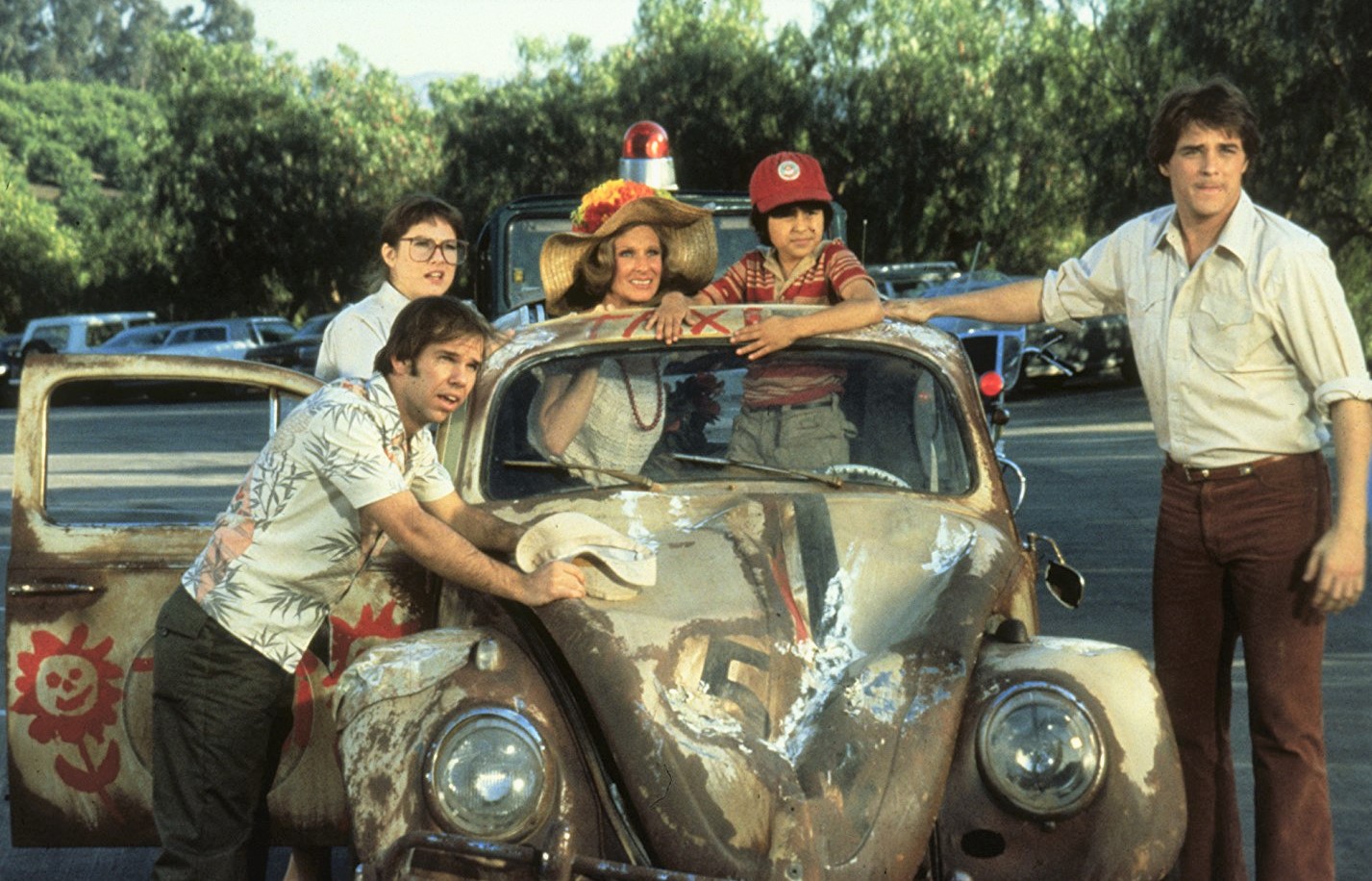
Herbie’s big break into broadcast TV would come a decade later, in the form of a full-on TV series. Herbie, The Love Bug was a mid-season replacement which ran on the CBS network for 5 episodes in March and April of 1982. Starring Dean Jones as Herbie’s on-again/off-again friend and driver, Jim Douglas, the show followed the retired racing star as he meets and becomes engaged to divorcée and mother-of-three Susan MacLane (played by Patricia Harty) - with a little help from Herbie, of course. Attempting to sabotage the couple’s courtship is Susan’s jealous ex-fiancé, Randy, played with ineffectual bluster by M*A*S*H’s Larry Linville. The cast is rounded out by Richard Paul as the prerequisite goofy mechanic pal, Bo (sort of a low-rent substitute for both Hackett and Don Knotts), and Susan’s three kids: oldest daughter Julie (a pre-Back to the Future Claudia Wells,) middle son Matthew (Nicky Katt) and edge-of-precocious Robbie (Douglas Emerson.) Actress Natalie Core also appears as the ex- fiancé’s mother, Mrs. Bigelow, so that we can get someone who says “Randy, why are you still obsessing over that woman?” in every episode.

Keeping up with the Joneses...

Though officially categorized as a sitcom, I have trouble describing the show as such, since it neither looks nor feels like contemporary sitcoms such as Taxi or Too Close For Comfort (why did I choose those two examples? Well, if you must know: Taxi has cars in it, and I freaking love Too Close For Comfort - so there.) Instead, Herbie, The Love Bug fits into that particular sub-genre that viewers (and reviewers) can’t seem to decide should be dubbed “comedy-drama” or simply “hour-long comedy.” Herbie, in fact, seems to be better bed-fellows with such contemporaneous programs as The Love Boat and Fantasy Island - or such current quirky favorites as Jane the Virgin and Crazy Ex-Girlfriend. While the show has plenty of wacky antics (mostly focused on Herbie consistently foiling Randy’s attempts at sabotage,) the show mostly revolves around Jim and Susan coming to terms with integrating their relationship into her family life. Closer to a light-hearted domestic drama than a knockabout comedy, coming into this show straight off the strained goofiness of Herbie Goes Bananas came as something of a respite for this blogger.

Fun fact: The jauntily corny theme song, entitled “Herbie, My Best Friend,” was actually performed by Dean Jones himself - presumably in character. Here it is, for your Summer listening pleasure:


The pilot episode - in which Jim and Susan meet after Herbie helps to foil a robbery at her bank - was helmed by veteran TV director Charles S. Dubin, and establishes the show’s premise and main cast well. The following four episodes find directing duties rotating between returning series director Vincent McEveety and Bill Bixby (best remembered as Dr. Banner in TV’s Incredible Hulk, but also a prolific director and producer.) Episodes 2 and 3 cover the troubled road to Jim and Susan’s wedding, which itself occurs in episode 4. The 5th episode almost seems out-of-place, detailing the day-to-day struggles of the newlyweds adjusting to married (and extended family) life. Perhaps this final installment was a window into what a continuing series would’ve looked like, had it been renewed?

Domesticated Herbie...

All episodes save for one (more on this in a moment) were written by Arthur Alsberg and Don Nelson, the sitcom-writing duo responsible for Herbie Goes to Monte Carlo. Alsberg and Nelson wisely ignore the events of Herbie Goes Bananas, establishing Jim and Herbie as ongoing friends and partners who set up a driving school following their retirement from racing. Their “Famous Driving School” seems to cater exclusively to kindly old ladies (a nod, perhaps, to Herbie Rides Again) - whom Herbie is able to assist when they fail to notice the occasional STOP sign or missed turn. Another main storyline focuses on Susan’s opposition to auto racing, since her first husband abandoned the family to become a racecar driver. Therefore the series ends up featuring only a couple of racing scenes. However, unlike previous film entries in which Herbie did not race, it makes sense within the established story. But despite this lack of racing scenes (and the fact that Herbie himself features less than most of the human cast,) Herbie, The Love Bug actually does feel like a continuation of the film series - certainly more so than the most recent sequel did.

Now cut that out!

While the show is an inoffensively pleasant, fairly breezy affair, I have to admit that the best episode by a long mile is episode 3. This installment heavily references the events of Herbie Goes to Monte Carlo, and features the return of Jim’s love interest from that film, Diane Darcy (played here by Andrea Howard, replacing Julie Sommars for some reason) - whom is invited to Jim’s bachelor party in an attempt by Randy to make Susan jealous. Oddly enough, despite extensively referencing the third film, as noted above this is the only episode that wasn’t penned by the writers of that movie; instead this episode was scribed by Herbie Goes Bananas screenwriter Don Tait. Despite the ire flung at him in my review for that movie, I must admit that his teleplay here - a somewhat wackier installment than the surrounding four episodes - entertains thoroughly. Perhaps more at home with writing for television, or working better within another writer’s framework, Tait’s work here - his very last screenplay, as of this writing - is fun and efficient in it's on-point comedy.

Herbie gets 'em to the church on time...

While the show’s brief run seemingly signaled the end of Herbie’s adventures, Disney wouldn’t let the little Bug disappear entirely. Besides keeping his memory alive through televised repeats and home video releases of his theatrical films, Herbie became a rare but consistent mainstay at Disney’s theme parks - but we’ll go into that in a future "Theme Park Rundown," of course. (No, we won’t.)

And then, fifteen years after the conclusion of his short-lived TV series, Herbie suddenly returned to the small screen in the form of a made-for-TV movie. Titled The Love Bug (usually referred to as The Love Bug ‘97 or “The TV Movie” to differentiate it from the 1968 original,) this rarely-seen Herbie adventure aired on ABC’s version of The Wonderful World of Disney on November 30, 1997. It was directed by Peyton Reed, who two years prior had overseen a Kirk Cameron-starring TV-remake of The Computer Wore Tennis Shoes, and would go on to direct Bring It On three years later (before taking the reigns of Marvel’s Ant-Man franchise starting in 2015.)

Okay, now a silly one you guys!

Hovering somewhere between a remake, reboot and continuation, the film sees Herbie worn-out but back on the racing circuit, under the drivership of an arrogant Scottish racer named Simon Moore III (played by John Hannah, familiar from the Mummy films and Starz’ Spartacus series.) After Moore dismissively gives Herbie up for scrap, he is rescued after being put into a “junk-car race.” There, small-time racer and mechanic Hank Cooper (the one-and-only Bruce Campbell) repairs and races Herbie, ending up the winner. One of the judges of the event is Alex Davis (Alexandra Wentworth) - an automotive magazine reporter and, naturally, Hank’s ex-girlfriend - so you can see where this is heading from the get-go.

By the way, as a fan of the Evil Dead series it came as quite a kick for me to see Bruce Campbell (“Ash” himself) appearing here - the first in a handful of appearances the quintessential B-movie star would make for Disney. Campbell is in “average Joe” mode here, however, playing a nondescript “vanilla” hero rather than the chainsaw-wielding badass familiar to the Fangoria set.

Good, bad - I'm the guy with the Bug...

Much of what occurs in this version of The Love Bug follows the original film (and it’s follow-ups to some degree): we have Herbie playing matchmaker to his driver and an initially reluctant love interest; an eccentric buddy (Kevin J. O'Connor as Roddy, a sculptor like Tennessee Steinmetz) whom early-on realizes the car’s sentience; a scene in which an emotional lead character realizes that Herbie has feelings; and a wacky climactic race. Really the only factor that doesn’t make this a remake is the mid-movie arrival of good ol’ Dean Jones as Jim Douglas, who arrives following Herbie’s destruction (SPOILERS!) to assist in rebuilding him. Jones, noticeably older by this point (the wide-shouldered business suits he wears here making his head look positively puny,) offers a few tidbits to the new characters about Herbie’s background, as well as the sole reference to the 1982 TV series to be found in any “Herbie” production, mentioning that Herbie helped him “meet his wife.” Jones also provides a brief narration at the start of he film, which significantly contextualizes Herbie’s rise to fame within the zeitgeist of the late ‘60s “love generation.”

What those familiar with the previous “Herbie” films may not see coming, however, is that this Love Bug goes somewhere unexpected and not entirely warranted: into an origin story. You see, once Herbie inevitably starts helping Hank win more races, a jealous Moore (slightly more crazy than most of Herbie’s previous nemeses) seeks to discover what makes the little VW Bug so special. He soon digs up one Dr. Gustav Stumpfel (Harold Gould,) the heretofore unheard of German scientist who, when tasked with creating a “people’s car” that would become the Volkswagen Beetle, inadvertently created a sentient “Love Bug” after a picture of his beloved wife accidentally fell into the vat of special metal he was brewing to make into the car. WHAA!?!

Mein Gott! Das auto!

This reveal is … odd, to put it one way. Ignoring the fact that the screenwriter (Ryan Rowe) chose to link Herbie's origin to a quasi-historical/fictional context (essentially making Herbie the progenitor of the entire VW Beetle "race",) it also shifts the core concept of the character. That Herbie, previously portrayed as a car that obtained consciousness through love, is now revealed to be the result of a “mad scientist” trope is fairly disappointing. This story reframes the image of Herbie as a byproduct of alchemy rather than a child of mysticism - a “happy accident” of human invention, rather than one bourne from pure thought. While the idea that Dr. Stumpfel’s love for his wife brought about emotional awareness within his creation is an interesting one, it somehow doesn’t quite fit in with the Herbie we’ve been witness to before (especially when he’s acted like a little thug several times before.)

She could tell right away that I was bad to the bone...

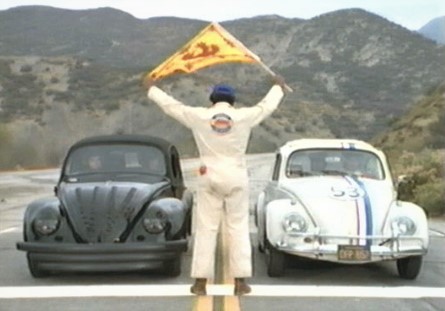
This brings us to the part of The Love Bug ‘97 that people seem to remember most: Horace, the Hate Bug. In the film the point of Moore’s uncovering of Dr. Stumpfel is to trick the eccentric old inventor into recreating his previous experiment, and then perverting said work by tossing a picture of himself into the “magic ingredients.” The resulting creation is a jet-black, souped-up Beetle that Moore dubs “Horace.” Unlike the gentle, child-like Herbie, Horace is a machine seething with rage and possessing an instinct to destroy (and even comes equipped with James Bond-style offensive weapons.) Another intriguing idea that gets rather bungled in the execution, the idea of a hate-filled “anti-Herbie” seems like a great addition to the franchise. Unfortunately, when framed within this film’s weird science theme, any idea of a “living car without a soul” ends up functioning more like a villain’s “super weapon” than it’s own character - frowning bumper or not. And the less said about Horace’s demise (in which he crashes through the ground, literally surrounded by flaming hellfire) the better.

Horace Goes to Hell!

Despite the presence of Dean Jones, a focus on auto racing and (admittedly superficial) discussions of love and hate, there’s something about this TV rehash that somehow feels … off. Not that it’s a bad movie by any means - while not great, it’s enjoyable and even has moments of genuine wit. It’s just that there are some small, niggling issues that really prevent it from fitting in with Herbie’s other adventures. This specific situation should sound familiar to older fans of the long-running English series Doctor Who (I’m going to go off on a bit of a tangent here, so my apologies.) That show, which ran uninterrupted from 1963 to 1989 (and began airing on PBS stations in the US in the mid ‘70s) was resurrected as a made-for-TV movie in 1996 as a co-production between the BBC and the FOX network. That movie (which in fandom is usually referred to as “The TV Movie” as well,) despite a number of call-backs and continuity references, looked and felt disconnected from it’s parent franchise - just like The Love Bug. For one, both “TV Movies” featured a returning cast member to lend some credence to their existence (Dean Jones in The Love Bug, “Seventh Doctor” Sylvester McCoy in Doctor Who,) as well as out-of-place quasi-celebrity cameos in bit-parts (comedian and MadTV performer Will Sasso as a morgue attendant in Doctor Who, ex-Monkee Micky Dolenz as a cigar-chomping car dealer in The Love Bug.) Both films also feature somewhat bland music; John Debney’s Doctor Who score sounds more like selections from FOX series Sliders, and Shirley Walker’s Love Bug score is forgotten almost as soon as it’s heard. This is a real shame, since Walker's work for modern classic Batman: The Animated Series featured some of the best music on television just a few years prior. At least Debney got to use the original Doctor Who theme, whereas George Bruns’ famous “Herbie Theme” is nowhere to be heard here.

Why do I bring up Doctor Who? Well, the similarities between these two attempts at reviving a long-running franchise is too great to ignore, especially since both came out within a year of one-another. Maybe I just wanted to write an entry that referenced The Evil Dead, Doctor Who and Batman? Incidentally, both “TV Movies” also ended up being dead-ends, as Herbie’s franchise would go dormant again thereafter, and Doctor Who failed to act as a “backdoor pilot” for a revived series. It would take both franchises a few more years to return to popular culture again, and would both stage successful returns in 2005. But more on that in the next entry...

Two players. Two sides. One is light... one is dark.

As we’ve seen, Herbie may have gone through a few long periods of rest, but he never really went away. Though largely forgotten, Herbie’s adventures in television kept the little living car puttering around in the public consciousness, like a well-known acquaintance always hovering in the background. Disney, both under Ron Miller and later Michael Eisner, knew that they still had a popular character on their hands, and wouldn’t let the opportunity to use him slip by; they just needed a few small-screen pit-stops to ensure the little old car would be ready for his inevitable big-screen victory lap.

Friday, June 22, 2018

Herbie Goes Bananas

Oh dear God … what happened here?! Three years after the ever-expanding Love Bug franchise seemed to return to form in Herbie Goes to Monte Carlo, director Vincent McEveety decided to take the titular little Volkswagen south of the border in 1980’s Herbie Goes Bananas. But instead of a continuation of Herbie’s adventures in the racing world, audiences were presented with yet another detour into the world of unfettered wackiness - or at least an attempt at it. The poor souls suckered into buying a movie ticket never knew what hit them.

I was forced to remove the turd I'd had here, then the rotten banana. So fuck 'em, here's a dumb poster.

Like it’s predecessor, the film opens with some rather lovely aerial photography that plays behind the opening credits. This time the sunny shores of the "Mexican Riviera" are on display, and the sandy beaches and azure waters of the Pacific are an enchanting sight to behold.

Now that we’ve covered everything good about the movie, let’s move on.

To put it simply, Herbie Goes Bananas is a rancid turd. It flat-out sucks. To call it “a disappointment” would be a laughably insufficient description; Herbie Rides Again was “a disappointment” - a slip-up by a well-meaning group of filmmakers who failed to capture the simple joys of the 1968 original. Herbie Goes Bananas, on the other hand, feels like an attempt at turning the "Herbie" series into a flaming pile of wreckage. It’s one of those films that, while watchable (in the sense that it doesn’t feel like it was made by amateurs,) makes one wonder why someone didn’t stop the production at some point and say “Something’s not working, because this is horseshit.”

The (stupid) gang's all here...

The story, such as it is, is such a mess that attempts to summarize it typically break down into a series of “then this happens, then this happens” - so let’s not even try. The script attempts to continue the narrative from the previous film, insomuch as one of our lead characters, Pete Stancheck (played with hunky blandness by Stephen W. Burns,) has inherited Herbie from his uncle, Jim Douglas (an absent Dean Jones,) who apparently ditched the little car after he stopped wanting to race. Boy, they sure try to make Douglas into a real jagoff when he’s not in the picture. The main character of the film is Paco (Joaquin Garay III,) a young orphan from Puerto Vallarta who befriends the little car and dubs him “Ocho”. In a hi-larious twist at the end, when questioned why he calls him this, Paco informs us that he was simply adding together the race numbers on Herbie’s hood: 53. That’s some real Oscar Wilde-like wit right there. There’s also a trio of crooks (John Vernon, Alex Rocco, and Richard Jaeckel) searching for a lost city or something, a cruise ship helmed by Harvey Korman (more on him in a moment,) Cloris Leachman playing yet another pathetic spinster, and Elyssa Davalos as her mousy niece, who shares a She’s All That-style romance with Stancheck that I couldn't give two shits about.

Strike up the band and make the fireflies dance silver-moon's sparkling...

Just about every decision made in the creation of this pile of garbage was a bad one, and many mistakes that had already been made in previous “Herbie” films were repeated. Once again, the story is absent any racing scenes - instead Stancheck and his pal D.J. (a completely wasted Charles Martin Smith, whom Disney owed Never Cry Wolf after this) are planning on entering Herbie into the Brazil Grand Prix, apparently after the movie’s over. Not only that, but by the film’s conclusion they’ve appointed little Paco to be their official driver, because of his bond with the car and Christ kill me now. Like the previous film, we also get another trio of hapless crooks, because the tedious shenanigans of the diamond thieves from Herbie Goes to Monte Carlo were surely the secret to it’s middling box office success. These three (who are American this time, because they wanted to cast John Vernon to please all the fans of Dean Wormer from Animal House) plan to make off with a large golden blah-blah-blah from a lost Inca city, and must be stopped because villains. To the film’s credit, the crooks here do pose a more tangible threat than the bumbling Brits from the last entry, since they seemingly transcend all laws of time and space. Paco can drive Herbie all the way from Panama to Mexico to avoid them, but they’ll already be waiting for him at a random spot along the way. As a matter of fact, every character in this film has the uncanny ability to find one another, illogically appearing all over the fucking continent no matter what distance separates them. One minute a character will be in Puerto Vallarta, and minutes later they’ve apparated somewhere hundreds of miles away to join in on some hijinks they’d have otherwise missed.

Villains, or menswear models from the 1979 Gottschalks catalog?

The cast, while made up mostly of fine actors, seems completely lost. Each actor (and therefore each character) is playing at odds to one another, as if no one told them all just what kind of movie was being shot. Stephen W. Burns has all the charisma of a handsome cardboard cut-out, and seems as though he wants the film to be a soap opera. Charles Martin Smith, tasked with a role seemingly written for Don Knotts, half-heartedly throws out goofy one-liners like a flailing stand-up comic. John Vernon seems to think he’s still in a Dirty Harry movie, and plays the villain completely straight until he finds himself slipping on banana peels in the climax. Poor Cloris Leachman was apparently doomed to keep repeating variations of her love-starved Last Picture Show character for years after, and honestly had a much more rounded character to work with in the previous years’ North Avenue Irregulars. Here her Aunt Louise character spends most of the film clumsily reacting to others’ pratfalls (a lot of the off-screen “Oh my goodness!”, “Oops!”, “My word! Are you okay?” variety,) and bewilderingly fawning over Harvey Korman’s character.


Cloris Leachman induces her gag reflex…

Which, unfortunately, brings us to Harvey Korman. I know I’m going to ruffle some feathers here, but for the life of me I’ve never understood Korman’s appeal as an actor or comedian. Perhaps best known for numerous appearances in Mel Brooks' comedies (including his turn as villainous Hedley Lamarr in the venerable Blazing Saddles,) Korman excelled in roles that required a measure of pomposity. If we’re being honest, though, playing a jackass is not difficult for any caliber of actor to pull off. One need look no further than Keenan Wynn playing the bad guy back in Herbie Rides Again for a better example of a crazed egoist; he really sold the idea of a blowhard barely keeping himself together. Korman, on the other hand, usually comes off as someone acting like a blowhard, merely playing at being unhinged. Hell, he couldn’t even pull off being a straight-man either, since he’s gone down in history as the guy who nearly pissed himself trying not to laugh at Tim Conway on The Carol Burnett Show.

However, I’m almost willing to give the guy a pass, just because he had to do this for a national TV audience in 1978's Star Wars Holiday Special:


In Herbie Goes Bananas, Korman plays the dictatorial captain of a cruise ship, named (I shit you not) Captain Blythe. Get it!? Like Captain Bligh of Mutiny on the Bounty fame, only it's Blythe!! But the word “blithe” means cheerful indifference or euphoric happiness - which describes the opposite of Korman’s character here. One could argue that they were trying to be ironic, but honestly I think it was just a stupid pun amongst innumerable other dumb jokes in this cinematic grab-bag of shitty gags. Blythe, as written and performed, is the biggest asshole on the seven seas, going off on long diatribes about the days of tall ships sailing across uncharted seas, when insubordinate crew could be punished with “lashes from the cat.” The dickhead seems to barely tolerate being the captain of a pleasure vessel, thundering angrily at passengers and crew members alike - especially ones that don’t play along with his Horatio Hornblower fantasies. While the character is clearly supposed to be a pompous ass, and suffers a number of slapstick humiliations over the course of the film, the really unfortunate thing is that we’re also supposed to find him funny. Witness a rib-tickler early in the film, when the camera cuts to the exasperated expressions of gathered passengers as Blythe admiringly recounts the following tale:
The booty was taken aboard the man-of-war, and the enemy vessel scuttled. The women were then turned over to the crew, the select ones going to the officers, naturally. The wenches were escorted below, and believe me, there was no poetry, or "by your leave," or "how lovely you look tonight". One got to the matter at hand in short order!
Grumpy Cap.

One of the biggest “I can’t believe I’m watching this shit” moments in Disney’s entire film library comes about halfway through this film, courtesy of our delusional captain. Blythe, enraged following Herbie’s wrecking of the ship’s hold (after Paco is discovered stowed away in his trunk,) abides “by the traditions of the sea” and orders the little car thrown overboard. Now up to this point, the film has been stupid, unfunny and full of lousy acting choices. But this scene, in which a Volkswagen was actually dumped off the side of a cruise ship while cameras rolled (and was never recovered afterward,) serves as a “point of no return” - the moment when the film loses all hope of redemption. Rather than “jumping the shark,” this film (and perhaps the franchise itself) has “dumped the Bug.” After this point, any attempt at making a cohesive movie falls apart, and the shit just piles up higher and higher until the credits roll. We get more of Cloris Leachman throwing herself at Captain A-hole, Herbie participating in a bullfight before driving across the country incognito under a pile of bananas (Aha! The title!), and finally using said fruit as artillery to bring down the fleeing villains (because hardened criminals with guns are no match for a car flinging bananas at them.)

Ocho swims with the fishes...

Looking over the list of the behind-the-scenes crew, it’s hard to figure out just where to place the blame for this abomination. Screenwriter Don Tait, a veteran of TV and movie writing (who’d written episodes for Maverick and The Virginian, as well as The Apple Dumpling Gang and The North Avenue Irregulars for Disney,) may’ve been past his prime by this point, though that’s hardly an excuse for a script this horrible. It’s telling, however, that this would be Tait’s final theatrical screenplay - his following pair of scripts being for TV shows broadcast in 1982. It’s also conceivable to lay some blame at the feet of returning director McEveety, as his previous Herbie film may've been the best work he did at Disney. A generally uninspired filmmaker at best, McEveety can also be credited with heading up such previous Disney-produced duds as 1973’s Superdad and 1975’s The Strongest Man in the World (the movie that killed off the "Dexter Riley" film cycle.)

I knew we should've taken that left turn at Albuquerque…

So far I’ve failed to talk about the music in the "Herbie" films, other than mentioning George Bruns’ "Herbie Theme" from the original. The Love Bug found the gifted musician in fine form, showcasing both his proficiency for jazz (in the high-spirited comedic segments) and exotica (in his eastern-tinged underscore for Tennessee Steinmetz’s philosophical musings). His score for the second film, while still enjoyable, wasn’t quite as inspired, leaning more heavily on the "Herbie Theme." Bruns was then replaced by prolific songwriter and TV theme-song writer Frank De Vol, whose credits include the music for Family Affair and The Brady Bunch. De Vol’s score for Herbie Goes to Monte Carlo was serviceable though not especially memorable, again making extensive use of a slightly-adapted "Herbie Theme." His score for Herbie Goes Bananas, on the other hand, is an ugly-sounding mélange of goofy orchestrations overdubbed with synthesized burbles and cheesy variations of "La Cucaracha" and "Jarabe Tapatio" (AKA the “Mexican Hat Dance”.) After all, this is set in Mexico, amigos!

Why grab the bull by the horns when you can just drop a car on him?

In another departure from the previous films, Herbie Goes Bananas features a pair of original songs. The first, a disco ballad entitled “Look at Me,” underscores the love scenes between Pete and Melissa, and is so breezy it barely exists. Hell, maybe it doesn’t, since I can’t seem to find any credited performers for it online, beyond a writing credit for De Vol himself. Maybe the singer wished to remain anonymous? Smart move. The second song - oh my fucking God. Also credited to De Vol, “I Found a New Friend” plays against the “heartwarming” scenes between Paco and Herbie Ocho, and in it’s entirety during a driving montage and the closing credits - so you have to hear it twice. I can’t seem to be able to express how bowel-drainingly awful this song is, so feel free to watch and listen for yourself:


So, yes - De Vol namechecks Charro in order to rhyme “tomorrow,” proving himself a true wordsmith to be reckoned with. Additionally, a new verse is added to the end of the song's reprise, in which the word “friend” is spelled out in song - only misspelled “f-r-e-n-d,” because the gods of rhythm demanded it. Already knee-deep in the waste that is this movie, it was all I could do to get through this insult to songcraft without shoving kabob skewers through my eardrums.

Here in my car, I feel safest of all...

It should come as no surprise that Herbie Goes Bananas was (and still is) the least successful film of the franchise, earning less than half of what Herbie Goes to Monte Carlo did - though I nearly spat out my coffee reading that enough people were apparently suckered into giving this dung heap $18 million. Garnering mostly bad reviews, one wonders if those few critics who gave the film any sort of plaudits are into sadomasochism or something; I honestly can't fathom how else they could've found anything to enjoy in this cinematic cluster-fuck. By this point, it was clear that Disney, in it’s current state, was no longer equipped to deliver on the franchise possibilities of the 1968 original. Thus, with Herbie left in the care of a Mexican orphan and covered with rotting banana peels, we wouldn’t be seeing the little VW Beetle with a mind of his own up on the big screen again for quite some time. Until then, the worn-out little car was in desperate need of a rest - save for a few TV appearances, of course.

Sunday, October 29, 2017

The Devil and Max Devlin

Let’s now kick off a trio of wicked film reviews just in time for Halloween. First up is an oddity from 1981 that many readers may never have heard of. Let’s all go straight to Hell for our review of The Devil and Max Devlin.


The film stars Elliott Gould (in his second of two roles for Disney) as sleazy Los Angeles landlord Max Devlin, who - less than four minutes into the film - is hit by a bus and is sent right into perdition. There he's placed before a panel of business-suited middle-men, led by the Devil’s chief henchman, Barney Satin (played by Bill Cosby, in what was - at the time - an ironic bit of against-type casting.) When it’s decided that Max deserves an eternity in the “horrible … horrible” level 4, he’s offered a way out: get three pure-hearted youngsters to sign over their souls, and he will be spared. Max naturally agrees, and is soon introduced to his targets: Stella Summers (Julie Budd,) a 20-something wannabe soft-rock songstress with crippling stage fright; the improbably-named Nerve Nordlinger (David Knell,) a bookish teenage geek who wants to be a motocross champ; and 11-year old Toby Hart (Adam Rich,) a kid who wants nothing more than to match up his widowed mother, Penny (Susan Anspach,) with an eligible father-figure. To aid in his despicable deeds, Max is granted a few handy magical powers, including the ability to teleport between his three marks, and to grant their innermost wishes - as long as they’re within eyeshot of him.

Damn dirty deed doers.

As you can no doubt imagine, the story is one of a clod finding redemption through demonic intervention (kind of like a reverse It’s a Wonderful Life,) and for the most part it works. That being said, the three plotlines play out with varying levels of success. Nerve Nordlinger's story (jeez, what a name; did they want to have a first and last name that both sound like “nerd”?) is given the smallest amount of screentime, since it's by far the least interesting. It can be succinctly summed up thusly: nerd wants to race motorcycles, Max grants him the ability to ride motorcycles. It doesn’t help that the young character has all the personality of a cardboard box, and actor David Knell (who would go on to a career full of small television roles) doesn’t imbue any additional energy into him.

The dirt-bike kid.

Toby’s story, which ends up being the film’s central focus almost by default, misses the mark due to a number of odd choices by the filmmakers. The young boy first encounters Max at a carnival, where he accepts the middle-aged man’s offer to buy him ride tickets and snacks in exchange for letting him spend the afternoon with him. Eww. By the time Max is walking the boy home (where his mother runs an in-home daycare,) Toby is saying that his fondest wish would be for “Uncle Max” to be his new Dad. Umm … what? I guess we’re to assume that Max is using his newly-acquired magic to sway the youth, but the whole thing is still two steps beyond squicky. The ensuing love story between Max and Penny gets off to an equally weird start. Following a series of altruistic gestures on Max’s part (including buying new playground equipment for her daycare,) the two share a few fireside kisses over the sleeping form of young Toby - who discreetly awakens and offers the camera a big, toothy grin. Viewers are once again left to assume that Penny must be rapidly falling for Max due to his black magic, yet by the film’s end Max himself is confessing to her that he loves her “more than anything.” Gould's interaction with Susan Anspach is sadly free of the chemistry needed to pull off such a brief love story. And while young Adam Rich is a decent enough child actor, Gould unfortunately can’t seem to act at all natural with him, either. Even with some suspension of disbelief, this whole storyline feels insincere.

Like a "My Buddy" doll come to life...

Strangely it’s Stella’s storyline that ends up being the most affecting. While not very original, the story of a young singer/songwriter who rapidly rises to fame only to find disillusionment could’ve potentially been expanded upon to replace the other, less interesting plotlines. The success of Stella’s tale is helped by a memorably earnest acting turn by Julie Budd, as well as the pair of songs that she performs with believable gusto, written by EGOT-winning songwriter Marvin Hamlisch. The film’s finale (in which all the characters gather at Stella’s “farewell” concert) sees her plotline go out in a Star Is Born-style extravaganza of multicolored stage lights and spinning-camera shots.

For Stella, singing lessons come second after her crochet class.

I suppose I can’t proceed further without addressing the elephant in the room: that of disgraced actor and comedian Bill Cosby. As noted earlier, the casting of the I Spy actor was purposefully done to play against his amiable public persona (a stunt that would’ve been even more noteworthy following the launch of his successful sitcom, The Cosby Show, three years later.) That by 2017 audiences are keenly aware of the despicable truth behind his chummy façade, watching Cosby play an agent of the Devil doesn’t seem so unbelievable any longer. As for this film, Cosby is called upon to deliver an oddly non-comedic performance, mostly serving as straight-man to Gould’s befuddled schlub. His Barney Satin (geddit?) pops in and out of the film, visible only to Max, offering some pithy commentary (as when Max instructs Nerve to drive his motorbike “like a bat out of Hell,” to which Barney sneers, “Have you seen one of our bats?”) and mild threats to keep him focused on his cruel task. Near the film’s conclusion, when Max has his inevitable change of heart and threatens to destroy the contracts promising Barney the kids’ souls, Cosby gets his big moment to overact. Suddenly appearing amidst smoke and hellfire, Barney’s true form is revealed, in all it’s red body-paint and Halloween Devil-horned glory. Brandishing a pitchfork (or is it a trident?), Barney taunts Max with threats of eternal pain and suffering, in a loud, angry shout that sounds suspiciously like the “angry wife” voice from Cosby’s own Himself comedy routine.

Who the hell took the last Pudding Pop!?!

The Devil and Max Devlin co-exists with a small number of films that many would find it hard to believe came from “House of Mouse” Disney. Apparently this was the first film the studio released containing profanity (a couple of “damnits” and an unfinished “son of a bitch”,) and was one of the features that lead to the eventual creation of Touchstone Pictures, to help keep the Walt Disney Pictures brand clean (discussed in my review of 1983’s Never Cry Wolf.) Personally, I wouldn’t put a movie about a guy being recruited by lawyers from Hell outside the realm of possibility for Disney to produce, even discounting the studios “dark turn” in the early ‘80s. For one thing, while the film’s representation of Hell may, at first glance, seem pretty intense for the family-friendly studio, it’s stereotypical “fire and brimstone” look actually comes off rather cartoonish, and can’t hold a candle to the startlingly Hellish landscape revealed during the climax of 1979’s The Black Hole (oops, uhm … SPOILERS - we haven't gotten to that one yet, have we?) Besides, looking at the studio’s long history there were already a fair number of depictions of Hell, from the 1935 short Pluto’s Judgment Day (with an afterlife full of demonic Cats) to the “Night on Bald Mountain” segment of Fantasia. For me, Disney’s most memorable portrayal of the underworld wasn’t actually in one of their filmed productions - but we’ll save that for a future “Theme Park Rundown” article.

Oh Hell no!

What actually makes this film seem different from Disney’s other productions is a matter of aesthetics. Visually, The Devil and Max Devlin is one ugly movie. While the red-hued scenes set within Hell are fairly dynamic (and some of Stella’s concert performances throw a bit of colorful light into the mix,) much of the film exists in a world of dull grays and mushy browns. Many characters exhibit an ever-present clammy sheen, as if the production was perpetually filming on the hottest day of the year. The various settings (Max’s rundown apartment building; Nerve’s dusty, beer-belly populated motocross track; Toby’s asphalt-floored carnival; and the tacky, hot-tub adorned suites where Stella attends record-executive’s parties) seem as though they were designed to make Hell seem like a nicer place to be. Perhaps an attempt to capture a visceral realism, the look of this film is disappointing.

In spite of everything going against it, I have to admit that I was mildly amused by the picture. Of course, this may be due to my expectations being at rock-bottom going in (and having a strong drink in-hand while watching certainly didn’t hurt.) Like my beloved Condorman of the same year, there are many instances of dumb (and mildly offensive) humor which wouldn’t fly today that I couldn’t believe I was actually chuckling at. Case in point: the bus that kills Max at the film’s start is full of Hare Krishnas, who promptly begin to dance joyfully and bang their tambourines upon his apparent resurrection atop the paramedic’s stretcher. Stupid, dated, derogatory? Yes - but I just couldn’t help myself. There are also some odd moments in the film that most would say work against it, but I appreciated for their come-from-nowhere charm. These include the moments when the camera randomly pauses to admire the Converse All-Stars worn by a cello player at Max and Penny’s wedding, and the lingering shots of awkwardly Disco-dancing extras at Stella’s release party.

Just call me angel of the morning...

However, as nominally entertaining as I found the film, I couldn’t shake the feeling of unease from contemporary events surrounding Cosby - much like the sickening feeling one now gets when “The Weinstein Company” logo appears before a once-favorite movie. Watching Cosby’s sinister performance as a personification of evil, I couldn’t help but think about what the man was doing in real life, possibly around the same time this movie was filmed; about all those women he victimized, and all the poor souls taken advantage of in reality. Nowadays, envisioning the man surrounded by the flames of eternal damnation doesn’t seem far off the mark.


Monday, October 23, 2017

TV Detour #5 - EPCOT Center: The Opening Celebration (EPCOT Pt. 2)

“Good evening ladies and gentlemen and welcome. Welcome to a party … it’s not really a party, it’s more a celebration; a dedication, a festival and an event - also a monumental achievement all rolled into one. And it’s also a party.” Host Danny Kaye’s exuberant and confusing introduction, delivered in a segment recorded at the last minute from the pre-opening VIP celebration, sets the tone for 1982’s EPCOT Center: The Opening Celebration - Disney’s attempt to showcase it’s newest, biggest and most expensive park, as well as explain to a skeptical public what it’s all about.


Disney had it’s work cut out for it marketing their new undertaking. As noted in my previous article, the world had been hearing about Walt Disney’s great unfinished project, the Experimental Prototype Community of Tomorrow, since before his death in 1966. Since then, Walt Disney World had been operating to great success, and planning a living model “city of the future” had fallen by the wayside. In it’s place, Disney instead decided to build a second theme park within it’s Florida property, albeit one that would be aimed at a more mature audience than either the Magic Kingdom or Disneyland. Resembling a sort of permanent world’s fair, EPCOT Center was to be focused on examining real-world issues and starting conversations about the future of the human race - a far less whimsical theme than they’d ever attempted before. But how to present this concept to the world? The route Disney chose is an interesting one - to state plainly that the new park was in fact the true culmination of their founder’s last and greatest dream. At best, one could suggest that branding EPCOT Center as Walt’s baby was somewhat problematic, and at worst say that it was an outright lie. Nevertheless, Disney’s marketing machine proudly rolled out images of a sun-drenched Spaceship Earth (the 18-story geosphere that serves as the park’s central icon - it’s castle, if you will)(and no, I will not refer to it as “that giant golf ball”) with proclamations that “Walt Disney’s EPCOT Center” would be opening soon, heralding the early beginning of the 21st century.

Say cheese! Now get back to work...

Disney’s difficult and specific task is set out in their hour-long Opening Celebration special, transmitted October 23rd, 1982 - 21 days after the official opening day, but the evening before it’s splashy dedication ceremony. Following the introduction described above, the show dives right into it’s complicated mission statement - in song form, no less! Backed by the gleaming and freshly flowered entrance plaza, Danny Kaye, arms spread wide, belts out a show-stopper entitled “Hooray for the 21st Century.” All about history being made before your eyes, and making numerous mentions of “the culmination … of one man’s imagination,” the number does some heavy lifting in relating Walt’s original “city of tomorrow” concept to the freshly-minted park previewed on-screen. Intercut with generous footage of concept art, Imagineers at work, and construction crews working feverishly to get everything completed in time (it wouldn’t be a Disney theme park if everything was quite ready for opening, after all,) it also contains a number of spoken-word asides in which Kaye specifically spells out much of what Disney wanted to emphasize about EPCOT Center. Disney has Kaye throw all of their cards on the table with the following proclamation:
“Just so there’s no confusion: EPCOT Center is located in the center of EPCOT. And EPCOT Center is made up of two parts, which is Future World and The World Showcase. It's 2.5 miles from The Magic Kingdom, which is also part of EPCOT, which is what the entire 2,700 acre area known as the Experimental Prototype Community of Tomorrow, or EPCOT, or Walt Disney World is called - hehe ... just so there's no confusion!"
So there you have it - Disney enlists a beloved celebrity to break the news that Walt’s E.P.C.O.T. already exists to a national viewing audience - half as a state of mind, half as the already-functioning “Vacation Kingdom” in which their new park, EPCOT Center, is located at the center of. Even 35 years after the fact, this zig-zagging bit of spin gives me a headache.

I want YOU to listen to me sing a lot!

Following this dizzying start, Kaye is seen walking across an expanse of lawn (EPCOT Center’s numerous lawn and garden spaces resembling nothing less than an extremely well-maintained college campus) under the shadow of Spaceship Earth. He’s soon joined by astronaut Alan Shepard, and the two settle upon a bench to discuss mankind’s possible future out in space. This special is wasting no time in getting into the nitty-gritty of EPCOT’s futurism. After Shepard says farewell, his spot on the bench is immediately filled by 7 year-old Drew Barrymore (“one of the first actresses to meet E.T. personally, and a national delight,” Kaye informs us,) decked out in pink Osh-Kosh overalls and matching hair-ribbons. After some “adorable” back-and-forth about what it’ll be like to live in the future (Kaye: “In the future, you might be going to Mars high school!” Barrymore: “Do they give homework?”,) we are treated to another musical interlude, this song all about Future World - and the hopes and dreams of the past that can be played out in the future.

The cuteness!

Like many of the montages in this special, clips from several different pavilions and attractions are shown all at once, without context as to what we’re being shown. However, unlike 1971’s Grand Opening of Walt Disney World (where previews of Magic Kingdom’s attractions were sidelined for variety show-style musical routines,) Disney’s goal here is to portray the concepts of EPCOT Center, rather than preview it’s rides specifically.

We have a T-Rex!

The closest we get to a straight-ahead preview is when country singer Roy Clark is recruited to give a quick rundown of the trio of attractions featured in the Kraft-sponsored Land pavilion (the Listen to the Land boat ride, Kitchen Kabaret animatronic revue, and a dull-as-paint film titled Symbiosis,) before serenading a boat-full of backup singers to a twangy rendition of “This Land is Your Land.” Clark is also introduced to Dr. Carl Hodges, director of the environmental research lab at the University of Arizona and consultant to the agriculture-based pavilion, who regales viewers with a brief summary of all the under-utilized foodstuffs available on Earth that could aid in vanquishing world hunger. Clark replies by asking the “Doc” if it’s possible to grow an olive with the martini already inside. Yuk yuk.

Roy Clark and the Mom-Jeans Gang

The tone of this program is somewhat more serious than previous specials (Kaye and Clark’s rib-ticklers notwithstanding,) but that’s not to say that it’s without it’s fair share of whimsy - far from it, actually. While Mickey, Goofy and their pals are nowhere to be seen (something that would be utterly unthinkable to today’s Disney company,) Kaye and Barrymore are briefly introduced to EPCOT’s pair of specially-created mascots, the jolly ginger-bearded Dreamfinder and his little purple dragon, Figment. Though their attraction, Journey Into Imagination, wouldn't be open until early the next year (Imagineers, led by living legend Tony Baxter, couldn’t quite get the complex attraction working in time for opening day, natch,) we are given a taste of the fanciful attraction which would go on to be one of the most popular, if not the single most popular, attraction in the park (before it was unceremoniously removed in 1998.)

35 Years and still moving t-shirts, baby!

We're also introduced to a talking robot named SICO (pronounced ‘say-ko’, like the watch,) who is seen trundling through the Communicore pavilion (the “Comm” was supposed to stand for COMMunity or COMMunication, but the pavilion is mostly recalled for it's look at COMputers) and flirting with another talking automaton, the fondly remembered SMRT-1 (pronounced ‘smart one’ - geddit?) A brief excerpt:

      “Hi cutie ...” SICO blurps as he rolls up to the squat purple SMRT-1, “do you live around here?”
      “Sure do!” SMRT-1 chirps back, “Work here, too! Right in the Communicore!”
      “Wow. Isn’t that kind of a big job for such a little robot?” SICO intones, condescendingly.
      “I take a very short lunch hour.” SMRT-1 zings back.

After more of this robotic “Hepburn and Tracy” banter, our look at Future World is wrapped up with a montage showcasing the “computer magic” used to run the park. This brief sequence, accompanied by a memorably sprightly synthesizer score, is absolutely wonderful. A blur of blinking lights, spinning dials, speeding monorail trains and gleaming EPCOT Center buildings, it was later isolated and ran during commercial breaks on The Disney Channel, enchanting a generation of ‘80s kids who had no idea it originally came from a television special (I've linked it here, in case you don't want to sit through the entire special.)

SMRT-1 Joins the growing list of robots alleging harassment by SICO

Next up is a look at the back-half of the park, the food-and-drink-heavy World Showcase. In what I can only describe as an astoundingly good bit of camera work on the part of the TV crew, the shot pans along with Danny Kaye as he departs Future World, Spaceship Earth already tiny behind him, and approaches the World Showcase lagoon. From this viewpoint, the lagoon (and the park itself) seems to stretch on for miles. In no other film, video or photographic record have I seen the incredible scale of EPCOT captured as well as it was in this one incidental shot, so I couldn’t help but mention it here.

Where's the bathroom!?

Anyhow, Kaye introduces several of the young members of Disney’s International Fellowship Program in a silly pre-recorded bit where they mistake him for a baggage-handler at Orlando International Airport. Naturally this features a tie-in with Eastern Airlines, the now-defunct “official airline of Walt Disney World.” Another musical number, extolling the virtues of the “world showcase of the fellowship of man” follows, in which quick scenes are presented of the various nation-pavilions (Mexico, China, Germany, Italy, Japan, the US, France, the United Kingdom and Canada - Morocco and Norway are still a few years off,) along with an appearance by the “World Showcase Dolls.” These original walk-around characters, essentially scaled-up, big-headed “dollies” decked out in the traditional dress of multiple countries, were adapted from similar characters that featured on floats in Magic Kingdom’s bicentennial parade a few years earlier. While I can go along with just about any of the eccentricities from EPCOT’s early years, these dead-eyed giants are just a tad too creepy for me. I’d say future guests were better off being photographed with “Kimono Minnie” and “Royal Mountie Pooh.”

Danny Kaye flees the Valley of the Dolls

Following a quick look at The American Adventure (the “host nation” of the World Showcase and a massive Animatronic and large-format film extravaganza that has surprisingly never received the attention it deserves,) Kaye touches base with Roots author Alex Haley. Haley, who’s encountered while randomly standing in the middle of the promenade, shows off a model of the Equatorial Africa pavilion “coming next year." It would’ve featured performers and cuisines from several African nations, as well as something referred to as a “sound safari.” This exhibit, along with other promised pavilions such as Spain and Israel, sadly never came to be. Perhaps it’s just as well in this case since, following the opening of Animal Kingdom in 1998, any other representation of an African township likely would've paled in comparison.

Anyone wanna play with my model? Hellooo?

Singer and apparent Aqua Net addict Marie Osmond then treats us to some behind-the-scenes footage of Disney film crews hauling their Circle-Vision cameras throughout China, as they are granted access to many never-before-caught-on-western-film locations (such as Beijing’s Forbidden City) for the Wonders of China presentation. But not before we are treated to yet another musical number!

Ch-Ch-Ch-China!

Osmond belts out a medley of songs that begins with Tim Hardin’s “Sing a Simple Song of Freedom” (or as she sings it, “Freeeeheeeheeeheeheeheeeeeeheeedom”) and just gets brassier from there. Though the program is stuffed with songs, this in the only one that I felt was out of place, or at least served little purpose beyond a bit of “variety show” distraction. It’s almost as if World Showcase’s purpose (to give a small sampling of other cultures - not, as cynics have suggested, to replace actual world travel) was much simpler to get across than that of Future World, and so this portion of the show had to be padded out more. I guess it should be no surprise at this point that this special was produced by Smith-Hemion Productions, who were behind 1971’s Grand Opening of Walt Disney World and several far worse Disney specials we’ll get around to in the future (and, as I failed to point out in that article, they were also the production company behind the beyond-infamous Star Wars Holiday Special from 1978 - yep, that's right.) All things considered, then, this combination of Disney's aspirations of futurism and Smith-Hemion's more frivolous tendencies result in what may be their best partnership.

A little bit country? Now that's a country I'd like to visit - am I right fellas? Huh? 

As night falls on EPCOT Center, Danny Kaye returns to his park bench below a now colorfully illuminated Spaceship Earth, for a discussion with author and journalist Eric Sevareid. Sevareid takes the opportunity to read an excerpt from his touching memorial to Walt Disney, originally read as part of his CBS newscast on December 15, 1966 (“He was an original - not just an American original, but an original, period. He was a happy accident, one of the happiest this century has experienced…”) to further tie the ghost of Walt to this massive new enterprise. Sevareid continues with his observations of EPCOT Center itself, noting that it’s “designed as information, instruction and inspiration … a permanent, tangible monument to real life and humanity.” These may be the best and most succinct words I’ve heard used to describe the magnificent achievement Disney managed to create within it’s swampy municipality.

Entertain, Inform, and Inspire

In our third and final article on EPCOT Center, we’ll take a look at the legacy this wholly unique place has left, and how it’s successes and failures lead Disney (and perhaps popular culture itself) into unexpected new directions. Until then, as Danny Kaye conducts the All-American College Band and the West Point Choir in a stirring medley of “My Country, ‘Tis of Thee” and “This Is My Country” against the shimmering backdrop of the Fountain of Nations, let us look back in admiration at the creation of a place so forward-looking that once, however briefly, held enough mythic power to begin the 21st century 18 years ahead of schedule.