Showing posts with label Pixar. Show all posts

Friday, March 30, 2018

A Bug's Life

Watch where you step! Today we’re going to take a brief look at Pixar’s sophomore outing, 1998's A Bug’s Life.

A more memorable way to spend 95 minutes?

The artists at Pixar Animation Studios really had their work cut out for them following the splash made by their first full-length movie, Toy Story. Actually, splash may not a big enough word to describe the tremendous impact the instant-classic had on the film industry … maybe a “huge kerploosh?” Having been first thought up in a 1994 lunch meeting between Pixar founders John Lasseter, Andrew Stanton, Pete Doctor and Joe Ranft (the same discussion which brought about plans for Monsters, Inc. and Finding Nemo,) their next film would shift focus from living plastic toys to another simple-to-render subject, the world of insects. Originally inspired by the fable of “The Grasshopper and the Ants” (until Stanton and Ranft realized that an actual grasshopper would simply take the food he wants,) A Bug’s Life tells the story of an independently-minded ant named Flik (voiced by The Kids in the Hall’s Dave Foley,) who unwittingly hires a troupe of “circus bugs” to help protect his hive from a group of marauding grasshoppers, led by the villainous Hopper (a sinister Kevin Spacey.)

"Deeply inappropriate drunken behavior"

A quick note: I realize that this film includes not one, but two powerful Hollywood players whose reprehensible behaviour has recently come to light (Lasseter and Spacey.) Readers familiar with some of my other articles (such as The Devil and Max Devlin with Bill Cosby) would probably expect me to work this into my review; but to be honest I’m pooped from my ramblings on race issues in last week’s Dumbo article. Since I’m trying to keep this review brief, if it’s all the same I’m going to lay off the heavy topics this time around.

Still with me? Thanks.

Expanding the scope from Toy Story, A Bug’s Life tells a story about little creatures on a large scale. Spaces like burrows under trees or grassy knolls become huge, sweeping vistas that stretch out for (simulated) miles. The natural world, when seen through the eyes of our tiny heroes, becomes a very dangerous place, where even a gentle spring rain can bring fear and destruction. Perhaps taking a cue from Honey, I Shrunk The Kids, the bug’s world is (literally) littered with gigantic items from the human world - creating a number of clever visual gags (such as P.T. Flea’s (John Ratzenberger) circus traveling around in a “Circus Animal” cracker box.) The “bug city,” a miniature metropolis created from garbage underneath a mobile home, is a cornucopia of gags piled one atop the other.

Ah, Bugopolis ... the 'Big Turd'

The cast is made up almost entirely of familiar voices, containing perhaps more celebrity voices than any other Pixar production before or since (‘B’ and ‘C’-list celebrities maybe, but well-known nonetheless.) Besides Foley as the heroic Flik, we have Seinfeld's Julia Louis-Dreyfus, comedienne Phyllis Diller, actress Edie McClurg (forever the “You’re fucked” lady from Planes, Trains and Automobiles,) a pre-Heroes Hayden Panettiere and Bullwhip Griffin himself, Roddy McDowall, leading the ant colony; the aforementioned Kevin Spacey and Richard Kind (in the first of his many Pixar roles) as the lead grasshoppers; plus Denis Leary, Frasier’s David Hyde Pierce, Lost In Space’s Dr. Smith, Jonathan Harris, Blazing Saddles’ Madeline Kahn, popular character actress Bonnie Hunt and Everybody Loves Raymond’s Brad Garrett making up the ragtag band of circus bugs. Whew! Despite the relative “star power” of this cast (who all put in fine performances, by the way,) none of the characters really make as lasting an impression as the cast of Toy Story managed three years prior. The sole exception, however, turns out to be Pixar’s story supervisor Joe Ranft, who steals the show as the German-accented voice of Heimlich the caterpillar (doing his best Sergeant Schultz impression.) Ranft’s memorably silly character would go on to inspire one of the Disney’s most bizarrely lame theme park attractions, which we’ll look at in a future “Theme Park Rundown” entry (should I ever get around to writing it.)

I know nuzzink!

Like everything Pixar did until they dared to slap faces onto motor vehicles, A Bug’s Life was the darling of the critical community, garnering near-universal acclaim - though much tempered when compared, again, to the reception granted their first film. Besides being the follow-up to Toy Story, A Bug’s Life likely got an extra publicity boost thanks to the release of Dreamworks’ first animated release, the similarly bug-themed Antz. Produced by Disney refugee Jeffrey Katzenberg, Antz was rumored to have been rushed through production in order to beat Pixar’s pending release date (interestingly, Antz was moved ahead of Dreamworks Animation’s originally-planned first feature, The Prince of Egypt.) An ugly and very public feud was stirred up between Katzenberg and Pixar, with John Lasseter and Pixar founder Steve Jobs insisting that Katzenberg had stolen their story from his time as Walt Disney Pictures’ creative chairman. Katzenberg naturally denied this, claiming that the idea for Dreamworks’ film originated from a proposed film called Army Ants, which had been pitched to Disney’s animation studio in 1988. Deepening divisions between all parties involved, in the end both films did well critically and financially, since Dreamworks’ film was aimed at a somewhat older audience than Pixar’s family-friendly feature.

Oh the pain...

When all’s said and done, A Bug’s Life is only okay. A pleasantly entertaining film that keeps your interest for the entirety of it’s runtime, once the credits (set to the tune of Randy Newman’s sprightly “Time of Your Life,” which - like all the music in this film - sounds like it was left over from the Toy Story recording sessions) stop rolling, the whole thing is quickly forgotten. Bereft of memorable characters and containing a familiar, slight storyline that still manages to take longer than it should to play out, A Bug’s Life feels like a placeholder - a scant snack to tide audiences over until they could be given another helping of the gang from Andy's room.

Na-na na-na na-na na-na na-na na-na - Bird Man!

The unfortunate truth is that no matter how well made Pixar’s follow-up to Toy Story turned out, there was no way it was going to have the same meteoric impact as it’s predecessor. At this point, Pixar wasn’t the household name it would become, either: the success of Toy Story was viewed by the general public mostly as a triumph for Disney (a distinction CEO Michael Eisner was in no hurry to dispel, naturally,) and it would take another few hits before people started taking notice of the Emeryville, California-based animation studio that was generating such a run of high-quality entertainment.

I'm like a bird, I wanna fly away...


Friday, June 16, 2017

Finding Nemo

It’s time to go under the sea ... sorry, poor choice of words - this review features no mermaids. It’s time to delve into the living seas (foreshadowing!) for a look at a modern Father’s Day favorite, and the movie that dethroned The Lion King as the highest grossing animated film: Pixar’s wet n’ wonderful 2003 production, Finding Nemo.

Come give me a hug if you into to gettin' rubbed

The film, as everyone surely already knows, follows the adventures of a Clownfish named Marlin (voiced by Albert Brooks,) who is on a desperate search to find his only son, Nemo (played by Alexander Gould.) Along the way Marlin is joined by an optimistic Blue Tang called Dory (Ellen Degeneres) who has chronic short-term memory loss. The two of them encounter a variety of perils and eccentric characters along the way to rescue Nemo from the aquarium of a dentist in Sydney, Australia. Like many of Pixar’s features, the setup is fairly simple, leaving the film’s creative team plenty of room to flesh out the characters and expand upon the story without having to worry about additional exposition.

Nine pies!? I have no place to put these boxes! Please, you're embarrassing me!

Though much of this film is uniformly well-done, what stands out most to me is the wonderful voice cast. I’ve said it before (and I’ll likely say it again,) but one of Pixar’s greatest strengths is in their casting, and Finding Nemo may be their best example. Albert Brooks’ performance as Marlin is funny and heartfelt; the concern in his voice feels quite genuine, and helps to counterbalance the character’s barely-contained annoyance with Dory throughout the film. While Brooks’ acting style (and his comedy) may not be to everyone’s taste, it’s hard to argue with the touching, fatherly performance he gives here. Besides, Lost In America should be required viewing for any serious student of comedic cinema.

It's the Ghost Light!

Who really surprised everyone (myself included) was Ellen Degeneres’ turn as the forgetful Dory. The popular comedienne and talk show host gives a predictably amusing performance, as Dory’s condition leads to many humorous misunderstandings. Going into the film, viewers expect the usual Pixar heartstring-tugging to result from Marlin’s storyline; but the pathos that Degeneres ends up pulling from the Dory character suddenly grips you, when one realizes how hard a life this little fish must lead. It’s the sign of a good actor that even a “comic-relief” character can elicit both laughter and sorrow so naturally. Audiences obviously connected emotionally to Dory’s plight, as she became the focus of 2016’s sequel, Finding Dory.

Are they small fins? I guarantee you there’s no problem. I guarantee you.

Young Alexander Gould gives a believable performance as an adolescent fish who wishes to experience more of the ocean than his over-protective father allows. The “getting ready for school” scene early in the film should be familiar to anyone with small children, faithfully recreating both the tedium of dull routine and the simple joys of friendly rough-housing. Gould is out-cuted, however, by young Nicholas Bird (son of fellow Pixar director, Brad Bird,) whose little Squirt makes one want to stop everything and go buy a baby Turtle doll. One of my favorite lines comes from Marlin, following Squirt’s precocious instructions on navigating the East Australian Current: “You know, you’re really cute, but I don’t know what you’re saying!”

Nemo gets tanked

Some of the funniest scenes in the film come as Nemo gets to know the other fish in the aquarium he ends up in. Among the familiar voices here are prolific character-actor Brad Garrett as Bloat the Pufferfish, The West Wing’s Allison Janney as Flo the Starfish, and ex-Tempted Christ Willem Dafoe as their leader, Gill (a Moorish Idol Fish.) The collection of cooped-up marine life seem to have developed a case of collective cabin-fever, as each has their own eccentricities; such as a Yellow Tang who’s obsessed with bubbles produced by the tank’s air-generator, or the Damselfish who’s convinced her reflection is actually her sister. The best part of Nemo’s storyline comes near the end, when their captor’s “fish-killer” niece, Darla, enters the office accompanied by the screeching violins from Hitchcock's Psycho. The fishes attempts to escape, resulting in Gill flopping up and down on top of a screaming Darla (while patients waiting in the lobby look on in terror) is worthy of a spit-take or two.

Ermahgerd - Ferndig Nermerr!!

Even the array of eccentric side-characters that Marlin and Dory encounter on their journey are more fleshed-out than the protagonists in many modern movies. There’s the trio of Sharks that have arranged a support-group to help them give up eating fish (and whose voice-actors include Eric Bana and Dame Edna himself, Barry Humphries). Then there’s the thrill-seeking Turtle, Crush, voiced by the film’s director Andrew Stanton - whose laid-back delivery (recorded while laying on a sofa) proves that a good “surfer dude” accent never gets old. And Nigel the Pelican (voiced by Geoffrey Rush,) who delivers Marlin and Dory to the Dentist office near the film’s end, provides a warm and jovial window to the outside world for the residents of the aquarium. At their best, Pixar excels at these kinds of extra characters, so richly drawn that one could easily imagine them leading lives and having adventures of their own.

I think you're gonna need a bigger blog...

I do have one problem with the film - and this is a very small, completely personal issue that actually has nothing to do with the movie at all. The silly Seagulls that show up a couple of times in the movie - with their intentionally irritating cries of “Mine! Mine! Mine!” are amusing enough in their short moments of screen time. However in the years following the film’s release, Disney has chosen to shoehorn Nemo and the other film’s characters into pre-existing attractions at their theme parks, rather than building new ones. At Disneyland, Nemo was added into the long-shuttered Submarine Voyage, which had been sitting unused for nine years - so that the property was used to resurrect an old favorite is actually a plus (that particular ride’s 1959 infrastructure and expensive operating issues notwithstanding).


Look, up in the sky! It's a bird! It's - oh, oh God ... right in my mouth ...


At Walt Disney World, on the other hand, the film was slapped into EPCOT’s formerly somber Living Seas pavilion, shifting the focus of this large aquarium-centered attraction from actual sea-life to fictional characters. The pavilion still features real fish and ocean-themed “Edutainment” in addition to Nemo and friends; however atop the lovely marquee fronting the building (designed to look like coastal rocks with simulated ocean waves crashing upon them) a trio of these cartoon Seagulls are now perched, screaming out a chorus of “Mine! Mine! Mine!” every few seconds. This shrill kiddie-bait is seriously annoying, and completely shatters the calm and reflective environment crafted by the original Imagineers.

We "MINE!" welcome you "MINE!" to "MINE!" Seabase "MINE!" Alpha. "MINE! MINE!!"

I know it’s stupid, but I can’t help but think about this when I watch the film now, imagining the piercing cries of those fake sea-fowls drowning out Future World’s sedate soundscape. Kind of like how I can’t watch Guardians Of The Galaxy now without thinking about California Adventure … actually, it's best not to get me started on that one.

While Pixar’s animation is predictably excellent (their work on animating realistic water effects were revolutionary at the time,) like most of their films the spectacle takes a backseat to the story and characters. The strong bond between a father and child is a common theme throughout family films (more so than between Mothers and their children, as I discussed in a previous Pixar review,) but few are portrayed more convincingly than in Finding Nemo. That such a feat is achieved in a film about fish is all the more impressive. Perhaps metaphor is best when trying to convey the complex emotional stew that defines such a relationship, which in the end is what the very best animated features are capable of achieving.

Have a righteous Father's Day, dudes!

Sunday, May 14, 2017

Brave

Stories about mothers and daughters are rare in popular cinema, and nearly unheard of in Disney's animated canon. Daughters with missing or deceased mothers seem to be prevalent; think of Belle, Ariel, Jasmine or Pocahontas. Likewise there are those who are orphaned completely, like Penny from The Rescuers or the Frozen sisters. There are a few examples of full families in Disney's films, such as Moana’s mother and father, and Aurora’s largely absent parents in Sleeping Beauty (though honestly her mother registers as such a non-entity that her voice-actor isn’t even credited.) When one thinks of “Disney mothers,” the popular notion that springs to mind is that of the “evil stepmother,” which has been a recurring theme in the animated canon from the very start (Snow White’s Queen, Cinderella’s stepmother, all the way to Rapunzel’s Gothel.) Off the top of my head, the only healthy relationship between a mother and daughter that comes to mind is the one between Tiana and her mother in The Princess And The Frog - yet even then Tiana spends more time working toward her restaurateur dream in service of her deceased father’s memory than anything else.

By the way, I’m not discounting Lilo and Nani’s relationship in Lilo & Stitch, although they’re technically sisters - and their relationship requires the intervention of a psychotic alien experiment who eats his own boogers.

Not surprisingly, it would fall on Pixar to produce Disney’s first full story of a daughter and mother coming together - 2012’s Brave. In doing so, Pixar’s filmmakers took their first leap into fairytale storytelling, and made what may be their most “Disney-like” film to date.

Merida, please hear my cry - and let your arrow fly...

Brave tells the story of headstrong teenager Merida (voiced by Kelly Macdonald,) daughter to Medieval Scottish King Fergus (the ever-crazed Billy Connolly) and Queen Elinor (Emma Thompson.) From a young age, Merida has been in possession of a fiercely independent streak; in her spare time, Merida rides her horse around the Highlands, climbing cliffs and perfecting her archery skills. Her mother, Elinor, is the very picture of the perfectly poised Queen, a graceful and regal counterpart to the gruff and boisterous King. Elinor has been prepping Merida for her eventual role as Queen from a young age, and the years of training and royal restrictions have created a friction between the two. Following the announcement of Merida’s pending betrothal to a son of one of her father’s allies (and her subsequent refusal to participate in the tradition,) the pair’s relationship strains to a breaking point. From here, the story veers off into fantasy, as Merida encounters a witch (voiced by Harry Potter franchise stalwart Julie Walters) who provides her with an enchanted cake that will supposedly change her fate. Believing her fate to be in the hands of her stubborn mother, Merida gives the cake to Elinor - who is promptly transformed into a bear.

Magic mirror in my hand, who's t - OH SHIT A BEAR!!

I recall being somewhat blindsided by Elinor’s transformation upon first viewing this film. Already the advertising for Brave focused heavily on the action/adventure elements of the film, so when the film turned out to be about the relationship between Merida and Elinor it was already a surprise. The magical metamorphosis and resulting “my mother the bear” storyline seemed to come out of nowhere. Taking the film as a whole, though, it actually makes perfect sense. The prologue, in which we first encounter the royal family celebrating young Merida’s birthday, sets the stage for both Merida and Elinor’s relationship, as well as King Fergus’ ongoing vendetta against the ferocious bear Mor’du. The Mor’du plotline, and its associated ursine imagery, comes to overshadow much of the film that follows, even as Merida’s family issues are developed. Until Elinor is revealed to have been changed into a large black bear, it’s not clear how the two plotlines will converge. It’s an unusual solution to this problem of plotting, but a unique one to be sure.

Hey Merida - I think Rapunzel may be able to recommend a good detangler...

It seems strange that the two can only learn to communicate when one of them (Elinor) is unable to speak, being a bear and all. But it does force her to listen to her daughter’s point-of-view without being able to interrupt, and to witness some of Merida’s useful survival skills first-hand. Likewise, trying to interpret her mother’s grunts and growls helps Merida to better understand the core of Elinor’s feelings, unfettered by traditions and royal necessities. Proof of this can be seen in the relative ease by which Merida is able to interpret her mother's pantomime sign-language while delivering a speech to the clan leaders. To top it all off, there’s nothing better than a little “life or death” in a film to force two parties into mutual understanding; the dangerous encounters with a vengeful Mor’du see Elinor putting the bear beat-down on the brute in order to protect her offspring.

No jamborees in this bear country

When it becomes clear that Mor’du is actually an ancient king of Scottish legend, himself turned into a bear, the true connection between Elinor’s transformation and the rest of the film becomes clear - but it also raises a few questions. When we first encounter the slightly-unhinged witch, she is trying her hardest to disguise her magical powers. This, she claims, is due to problems with “too many unsatisfied customers.” This got me wondering: is this same witch responsible for the transformation of Mor’du? If not, is the mention of “unsatisfied customers” simply a humorous aside? It’s possible, as much of the witch’s scenes are played for laughs. It just seems odd that the same spell (or a very similar one) would’ve been performed by two separate enchantresses for seemingly different reasons. True, Merida surmises that Mor’du became a bear because, like herself, he wanted to “change his fate.” Perhaps there’s some Celtic witch glossary that translates “change your fate” exclusively to “become a bear?” Based on the manner of the witch we meet, it seems more likely that all she’s capable of doing is transforming people into bears; even in her wood-carving business she only seems capable of carving bear totems.

And Pizza Planet trucks...

Interestingly (if predictably,) the solution to Merida and Elinor’s problem is presented in the same prologue that sets up the source of their antagonism. When we first encounter the pair, they’re engaged in a game of hide-and-seek, and Elinor clearly loves her daughter very, very much. Just minutes later, King Fergus gifts Merida her very own bow, encouraging her adventurous nature. Elinor is apprehensive, bemoaning to the King “a bow, Fergus? She’s a lady …” From this point on, mother and daughter seem to naturally diverge in their views. However, besides the obvious need for the two of them to actually sit and listen to one another, the key to their peace can be seen as a matter of shedding all of the baggage that their lives have loaded them with and getting back to basics. Much like Merida’s diplomatic speech to the clans, in which she preaches the importance of remembering their bonds of trust and friendship; in the end what needed to be done was to “go back to the beginning,” and realize that they were still the little girl and young mother who loved nothing more than to spend time being together.

Hush me wee bairn, don't you cry ... Och! 

At Brave’s conclusion, the clans are at peace, and Merida and Elinor are once again enjoying each other’s company; they work together on a new tapestry, ride horses together, and Elinor has even begun to wear her hair down. When forced into mutual understanding, both ended up seeing the world differently, realizing that they were not each other’s enemies. Beyond its considerable technical achievements and action-packed story, Brave is at its heart a story about the deep connection between mothers and daughters. For this alone I feel the film deserves a place as a cherished modern fairy tale - whether made by Disney, Pixar, or anyone else.

Sometimes you eat the bear, sometimes the bear eats you

Saturday, April 29, 2017

Ratatouille

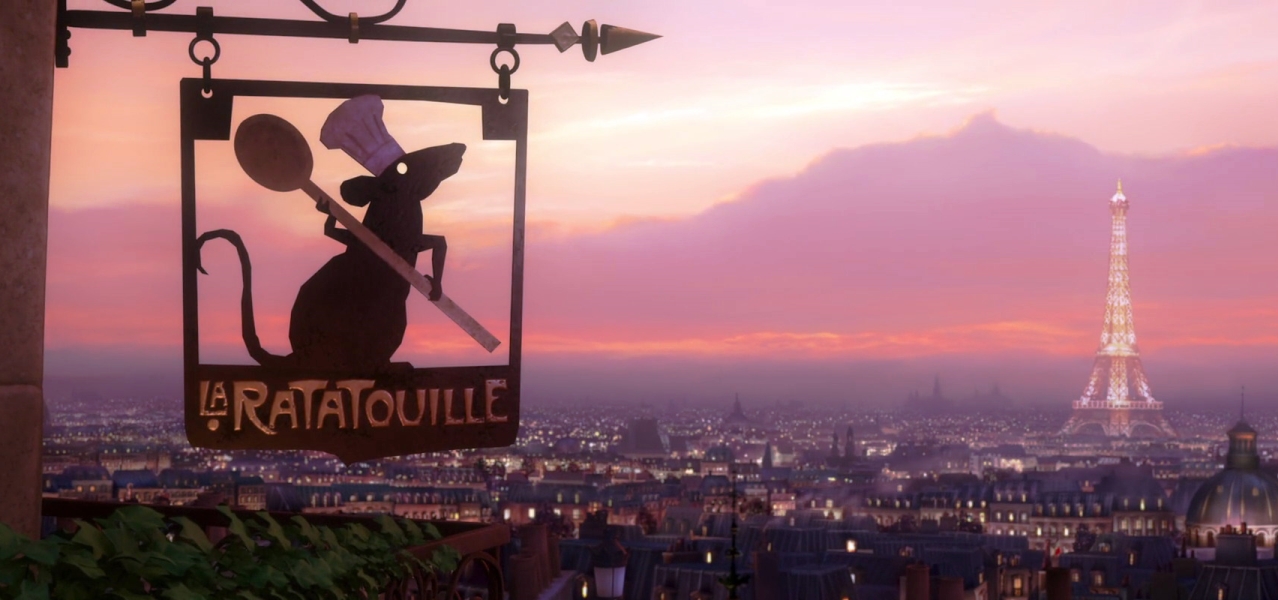
Bonjour! Let’s go ahead and treat ourselves to a second helping from the kitchens of Pixar - 2007’s cooking rat tail tale, Ratatouille. The strained food metaphors will now cease.

Tonight on Hell's Kitchen...

This film tells the story of Remy, a young rat who aspires to rise above the low habits of his fellow vermin. Gifted with a fine sense of smell, he one day discovers the joys to be had in combining flavors of different foods, and decides that he was born to be a chef. After becoming separated from his family and the rest of his colony underneath the city of Paris, Remy ends up in the kitchen of Gusteau’s Restaurant, originally opened by deceased Chef Auguste Gusteau (Remy's idol.) He is soon swept up into the world of fine dining, as he and a young human named Alfredo Linguini learn to work together to achieve Remy’s dreams of cuisine. The film has a strong and unique premise, although much of its second half becomes bogged down with subplots involving a love story, a crooked head chef and a villainous restaurant critic.

That ... is absolutely fucking disgusting. Where's the lamb sauce!?

During sequences where Remy observes and practices the culinary arts, the movie soars. Ratatouille is one of the best representations on film of the high that can be experienced when one enjoys or produces true works of art. The process of discovery by which the little rat realizes that he can not only appreciate, but actually create wonderful food, feels very genuine. His continuing enthusiasm for new culinary discoveries is palpable; one actually senses the passion that great chefs (both professional and amateur) feel while working in the kitchen. The film also educates audiences on how a working kitchen operates, including the different kinds of cooks that work together to make it run like a well-oiled machine. Remy himself is a wonderfully likeable character to experience this through, with actor and comedian Patton Oswalt imbuing the lovable rat with an easy warmth. Through Oswalt’s performance, we feel not only the joys of cooking, but also the pitfalls of being a rat in a human world.

You need to communicate! Work together as a team! Donkeys!

As noted in my review of Cars, Pixar has always had a knack for selecting the perfect voice actor for each of their roles, even when their choices seem odd at first. Besides Oswalt, Ratatouille is full of familiar names delivering surprisingly suitable vocals. Ian Holm, who excels at playing short and ineffectual authority figures (and Hobbits,) seems to be having a ball playing the dastardly diminutive Chef Skinner, ranting and raving about the supposed conspiracies at work to bring down his frozen-food empire. An unrecognizable Janeane Garofalo plays chef Colette Tatou, the tough-as-nails rôtisseur who mentors Linguini. And Peter O’Toole, as the vampiric restaurant critic Anton Ego, gets to do his nastiest snobby snarl, like Boris Karloff’s animated Grinch reincarnate. The genial O’Toole clearly relishes every despicable syllable he gets to slither over, creating an amusing, though wholly unlikable character. I know it’s just a cartoon, but when Ego verbally sucker-punches Gusteau’s amiable waiter (Pixar lucky-charm John Ratzenberger,) I felt my teeth clenching; if I were running that restaurant and a critic spoke to my staff like that, he’d get the ol’ fork-in-the-eye.

Can we get security and get this knob back to his seat, yes?

Who really doesn’t do it for me, though, is the main human character, Alfredo Linguini. Played by Pixar production animator Lou Romano, the hapless garbage-boy turned restaurant-owner is a gangling, clumsy buffoon who is supposed to be haplessly likeable. However, I find the character's constant lack of physical coordination and “lovable loser” shtick wears really thin, really fast. Beyond the fact that he doesn’t kill Remy, falls for Colette, and turns out to be the long-lost son of Chef Gusteau, what’s to like about him? In all of his scenes, even after we see his apartment and witness his drunken exchanges with Chef Skinner, we never learn anything more about Linguini beyond his ineptitude. Besides his clumsiness, he has ZERO personality. I imagine he was a fun character to animate, and I hold no ill-will toward Mr. Romano for his vocalization. I also realize that his appeal is supposed to be in his physical comedy, like an animated, modern-day Buster Keaton or Harold Lloyd; however those silent-film performances worked so well partly because they were silent. We therefore didn’t have to suffer through an unending stream of wordless exclamations as they fell about: “Whoah, whoah, whoah-hoaohohowhaooaahh …. Hey, wha-wooahh, I - wha-ha-heyyeyy a-whaa!” Ugh, just kill me now.

I've never, ever, ever, ever met someone I believe in as little as you.

Which brings me to another point of contention with Ratatouille: the whole gimmick of Remy controlling Linguini like a marionette is ridiculous. What the hell sort of miraculous physical abnormality would cause a human being’s entire musculature to be able to be manipulated through a few strands of hair? It’s hard enough to accept that Remy can somehow make the young man’s arms and hands move, but when we witness the rat able to make a sleeping Linguini rise and stand up, like some kind of malfunctioning Gundam suit, it throws all believability out the window. It’s a rather too convenient solution to the film’s central problem and, frankly, smells of lazy writing.
 
You useless sack of fucking yankee dankey doodle shite...

This central issue I speak of is one that everyone must dance around when discussing Ratatouille; it's why the film isn’t spoken of as often as Pixar’s other movies, and why reactions to the film vary wildly from love, to hate, to indifference. When you get right down to it, the movie’s about a rat in a kitchen. While we have Remy standing over a boiling pot of his culinary creations, or hear his voice-over narration discussing the wonders of food, the movie is sublime. But cut to long shots of him scurrying around the restaurant’s refrigerator, or worse, shots of whole swarms of rats running around a kitchen, and one’s skin instinctively begins to crawl. Make the rats as cute and anthropomorphic as you wish, there will always be certain “ick” factor involving vermin around food. While the issue of rat and human coexistence is a recurring theme in the film, it’s treated more like “story wallpaper” than a real challenge for the characters to overcome.
 
Oh my God, look at the state of this fucking place...

While critical praise for the film was near unanimous upon it’s initial release, in years since the film is usually only invoked by the general public when discussing the full Pixar canon, or when someone wants to play the “underrated” card. Director Brad Bird, who is apparently immune from criticism due to the cultish devotion around his 1999 film The Iron Giant, seems to have a habit of heading up films that are heavy with ideas and incident, but fall a bit short when trying to tie everything together (very much like 2004’s The Incredibles and his later Tomorrowland.) While the central premise and main character are a delight, I think Ratatouille could've turned out better if the filmmakers had just cut to the chase, as it's one of the few good Pixar movies that would benefit from some judicious editing. Perhaps a few less characters, or an excised subplot or two would’ve made the film a more streamlined and enjoyable affair.

Whether or not this would’ve helped to resolve the film’s gross central conceit will remain a topic of debate.

Now fuck off...
 

Saturday, April 22, 2017

TV Detour #1 - Disney's Animal Kingdom: The First Adventure

Jambo! Today we finish up Animal Adventures week by taking a detour into the world of Disney’s theme parks on television, and tune in for Disney’s Animal Kingdom: The First Adventure.


(Note for this and future reviews of television specials, the copies I watch and screen-cap are from YouTube; a link to the original video is provided in the special’s title, above)

Originally airing on April 26th, 1998, as part of ABC’s The Wonderful World Of Disney, this special highlights the newly-opened theme park, which debuted to the public on Earth Day of that year. It’s hosted by a pre-Price Is Right Drew Carey (frantically reading those cue-cards like a pro,) and features appearances by Jane Seymour, Paul Rodriguez, Sister-Sister’s Tia and Tamara Mowry, Smart Guy’s Tahj Mowry, Boy Meets World’s Will Friedle and Danielle Fishel, and famed primate expert Jane Goodall. The odd mixture of talent on display here personifies the confusing message that Disney continues to send about Animal Kingdom – is it a theme park, a wild animal park, or both? Disney seems forever hesitant to push too far in either direction when it comes to their fourth Florida-based park.

The tree is alive ... with the sound of music...

This dichotomy can be witnessed in the opening of this special, as the cast of the Broadway adaptation of The Lion King gathers around the park’s icon, the massive Tree of Life, to sing a stirring rendition of “The Circle of Life.” During the song’s brief bridge, an insert of Drew Carey, saying how excited he is to be there, is shoved in - complete with a frantic whip-pan past the park’s entrance which doesn’t mesh with the more sedate camera-work in the surrounding musical number. The longer I watched The First Adventure, the more convinced I became that Drew Carey was simply the wrong choice to host. His style of nervous-energy stand-up comedy seemed to clash with the serene image that Disney was pushing for Animal Kingdom. I think James Earl Jones would’ve been the perfect host, but there’s no ABC synergy to be had with that option.

Hey! What do Indians fans use for birth control? Their personalities!

In the following segment, we join Jane Seymour and her family as they ride the Kilimanjaro Safari attraction. I began to wonder if Seymour would’ve been a better choice to host - or at least narrate. Her primary role in this special, though, was playing the mother to her young sons, as they pointed out the various animals on view within the attraction. No doubt this was to show that small children could enjoy the park. Maybe she wouldn’t have been the best choice to host - perhaps I’m just fond of her voiceover work for Kay Jewelers?

A brief note about Kilimanjaro Safari: the attraction originally had a storyline attached to it during early previews, which involved catching elephant-killing poachers. Boy, Disney sure was fond of using poachers as go-to villains in the ‘90s; from A Far Off Place and Mighty Joe Young to this, where a portion of the ride would’ve passed by the (simulated) slaughtered remains of a poor mother elephant. Thankfully, someone came to their senses and ditched this idea prior to the attraction’s public debut.

The man of my dreams has almost faded now ... the one I have created in my mind...

After some more God-awful jokes from Carey, we are then treated to the Mowry siblings having a radical time in Dinoland, USA. Prior to the addition of the garish Chester & Hester’s Dino-Rama, there was little to see in Dinoland besides The Boneyard (a children’s play-area) and Countdown to Extinction (a time-traveling Indiana Jones Adventure clone that was later renamed Dinosaur – I guess "Countdown to Extinction" doesn’t make it clear enough that there are DINOSAURS on the ride.) Therefore little Tahj Mowry spouts off some dinosaur trivia, then runs around with a few kids, pretending to run away from a Tyrannosaurus in fast-motion. Now my ears may be deceiving me, but while Tia and Tamara are passing through the queue for Countdown To Extinction, I swear I heard one of the fake scientists refer to another as “Dr. Mantle.” Wow, a Dead Ringers shout-out in a theme park special!

Which twin wants to try the Mantle Retractor first?

Next is a blink-and-you’ll-miss-it preview of It’s Tough To Be A Bug with Paul Rodriguez - and why not? The strange thing about this segment is that the film on which the show is based, Pixar’s A Bug’s Life, is never once mentioned, nor are any characters​ from the film shown. According to Wikipedia, the attraction debuted a full seven months ahead of the film, but it’s still odd that Disney didn’t take the opportunity for additional pre-release cross-promotion.

Don't stare at me, you got them bug-eyes...

This is followed by a clear bit of ad-libbing by Drew Carey, where he comments to a Cast Member (or “employee” in non-Disney talk) that one of their massive turkey leg snacks looks like dinosaur meat. The cast member could care less, and repeats to him that it’s a turkey leg. This awkwardness resurfaces later as Carey is shown riding the Kilimanjaro Safari attraction with a Ghanaian tour guide, who obligingly smiles and nods during his barrage of dumb jokes. The fact that they show the Safari attraction twice in 43 minutes should give you an idea of how few attractions the park opened with.

Grin and bear it...

Following a short performance by a troupe of African dancers (in what may be the most entertaining portion of the show,) the Gorilla Falls Exploration Trail is previewed. It’s also given a glowing recommendation as a suitable primate sanctuary by Jane Goodall. Moments like this, wherein Goodall points out the importance of conservation, are the ones that work best in this special, highlighting what makes Animal Kingdom unique from its Orlando-area brethren. The approval of such an important and respected voice as Goodall really goes a long way to help sell the concept and validity of the park.

Gorilla my dreams...

After this, with time running out, they cram in a segment with Will Friedle and Danielle Fishel on a whirlwind tour of Gorilla Falls, the child-friendly Conservation Station, and long-running bird show Flights of Wonder. That they bothered to preview Flights of Wonder is interesting, as it was the sole attraction representing the Asia section of the park. The deforestation-themed Kali River Rapids and tiger-occupied Maharajah Jungle Trek were still a year away, and E-ticket attraction Expedition Everest wouldn’t bow until 2006. The segment is memorable, however, as we get to see Friedle interact with some beautiful toucans, parrots and cranes.

No condors, unfortunately. Back in the car, Crawford...

The show closes with a performance by Kimberly Scott, singing the song “We Are One” from the yet-to-be-released Lion King 2: Simba’s Pride (so Disney is OK cross-promoting here – then why no Bug’s Life?), bookending the special with a pair of Lion King songs. Just as it does to this day, Animal Kingdom relied heavily on the popularity of The Lion King, with its Simba-centric shows, merchandise and music. After this, the special concludes on a solemn and powerful note, as Jane Goodall speaks to viewers about the wonders and importance of all creatures, great and small – and of humanity’s symbiotic relationship with nature. A perfect, respectful moment to end with.

And then Carey comes back with a half-assed sign off: “Well, I hope y’had as much fun in the Animal Kingdom as I did – g’night.” For fuck's sake...

Oh well. Happy Earth Day, everyone!


Friday, April 7, 2017

Cars

I suppose it's about time I got around to reviewing one of the movies created by the fine people at Pixar Animation Studios - and there's no better place to begin than with everyone's favorite, Cars!

Air McQueen

What's that you say? 2006's Cars isn't the best or most popular Pixar film? The heck you say!

Perusing the inter-webs, there seems to be a loose consensus (but no mandate, by any stretch) that many find the film to be too predictable, with a pedestrian storyline and broad characters. These are charges that I don't necessarily disagree with, but the other leading theory behind Cars' unpopularity is the blandness of its central gimmick, that of a world inhabited exclusively by living vehicles. To this I proclaim "CHALLENGE!" I would argue that, up until the point of Cars' release, all of Pixar's films were possessing of central gimmicks that were of questionable originality.
  • Living toys? Seen that in cartoons and TV shows plenty of times.
  • Intelligent bugs? Yawn.
  • Monsters scared of children? Big deal.
  • Talking fish? Is that even a gimmick?
  • A family of superheroes? Comics had been doing that for decades.
But the secret of Pixar's popularity was never its gimmicks (besides, perhaps, the fact that Toy Story was the first entirely computer-animated film,) but in the execution. People love the Toy Story franchise because of its clever writing and sharply-drawn characters, not because it's about toys coming to life; the gimmick is a source for gags, not heart.

Get to da choppa!!

And that seems to be where many people find Cars comes up short: with the all-important "charm factor" (an especially essential part of the film-going experience when discussing Disney.) Though I don't dislike the film, I do sense that at some point the filmmakers let themselves coast on automotive-themed gags and puns, more so than in most of their other movies. I also think, however, that a lot of displeasure with the film may simply come down to taste. Many viewers simply never warmed up to Lightning McQueen and Mater like they did to Woody and Buzz, or Marlin and Dory (although I'll never understand anyone who prefers A Bug's Life to Cars - especially considering that fact that these "cars" may actually be highly-evolved bugs anyway - but I digress.)


Ha ha, get it?

Something that I've always admired about Cars is the way it builds its world. I'm not talking about the humanity-free version of Earth the film exists within, but the town of Radiator Springs. Once McQueen (voiced by Owen Wilson) reaches this central setting, the whole thing seems to click. Each of the oddball residents of "the cutest little town in Carburetor County" reveals a different aspect of the town itself. There's the slightly-unhinged old-timer who nevertheless retains knowledge of the town's past (Katherine Helmond's Lizzie,) the hospitably simple blue-collar worker (Larry The Cable Guy's Mater, a character who retroactively gives the comedian a reason to be a thing,) the town's military nut and its anti-establishment hippie (Paul Dooley's Sarge and George Carlin's Fillmore, respectively) who still manage to get along despite their clashing ideologies, and the immigrants running their business with a passion that outweighs their profits (Tony Shalhoub and Guido Quaroni as Luigi and Guido,) to name a few.

Round up the usual suspects

Dare I suggest that Radiator Springs could represent some sort of American microcosm?

It's possible, as Cars tells a story that is very much rooted in the American southwest. Radiator Springs, a singularly unique creation in the Pixar canon, is itself an amalgamation of a hundred different roadside towns that have gone to dust after decades of neglect and isolation. The fact that this "town of crazies" may actually exist somewhere along the remnants of Route 66 (as flesh-and-blood humans, of course) is an idea that is alien to many film-goers, both worldwide and in the United States.

The truth is out there...

Herein, I believe, lies the misunderstanding that Cars has with its audience: the big beating heart of the film is not the story of Lightning McQueen finding love and peace in a small town (an old idea lifted form 1991's Doc Hollywood, among others,) but in the story of Radiator Springs and it's forgotten souls, left stranded out in the middle of a nowhere created by progress (represented by the interstate system.) That those who haven't packed-up and left town have instead stayed and remained hopeful is the real heroism on display, not in the frenetic racing scenes. This story is explicitly spelled-out in the "Our Town" sequence, and the fact that it's presented in a song-montage relatively late in the film makes me wonder if many viewers take this entire plot as mere window-dressing, a backdrop for McQueen's story to unfold in front of. This is a presumption that gets everything as ass-backwards as Mater's rear-view driving; it's actually McQueen's simple morality-play that leads to the bigger story as the film plays out.

Desolation row

When all is said and done, the years seem to have been good to the film: Pixar has gone on to make many better and many worse films. Despite one of those cinematic turds being the films' own sequel, the franchise lives on through its popularity with children, racing enthusiasts, and the success of an astonishingly-realized themed land at Disney California Adventure. One can hope that future installments take into account that the true heart of the matter lies not under the hood, but out on The Mother Road.