Showing posts with label 2010s. Show all posts

Sunday, August 6, 2017

Frozen

Sometimes, a piece of popular art hits a certain chord that resonates with a generation of fans, and a phenomenon is born. As much as companies try to plan and manipulate consumers into spending their hard earned time and money on their products - be they movies, cars, TV shows or whatever - pinpointing what will be a success is never certain. And while a film does not necessarily have to be a well-made product in order to be successful (four Transformers sequels have been shat out, after all,) it helps when the production goes beyond the necessities of it’s intended audience in the marketplace. A popular film becomes a classic when it rewards attentive audiences with deeper themes, making them think and discover new ideas with repeated viewings. In this spirit, let’s take a look at Disney’s runaway success from 2013, Frozen.

Sisters are doin' it for themselves

Hans Christian Andersen’s 1844 fairy tale The Snow Queen had been a long-time thorn in the side of Disney. In the months before Snow White And The Seven Dwarfs was released in 1937, the studio had been in talks with MGM to partner together on a hybrid live-action/animated film about the Danish author, with Walt’s boys providing animated segments dramatizing such stories as The Little Match Girl, The Steadfast Tin Soldier, The Little Mermaid, Thumbelina and The Snow Queen. The animators, however, had great difficulty adapting The Snow Queen for a modern audience. Once WWII hit, and the studio was forced to tighten it’s belt (noted in prior reviews,) causing the deal with MGM to fall apart and the abandonment of the project. MGM would go on to produce an entirely live-action biopic starring Danny Kaye in 1952, which was met with great critical and financial success (I’m personally not a fan of that film - but we’ll be seeing Kaye around these parts in October.) Disney would hold on to the concept art prepared for these stories, many of which would eventually see the light of day as animated adaptations many decades later.

Imagineering briefly toyed with the idea of a Snow Queen attraction at Disneyland.
"Enchanted Snow Palace" concept art by Marc Davis, c. mid-1970s

Further attempts were made in the late 1990s and early 2000s to adapt Andersen’s story, including a pitch by actor Harvey Fierstein(!), a pass by animator Glen Keane (who would give up and move on to an adaptation of Rapunzel instead,) and a push by Michael Eisner to get a Taming of the Shrew-like romantic comedy version out before 2007. Despite these aborted attempts, the cinematic potential of the tale of a queen who could control winter was just too great to pass up. Work began again in 2010, with director Chris Buck determined to make the concept work. It wasn’t until the following year (and after the successful release of Glen Keane’s Rapunzel adaptation, Tangled) that the project finally began to gel, following chief creative officer (and Pixar king) John Lasseter’s suggestion that the film’s main characters, Anna (based on the original tale’s character, Gerda) and Elsa (the titular Snow Queen) could be sisters. From there, despite numerous further difficulties and re-writes up to and throughout the film’s production (screenwriter and eventual co-director Jennifer Lee, for instance, wasn't brought in to write the screenplay until she'd completed the previous years' Wreck-It-Ralph,) the creative juices were flowing, and all the pieces truly began falling into place.

My Frozen commemorative plates are here!

The long and difficult journey was, for the Walt Disney Corporation, most assuredly worth it. Within months of the film’s release, planet Earth rapidly became over-over-saturated with Frozen. Hell, as the father of a 2-year-old this is something that I know first-hand: I’ve played the soundtrack in the car so many times that I could regale you with a full song-and-dance re-enactment right now, complete with grandiose vocal inflections and sassy hand gestures (go on - dare me!) In a very short time the film’s overwhelming financial success and subsequent cultural saturation forced a typically under-prepared Disney to scramble and push their Elsa-gowned cash-cow as quickly as possible. Little girls demanding Elsa dolls? Fast-track them into Target stores and add on spring-loaded “icy magic” action (yes, this is a thing; Elsa chucks plastic ninja-star-like snowflakes at your unsuspecting cat!) Kids want to see Anna and Elsa at Disney World? Let’s rip Maelstrom out of EPCOT’s culture-centric Norway Pavilion and replace it with a ride based on a fairy tale! A quick trip around your local supermarket will surely leave you marking several Frozen-themed items off your grocery list: Frozen frosted cereal, Frozen-themed Campbell’s soup, Cheez-It’s with Sven the reindeer on the box, Ziploc sandwich bags with Olaf plastered on each one. Frozen the t-shirt! Frozen the coloring book! Frozen the lunchbox! Frozen the towel! Frozen the flamethrower! With so much Frozen being crammed down our throats, it can be so very easy to resent the film that spawned it all.

And yet ... I can’t. It’s too damn good.

I’ll admit, when I first saw the film (at the theater, no less,) I walked away less than impressed. I mean, it was okay; the animation was very good, that Adele Dazeem (or Idina Menzel, or whatever her name was) could certainly sing, and the talking snowman was slightly less annoying than I’d feared. A lot of my initial issues, I later realized, may have stemmed from the fact that - having just turned 30 - I was apparently already lapsing into old-fart fuddy duddyness. Why, I wondered, did half the characters talk so … modern? Back in my day you wouldn’t have had Belle singing “don’t know if I’m elated or gassy, but I’m somewhere in that zone,” or have Aladdin referring to Jasmine as “feisty-pants” (despite the fact that her pants were actually pretty fierce.) Damn kids and their jive talk! I came to wonder, though, if it was just as likely that some older fans felt the same way about the films I grew up enjoying at their time of release; imagine growing up with Pinocchio and then wandering into the manic humor found in something like The Lion King (or - heaven forbid - Hercules.) Besides, the occasional slang thrown out by characters in these movies is merely window-dressing, a shorthand to get younger viewers on-board more quickly and follow along with the story. Like all entertainment, these productions reflect the time of their release more than anything else; if Disney’s characters were portrayed strictly in accordance with the periods in which their films are set, not only would Gaston have been boasting in French, but Sleeping Beauty would’ve resembled Game of Thrones more than a flashy ‘50s musical. But I digress …

Hey girl...

While not as rewarding upon first viewing as, say, 2010’s Tangled, Frozen is one of those very rare family films that improves with repeated viewings. It’s first impression may leave some viewers feeling somewhat let down, just as I was - it is a fast-paced (though never manic) movie, and despite packing a lot of incident into the narrative, it tells a deceptively straightforward story. However, I eventually came to see that Frozen has a lot of emotional and psychological depth hiding beneath its’ fairy tale veneer, presenting much food for thought without providing easy answers. This is why I feel it’s connected with so many filmgoers, beyond the multitude of children who enjoy the film for it’s fun sense of humor and exciting adventure. For the first time in forever a long time (since at least Beauty And The Beast,) a Disney movie had some real subtext.

Automatic, systematic - full of color self contained...

For example, for a long time I believed that Anna (voiced by Kristen Bell) was a one-note character, defined by her clumsy immaturity. Her entire character arc (not a phrase I'm really a fan of, by the way) sees her going from a naive youth to a more mature young woman who's eventually able to help her sister come to terms with their strained relationship. The fact that Elsa (and, by extension, the screenwriters) tells her how ridiculous it would be to marry someone you just met (the deceptive Prince Hans, voiced by Crazy Ex-Girlfriend’s Santino Fontana) didn’t seem as big a deal (or as “meta”) to me as it did to many viewers. Her eventual love story with Kristoff (voiced Jonathan Groff) seemed to indicate that the movie wasn’t quite as progressive as some claimed. With further viewings, I realized that what Anna learned over the course of the film wasn’t necessarily (or simply) that “true love” was not something that happens on first sight, but that love itself is something one must be an active participant in. “True love” is real, but it doesn’t just happen to you. Anna always loved her sister, but showed it through her actions throughout the story - by the fact that she went after Elsa immediately following her flight from Arendelle, without hesitation. Her sacrifice during the climax was merely the noble cherry atop her already piled-high sundae of love (good lord, that’s an awful metaphor.)

You mad bro?

On a side-note: the love story between Anna and Kristoff, while clearly meant to contrast with the “falling for a handsome Prince” cliché earlier in the film, is spoiled for me by interference from the trolls. Already frustrating insomuch as their leader, Grand Pabbie (voiced by Ciarán Hinds) only speaks in riddles regarding Elsa’s powers (would it be so hard to say “a healthy emotional lifestyle will control your powers," or is he just pulling advice out of his mossy ass?), the goofy “Fixer-Upper” musical number ruins any subtle momentum the love subplot had been building up to that point. It’s as if the filmmakers didn’t trust the audience to see that Anna and Kristoff were developing a relationship over the course of their adventure, and had to shout out “Hey kids! The Princess and the big blonde lug are falling in love! Wouldn’t it be great if they got married later!?” - more or less cancelling out the whole point of the comparison to Hans’ proposal. Plus, since their love story is really of secondary importance to Anna and Elsa’s relationship, dedicating a whole musical number to it seems like an unnecessary waste of time.

Elsa's experiments with cake frosting go horribly awry...

The big issue that the film seems to present without comment, but is fairly obvious to anyone who views it more than once, is how awfully Anna and Elsa’s parents screwed them up. From the first few scenes - in which little Elsa’s cryokinetic magic (thanks Wikipedia!) accidentally strikes her sister, prompting her father to exclaim “Elsa! What have you done!? This is getting out of hand!” as he runs in the room - it’s clear that the King and Queen of Arendelle have no clear idea of how to properly reconcile their first daughter’s mental well-being with her unique gifts (though perhaps I should just accuse the King, as their mother doesn’t say more than two words; an indicator, perhaps, that the best answers don’t lie with the patriarchy?) Seeking advice from the trolls, not only do they agree to let Anna’s memories be altered (an honestly terrifying prospect, even when there's some inscrutable form of magic behind it,) but they take the warnings of Grand Pabbie - that Elsa’s growing powers have “great beauty … but also great danger,” and that she “must learn to control it” - in the worst possible way. Rather than working to help Elsa actually control her powers, they instead force her to suppress them, and keep them from manifesting by pushing Elsa to stifle her emotions completely. Not only that, but they essentially quarantine the already terrified child within the castle, and isolate themselves and both children from the rest of the world. Seems like massive overkill to me, and indicates that the parents are actually more frightened of their daughter’s power than she is. You can see on their faces, in a scene featuring a 12-year-old Elsa desperately crying out for help and comfort (“I’m scared! It’s getting stronger!”), that they may realize just how badly they’ve fucked up when she recoils in terror as they try to soothe her, spluttering “No! Don’t touch me! Please ... I don’t want to hurt you.”

O Lord, bless this thy hand grenade, that with it
thou mayst blow thine enemies to tiny bits, in thy mercy.

Elsa’s life, from an early age, is one of terrified isolation. Not only have her parents treated her like some fearsome monster, but they’ve also ensured that she shares a codependent relationship with them, as they’re presumably the only human contact she has (outside of some limited house staff, one assumes.) Contrast she and Anna’s farewells as the King and Queen leave on what would be their fatal sea voyage - Anna giving them warm hugs, chirping “See you in two weeks!”, Elsa bowing politely and asking “Do you have to go?”, her eyes and voice pleading. When news comes that the King and Queen are dead, Anna (who is seen at the commemorative service alone) is naturally sorrowful over the loss of her parents, pleading through Elsa’s door that “it’s just you and me - what are we gonna’ do?” Elsa, on the other hand, is utterly devastated, silently weeping alone, her unchecked (and unsupported) emotions causing a subzero blizzard within her bedroom. One wonders how she managed to get by at all in the three years separating her parents’ death and her coronation ceremony. The inevitable revelation of her powers and subsequent self-exile naturally leads to the show-stopping “Let It Go” number (still a fantastic song and powerful character piece, even after it’s been played and performed over 9,000 times,) in which Elsa’s sudden freedom brings unexpected joy. Her emotional emancipation therefore allows her powers to become focused and less chaotic than they were under her parent's forced restraint.

Now appearing at the Ice Palace - the fabulous Eileen Dover!

Much about Elsa is left open to interpretation, which actually helps make her the most memorable character in the film. We are never told exactly where Elsa’s powers originate from (her father tells the trolls that she was born with them, not cursed - which brings up a whole other set of interesting questions - like where, or whom, do such curses come from?), nor the extent of her abilities. We see that severe emotional outbursts can cause winter in the middle of summer across the kingdom - but how far this extends is a mystery. Could Elsa threaten a new ice age? Incredibly, Elsa powers also allow her to instantaneously create life, first in the snowman Olaf (voiced by Josh Gad,) and then in her hulking bodyguard, the ridiculously-nicknamed Marshmallow. The formation of these two beings is another window into Elsa’s psyche, as she creates the loveable Olaf (an imaginary playmate from happy childhood memories) during a moment of joyful exuberance, and the much larger and fearsome Marshmallow during a moment of anger and fear. It’s also interesting to note that the gentle Olaf was created unknowingly, the fact of his sentience coming as a surprise to Elsa (who looks at her own hands with muted awe after he’s revealed); Marshmallow, on the other hand, was spawned purposefully, fashioned to eject unwanted guests from Elsa’s fortress of solitude (Elsa backing away with her hands up after he appears, “washing her hands” of whatever the monster does to her sister and company.)

Don't talk to daddy before coffee...

Frozen’s refreshing ambiguity leads to a number of intriguing questions - and the unavoidable fan theories that follow. Much worthless internet space has been dedicated to the question of whether Anna has powers as well, specifically super strength. This can actually be borne out from the film itself, as Anna is seen to effortlessly fling a large bronze bust across a ballroom during the “For the First Time in Forever” sequence, and later when she sends a number of large Timberwolves flying after El-Kabonging them with Kristoff’s lute. Lastly, when Anna punches Hans in the face following the film’s climax, the strapping young Prince is literally sent flying through the air, off a ship and into the fjord below. Also never revealed in the film is whether or not Kristoff was an orphan, as surely some bother would’ve been raised in Arendelle after a local youth was kidnapped and raised by a well-meaning troll. My personal favorite theory is that the deceptive Prince Hans possesses icy-magic powers himself. It’s intrigued me from my first viewing that, like Elsa, Hans is seen to always wear a pair of snug-fitting gloves, making a point to take them off only once in the film when he's seen to snuff out a candle with his bare fingers, and then put out a large, roaring fire with a half-full pitcher of water. It’s a silly notion, I know, but why make it a point to show the whole glove thing at all? Especially since a point was made early in the film that Elsa depended on her gloves to keep her powers in check (more like a security blanket than an actual deterrent, I’m sure,) and to show her dramatically flinging them away as she accepts her powers during “Let It Go.” If Hans truly possesses such powers (which, again, I’m sure he’s not really meant to,) why keep them hidden? What nefarious plans did he have once he’d claimed the Arendelle throne? Oh well - maybe all will be revealed in the sequel?

Never, under any circumstances, pause a Disney movie...

Beyond the deeper undercurrents running below Frozen’s cinematic ice sheet (both intended and otherwise,) the film is a solidly entertaining adventure that’s obviously found a special place with a generation of moviegoers. The animation takes the technical advances made for Tangled and pushes them even further, the music serves the visuals well and (nearly) all the songs are memorable, and the vocal performances are all top notch (including a humorous turn by Alan Tudyk as the scheming Duke of Weselton - Tudyk quickly becoming the John Ratzenberger of Disney Animation.) Some have said that the runaway success of Frozen with girls and young women is akin to the sudden popularity of Star Wars back in 1977 - and the non-cynical side of me can certainly believe it when witnessing the faces of children (both boys and girls, I should point out) betraying their delight at spotting the films' characters at Disney’s theme parks.

Besides the filmmakers’ own commendable achievements and the movie’s undeniable worldwide popularity, I’ll always remember Frozen for as long as I live because it was the first movie my own little girl was a fan of. Her bright little eyes still light up at the sight of “Anna Elsa!” (as she calls the film’s royal sisters,) and she snuggles into the arms of either myself or my wife as we sit to all enjoy a great animated movie together.

That, dear readers, is real magic.

Sunday, May 14, 2017

Brave

Stories about mothers and daughters are rare in popular cinema, and nearly unheard of in Disney's animated canon. Daughters with missing or deceased mothers seem to be prevalent; think of Belle, Ariel, Jasmine or Pocahontas. Likewise there are those who are orphaned completely, like Penny from The Rescuers or the Frozen sisters. There are a few examples of full families in Disney's films, such as Moana’s mother and father, and Aurora’s largely absent parents in Sleeping Beauty (though honestly her mother registers as such a non-entity that her voice-actor isn’t even credited.) When one thinks of “Disney mothers,” the popular notion that springs to mind is that of the “evil stepmother,” which has been a recurring theme in the animated canon from the very start (Snow White’s Queen, Cinderella’s stepmother, all the way to Rapunzel’s Gothel.) Off the top of my head, the only healthy relationship between a mother and daughter that comes to mind is the one between Tiana and her mother in The Princess And The Frog - yet even then Tiana spends more time working toward her restaurateur dream in service of her deceased father’s memory than anything else.

By the way, I’m not discounting Lilo and Nani’s relationship in Lilo & Stitch, although they’re technically sisters - and their relationship requires the intervention of a psychotic alien experiment who eats his own boogers.

Not surprisingly, it would fall on Pixar to produce Disney’s first full story of a daughter and mother coming together - 2012’s Brave. In doing so, Pixar’s filmmakers took their first leap into fairytale storytelling, and made what may be their most “Disney-like” film to date.

Merida, please hear my cry - and let your arrow fly...

Brave tells the story of headstrong teenager Merida (voiced by Kelly Macdonald,) daughter to Medieval Scottish King Fergus (the ever-crazed Billy Connolly) and Queen Elinor (Emma Thompson.) From a young age, Merida has been in possession of a fiercely independent streak; in her spare time, Merida rides her horse around the Highlands, climbing cliffs and perfecting her archery skills. Her mother, Elinor, is the very picture of the perfectly poised Queen, a graceful and regal counterpart to the gruff and boisterous King. Elinor has been prepping Merida for her eventual role as Queen from a young age, and the years of training and royal restrictions have created a friction between the two. Following the announcement of Merida’s pending betrothal to a son of one of her father’s allies (and her subsequent refusal to participate in the tradition,) the pair’s relationship strains to a breaking point. From here, the story veers off into fantasy, as Merida encounters a witch (voiced by Harry Potter franchise stalwart Julie Walters) who provides her with an enchanted cake that will supposedly change her fate. Believing her fate to be in the hands of her stubborn mother, Merida gives the cake to Elinor - who is promptly transformed into a bear.

Magic mirror in my hand, who's t - OH SHIT A BEAR!!

I recall being somewhat blindsided by Elinor’s transformation upon first viewing this film. Already the advertising for Brave focused heavily on the action/adventure elements of the film, so when the film turned out to be about the relationship between Merida and Elinor it was already a surprise. The magical metamorphosis and resulting “my mother the bear” storyline seemed to come out of nowhere. Taking the film as a whole, though, it actually makes perfect sense. The prologue, in which we first encounter the royal family celebrating young Merida’s birthday, sets the stage for both Merida and Elinor’s relationship, as well as King Fergus’ ongoing vendetta against the ferocious bear Mor’du. The Mor’du plotline, and its associated ursine imagery, comes to overshadow much of the film that follows, even as Merida’s family issues are developed. Until Elinor is revealed to have been changed into a large black bear, it’s not clear how the two plotlines will converge. It’s an unusual solution to this problem of plotting, but a unique one to be sure.

Hey Merida - I think Rapunzel may be able to recommend a good detangler...

It seems strange that the two can only learn to communicate when one of them (Elinor) is unable to speak, being a bear and all. But it does force her to listen to her daughter’s point-of-view without being able to interrupt, and to witness some of Merida’s useful survival skills first-hand. Likewise, trying to interpret her mother’s grunts and growls helps Merida to better understand the core of Elinor’s feelings, unfettered by traditions and royal necessities. Proof of this can be seen in the relative ease by which Merida is able to interpret her mother's pantomime sign-language while delivering a speech to the clan leaders. To top it all off, there’s nothing better than a little “life or death” in a film to force two parties into mutual understanding; the dangerous encounters with a vengeful Mor’du see Elinor putting the bear beat-down on the brute in order to protect her offspring.

No jamborees in this bear country

When it becomes clear that Mor’du is actually an ancient king of Scottish legend, himself turned into a bear, the true connection between Elinor’s transformation and the rest of the film becomes clear - but it also raises a few questions. When we first encounter the slightly-unhinged witch, she is trying her hardest to disguise her magical powers. This, she claims, is due to problems with “too many unsatisfied customers.” This got me wondering: is this same witch responsible for the transformation of Mor’du? If not, is the mention of “unsatisfied customers” simply a humorous aside? It’s possible, as much of the witch’s scenes are played for laughs. It just seems odd that the same spell (or a very similar one) would’ve been performed by two separate enchantresses for seemingly different reasons. True, Merida surmises that Mor’du became a bear because, like herself, he wanted to “change his fate.” Perhaps there’s some Celtic witch glossary that translates “change your fate” exclusively to “become a bear?” Based on the manner of the witch we meet, it seems more likely that all she’s capable of doing is transforming people into bears; even in her wood-carving business she only seems capable of carving bear totems.

And Pizza Planet trucks...

Interestingly (if predictably,) the solution to Merida and Elinor’s problem is presented in the same prologue that sets up the source of their antagonism. When we first encounter the pair, they’re engaged in a game of hide-and-seek, and Elinor clearly loves her daughter very, very much. Just minutes later, King Fergus gifts Merida her very own bow, encouraging her adventurous nature. Elinor is apprehensive, bemoaning to the King “a bow, Fergus? She’s a lady …” From this point on, mother and daughter seem to naturally diverge in their views. However, besides the obvious need for the two of them to actually sit and listen to one another, the key to their peace can be seen as a matter of shedding all of the baggage that their lives have loaded them with and getting back to basics. Much like Merida’s diplomatic speech to the clans, in which she preaches the importance of remembering their bonds of trust and friendship; in the end what needed to be done was to “go back to the beginning,” and realize that they were still the little girl and young mother who loved nothing more than to spend time being together.

Hush me wee bairn, don't you cry ... Och! 

At Brave’s conclusion, the clans are at peace, and Merida and Elinor are once again enjoying each other’s company; they work together on a new tapestry, ride horses together, and Elinor has even begun to wear her hair down. When forced into mutual understanding, both ended up seeing the world differently, realizing that they were not each other’s enemies. Beyond its considerable technical achievements and action-packed story, Brave is at its heart a story about the deep connection between mothers and daughters. For this alone I feel the film deserves a place as a cherished modern fairy tale - whether made by Disney, Pixar, or anyone else.

Sometimes you eat the bear, sometimes the bear eats you

Friday, April 28, 2017

TRON: Legacy

Greetings yet again, programs! It’s time to squeeze back into your unitards and reboot The Grid, as we initiate a scan of 2010’s TRON: Legacy.

Anyone for some Frolf?

A long-gestating sequel to the 1982 original, TRON: Legacy was as unlikely a film to appear as anyone growing up in the ‘80s and ‘90s could’ve expected. As noted in my review of TRON, that film wasn’t exactly a jewel in Disney’s cinematic crown, and was just one of a string of less-than-successful films that helped lead to the ascension of a new management team. Yet the film slowly found its niche as a somewhat popular cult film, being continuously re-discovered by successive generations through television repeats, video and DVD. TRON also lead the charge in the rapid rise of computer graphics as the primary vehicle for cutting-edge movie effects - an interesting development, as the film was originally disqualified for Oscar consideration because of this (the Academy feeling that using computers was “cheating”.) Following the (financial!) success of George Lucas’ Star Wars prequels, however, it seemed that Hollywood became more interested than ever in resurrecting any old or dormant franchises that could pull in fan dollars. Yet even amidst the recent onslaught of sequels, prequels, reboots and shared cinematic universes, TRON still seemed like one of the unlikeliest candidates for a 21st century reimagining - especially one that continued the original storyline, rather than receiving a straight remake.

Not his daddy's Grid

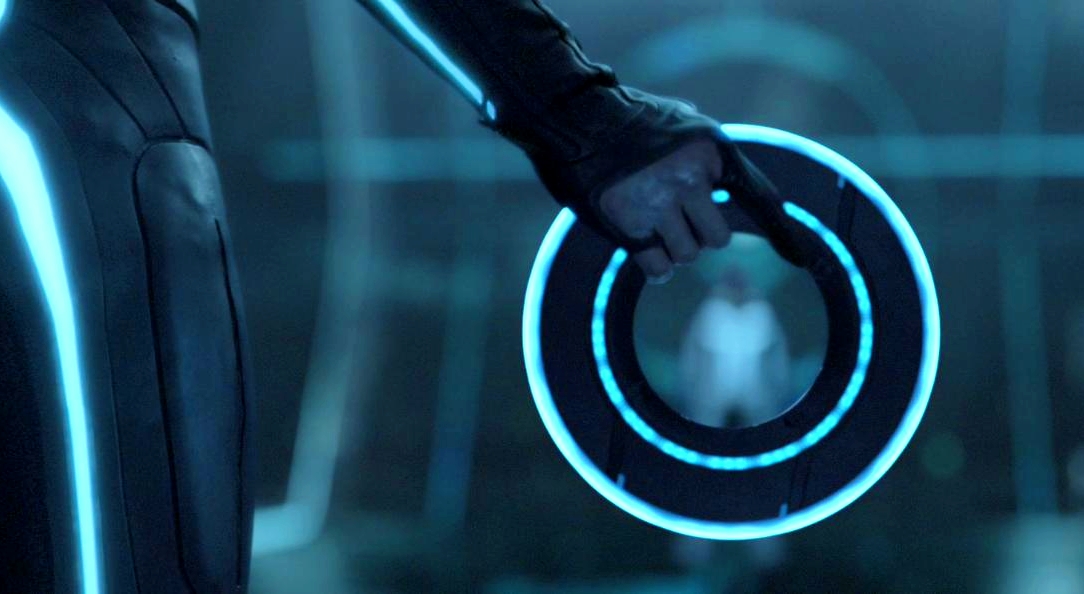
In many ways, though, TRON: Legacy does play like a reboot of the original. Much like Disney’s recent continuation of the Star Wars saga, The Force Awakens, the movie revisits and reinvents many of the same situations and story-beats as the original. As before, we have a protagonist that is sucked into a computer world, forced to fight in gladiatorial video-games, escapes, and joins a pair of video-warriors to take down a tyrannical Program. The fact that this film is "TRON for a new generation” is reinforced from the very start of the film, where the title is given simply as TRON - the full name not shown until the end credits. And while the entire design of The Grid is presented in a much more organic manner (like modern computer effects, trying to mimic reality,) much of the iconography remains recognizable from the original film’s designs. These include the Disc Wars and iconic Light Cycle games, the Recognizer and Solar Sailer transports, and the glowing costumes worn by the cast (achieved this time through physical effects, ironically enough.)

Born to be wild...

Besides the design-upgrades, TRON: Legacy continually dances a fine line between nostalgia and the necessities of contemporary cinema. Many of its most obvious callbacks come rapidly in the reality-set opening scenes of the film, including a flashback to young Sam Flynn’s childhood bedroom, stuffed to the rafters with a nerd's-paradise of TRON (and Black Hole!) figurines, read-along records and bedsheets. We also revisit Flynn’s Arcade, which blasts Journey music (their 1983 hit “Separate Ways” - AKA the best damn song ever) when the power is turned back on - a nice touch. We also get a look at a modern ENCOM corporation, seeming more like a dark version of Apple that employs the offspring of the original film’s villain, Ed Dillinger (played here by Cillian Murphy, in an uncredited cameo) - and the office still has “a big door.” Yet the intensity of the action scenes, the increased physicality of the cast, and the sometimes Matrix-esque cinematography helps to differentiate the film from its predecessor - as does less reliance on technobabble and “geek-speak” to explain itself.

You can't be worried about that shit. Life goes on, man.

Possibly the best example of TRON: Legacy’s past/present merging is in its soundtrack. French techno-mavens Daft Punk provide the adrenaline-pumping score, which one-ups the original film’s music in almost every way. Famed electronica artists and admitted TRON fans, this was the pair’s first (and thus far, only) soundtrack effort, and it’s clear that they studied a few recent film-scoring trends while preparing for the task. The film is full of bold blasts of brass, driving string rhythms and repetitive instrumental hooks, reminding one of Hans Zimmer’s Dark Knight scores. Like the original TRON, however, the duo works in plenty of electronic magic, melding the orchestral music with keyboard-infused melodies and digitized samples. Daft Punk even gets to do a bit of what they do best in a trio of songs accompanying scenes at the electronic “End Of Line” nightclub, in which they have a cameo as a pair of DJ Programs (supplying their own headgear, naturally.)

Take a look at me now...

The cast is a mix of old and new faces. Jeff Bridges returns as an aged Kevin Flynn, his decades trapped within The Grid having turned him from the brash young computer-whiz of the first film into a complicated and contemplative mentor figure. With his grey beard and Zen attitude, Bridges often comes across as a mix of Alec Guinness’ Obi-Wan Kenobi and the actor’s own “The Dude” Lebowski. Bridges also voices (and face-models) the film’s antagonist, the rogue Program CLU. Ever an evolving technology, the motion-capture effects used to bring a younger Jeff Bridges to life are … well … not quite there yet. The filmmakers' best efforts to present a mid-’80s Bridges amidst a cast of live actors never really overcomes the “uncanny valley” syndrome, and all believability falls apart as soon as CLU opens his mouth. Bruce Boxleitner, who’s matured into a gravelly-voiced silver fox, returns as Alan Bradley and also voices a CG-recreation of his TRON character.
 
 
You used to buzz me on my pager,
late night when you need my love...

Heading up the new cast is Garrett Hedlund, who portrays Flynn’s son, Sam. He gives a decent but understated performance, never really rising above the admittedly overwhelming special effects around him. Perhaps the filmmakers could’ve had Hedlund pull double-duty and portray CLU as well, avoiding the ropey CG work and adding a “good son/bad son” element to the story? Strangely, an awful lot of post-release praise has gone to British actor Michael Sheen, playing the duplicitous Program, Castor. The accolades afforded to his flamboyantly campy performance seem to point at a trend of applauding over-the-top acting within genre pictures, something I’ve noticed more and more since the late Heath Ledger’s brilliant performance in 2008’s The Dark Knight. While I’ve always enjoyed a good moustache-twirler, I personally find Sheen’s character really annoying.

Ziggy plaaaaaaayed guitaaaar...

For me, the standout in the cast is Olivia Wilde, playing the "isomorphic algorithm" Quorra, her wide eyes and asymmetrical haircut helping her stand out from a cast full of bland models. Beyond the look, Wilde’s Quorra is a more fascinating character than any other in the film; her seemingly endless desire for knowledge about the outside world brings a sense of childlike wonder that comes across beautifully in the performance. She also portrays her character as a focused fighter and survivalist, her dedicated energy livening up many effects-heavy action scenes. Though Quorra’s character doesn’t go through any major changes over the course of the story, she’s nonetheless fascinating to watch, jumping from wide-eyed dreamer to laser-focused warrior. Seeing her take in a real sunrise in the final scenes is perhaps the best ending one could imagine for both the character and the film itself.

Quorra v2.0, now with Velma Kelly mod

In a case of history repeating itself, TRON: Legacy was released to so-so reviews, praised for its stunning visuals but criticized for its thin plot - just as the original was in ‘82. Astoundingly, however, some critics compared the film unfavorably to the original, suddenly regarding TRON as an untouchable classic. Is this blind nostalgia at work, or sloppy criticism? Certainly TRON: Legacy isn’t the best film by any stretch - the plot is a predictable copy of the original, there’s too much exposition spread throughout the film, and there are some interesting ideas brought up that could’ve been explored further (the digital/organic Iso’s, for example.) In spite of this, there are many (myself included) that appreciate the film for what it is: a well-made modern action film that pays homage to the original. Then again, perhaps too much homage was paid, so that not enough time was spent developing its own identity? Maybe I enjoy the sequel so much because I love the original? I have to point out, however, that there are those - like my significant other - that enjoy this film immensely despite hating the original.


Tight ends only...

The film earned just over $400 million on a $170 million budget, but having put so much time and additional money on a multi-platform marketing blitz, Disney was underwhelmed by the films returns. Despite the greenlighting of a follow-up film in early 2015, and with director Joseph Kosinski and much of the cast ready to go (with a script nearing completion,) by late May Disney had changed its mind and halted any further work from moving forward. Since the company’s acquisitions of Marvel in 2009 and Lucasfilm in 2012 - and the massive financial successes that those brands have garnered - it seems less and less likely that Disney will be pushing ahead with any home-grown sci-fi franchises anytime soon. At least we lovers of the strange and wonderful world of TRON were allowed a brief moment to bask in the glow of the mainstream, and even got a pretty decent movie in the deal.


Wednesday, April 12, 2017

Tangled

Today let’s turn our attention to the movie that helped Disney reclaim its crown as the king of feature animation, 2010’s Tangled.

The girl in the high tower

Tangled was released at a point when I wasn’t really paying attention to Disney. Don’t get me wrong: I was still a fan, reading up on Disneyland and possessing a modest collection of DVDs – but wasn't nearly as into their slate of films as I am now. Following the frankly awful back-to-back releases of Home On The Range and Chicken Little (maybe my opinions will change upon review?) I had basically written Disney animation off; they were doing CG movies now, chasing the successes of other studios and creating mere kiddie-fluff (once an animation studio adds dancing characters to their end credits, they’re dead to me.)  At least I still had Pixar to scratch that animation itch. Heck, I didn’t even realize until later that Disney’s computer-animated output was considered part of their “official animated canon.”

And then Tangled came out – and it looked, for all intents and purposes, like a classic Disney film. My eventual viewing of the movie only solidified this impression.

While I don't think that Disney animation should only be about adapting fairy tales – some of their best works aren’t based on fables – but when the studio is in need of refocusing itself, they do it best by revising an old-world fairy story, just as they did with The Little Mermaid in 1989. The tricky part about doing what Disney does best is striking the right balance between the classic and the contemporary, and here is where they had faltered so often in the decade prior to Tangled’s release. Too often an animated film can become overloaded with painful attempts to be hip and current – especially prevalent in the era of CG, as movies can be produced more quickly than with hand-drawn animation, and therefore pounce on current trends (see the aforementioned Chicken Little, or just about anything from Universal.) On the other hand, when they rely too heavily on charming old stories and playing it safe with “what always worked before,” they run the risk of not connecting with their audience, and pushing out a boring film (2009'sThe Princess And The Frog steers awfully close to this pitfall.) With Tangled, and most of the films produced after, Disney seems to be striking the right balance for today’s audiences.

Permanecer sentados, por favor

There are two big factors that make Tangled work so well, and one is the animation itself. Disney finally started to pull away from its CG-animation peers when it began to mimic its own hand-drawn style. Up until this point, the world of computer animation had followed the dictum of art following technology, to a certain degree. Look back at something like 2001's Shrek (no, the actual Shrek) and you will see characters and environments that follow real-world physics - in others words, characters that move more like filmed actors than cartoon characters. The best animators were able to get around this with different methods: Pixar chose its subjects to fit the animation (films about living toys, bugs or fish,) DreamWorks focused on fluid and dynamic motion, etc. Look again at Chicken Little, or Meet The Robinsons: the character designs are whimsical and cartoon-like, but their action (though frenetic) is still stiff and basically realistic.

For the ladies...

What was missing was the old “squash and stretch” rule, the foremost of the so-called 12 Basic Principles of Animation defined by Ollie Johnston and Frank Thomas (two of Walt’s “nine old men”) in their indispensable book, 1981's The Illusion of Life: Disney Animation. Once the technology at Disney's disposal was able to adapt this and other principles into its animation, and pair it with backgrounds that weren’t trying to imitate reality, the difference was astounding. Suddenly the characters onscreen were alive and vibrant, bypassing the “uncanny valley” effect and becoming true personalities, not just animated figures.

Unfortunately you then get weird stuff like this...

While Tangled visually dazzles by looking back to Disney’s animated roots, the other big factor working in the film’s favor is one that looks forward: the characterization of Rapunzel. Voiced by actress and singer Mandy Moore, Rapunzel was the first Disney character in a long time that seems like a fully-formed individual. Sweet and naïve, the character is nevertheless driven in her dream to see and experience more than her captivity allows. This desire eventually overcomes her very real concern for her “mother” and captor, Gothel (a vampish Donna Murphy.) Once released from her tower - the only world she’s known - Rapunzel proves herself more than capable of taking care of herself. Her guide, Flynn Rider (an amusing Zachary Levi,) only earns her trust after they work together to survive a series of life-or-death exploits – and after receiving a few sound whackings with Rapunzel’s frying pan. The inevitable love story therefore feels as naturalistic as permitted by the fairy tale framework.

Welcome to the happiest restroom on earth!

Not to take anything away from the “independent females” of other modern Disney films (Belle, Jasmine and Esmerelda went a long way to help smash the patriarchy – and Mulan kicked serious ass,) but Rapunzel’s independent spirit and, more importantly, her fluid temperament was like a breath of fresh air. It’s one thing to call a female character independent and push ahead with one or two defining characteristics (Belle is an outsider who reads, Jasmine doesn’t want an arranged marriage, etc.,) it’s another matter entirely to completely flesh them out with a world view and emotions that they struggle with throughout the story. See the way Rapunzel’s decision to leave with Flynn weighs so heavily upon her, and she continues to feel remnants of devotion to Gothel even after she’s revealed to be a villainous kidnapper. Rapunzel’s feelings about herself, her world and those she encounters continue to grow and evolve as the story moves along - not just the usual “first she thought A and then B happened to make her feel C.” That Rapunzel was quickly entered into the “Disney Princess” pantheon sent a message to both critics and defenders of the franchise (those who bother to pay attention, anyway) – the bar for princess-loving young girls to aspire to was to be set higher in the future.

Weaponized symbol of oppression FTW!

I could continue to sing the praises of Tangled, but nothing can express how well it works better than actually settling in to watch it. I also don’t want to give an inflated impression – the film is far from perfect. Despite the strong characters, the story is predictable. The big quarry-set action sequence in the middle of the film is an obvious and over-long set piece. And despite Murphy’s strong vocal performance, Disney “nasty woman” Gothel still falls short of being a truly memorable villain (a problem Disney continues to face in the 21st century.)

Pascal: bringer of death

In the works for decades and costing a whopping $260 million to produce (and earning an even-whoppinger $591 million,) Tangled has quickly secured itself as a modern classic, setting the stage for even greater successes and impressive feminine heroes to be showcased in coming years. Bravo.

Two thumbs up...