Showing posts with label 1990s. Show all posts

Friday, June 29, 2018

TV Detour #6 - Herbie's Adventures in Television

When we last saw Herbie - the plucky little Volkswagen with a mind of his own - he’d been run ragged and stunk of rotten fruit following the release of the embarrassingly awful “comedy,” Herbie Goes Bananas. By the dawn of the 1980s, the franchise had clearly been run without a tune-up for too long. Much like the once-sprightly “love bug” himself, the series was in need of a rest before returning to the silver screen. Rather than letting Herbie drive off into the sunset of nostalgia, however, Disney would put their vehicular mascot to work on the small screen; Herbie would therefore be called upon to front a pair of television productions aired some 15 years apart. So before Herbie takes his final lap, let’s take a look at his adventures in television.


Groovy...

Herbie’s first foray into television, as we’ve discussed previously, came back in 1971 when he was featured in The Grand Opening of Walt Disney World TV special. Appearing alongside his Love Bug co-star Buddy Hackett, the duo faced off against a handful of genuine race car drivers at the Magic Kingdom’s Grand Prix Raceway attraction. This infamous bit is memorable for seeing Hackett use a giant wind-up key to start Herbie - because apparently nobody associated with that program had ever seen The Love Bug (or seemed to know what the hell was going on in general.)

'Memba TV Guide?

Herbie’s big break into broadcast TV would come a decade later, in the form of a full-on TV series. Herbie, The Love Bug was a mid-season replacement which ran on the CBS network for 5 episodes in March and April of 1982. Starring Dean Jones as Herbie’s on-again/off-again friend and driver, Jim Douglas, the show followed the retired racing star as he meets and becomes engaged to divorcée and mother-of-three Susan MacLane (played by Patricia Harty) - with a little help from Herbie, of course. Attempting to sabotage the couple’s courtship is Susan’s jealous ex-fiancé, Randy, played with ineffectual bluster by M*A*S*H’s Larry Linville. The cast is rounded out by Richard Paul as the prerequisite goofy mechanic pal, Bo (sort of a low-rent substitute for both Hackett and Don Knotts), and Susan’s three kids: oldest daughter Julie (a pre-Back to the Future Claudia Wells,) middle son Matthew (Nicky Katt) and edge-of-precocious Robbie (Douglas Emerson.) Actress Natalie Core also appears as the ex- fiancé’s mother, Mrs. Bigelow, so that we can get someone who says “Randy, why are you still obsessing over that woman?” in every episode.

Keeping up with the Joneses...

Though officially categorized as a sitcom, I have trouble describing the show as such, since it neither looks nor feels like contemporary sitcoms such as Taxi or Too Close For Comfort (why did I choose those two examples? Well, if you must know: Taxi has cars in it, and I freaking love Too Close For Comfort - so there.) Instead, Herbie, The Love Bug fits into that particular sub-genre that viewers (and reviewers) can’t seem to decide should be dubbed “comedy-drama” or simply “hour-long comedy.” Herbie, in fact, seems to be better bed-fellows with such contemporaneous programs as The Love Boat and Fantasy Island - or such current quirky favorites as Jane the Virgin and Crazy Ex-Girlfriend. While the show has plenty of wacky antics (mostly focused on Herbie consistently foiling Randy’s attempts at sabotage,) the show mostly revolves around Jim and Susan coming to terms with integrating their relationship into her family life. Closer to a light-hearted domestic drama than a knockabout comedy, coming into this show straight off the strained goofiness of Herbie Goes Bananas came as something of a respite for this blogger.

Fun fact: The jauntily corny theme song, entitled “Herbie, My Best Friend,” was actually performed by Dean Jones himself - presumably in character. Here it is, for your Summer listening pleasure:


The pilot episode - in which Jim and Susan meet after Herbie helps to foil a robbery at her bank - was helmed by veteran TV director Charles S. Dubin, and establishes the show’s premise and main cast well. The following four episodes find directing duties rotating between returning series director Vincent McEveety and Bill Bixby (best remembered as Dr. Banner in TV’s Incredible Hulk, but also a prolific director and producer.) Episodes 2 and 3 cover the troubled road to Jim and Susan’s wedding, which itself occurs in episode 4. The 5th episode almost seems out-of-place, detailing the day-to-day struggles of the newlyweds adjusting to married (and extended family) life. Perhaps this final installment was a window into what a continuing series would’ve looked like, had it been renewed?

Domesticated Herbie...

All episodes save for one (more on this in a moment) were written by Arthur Alsberg and Don Nelson, the sitcom-writing duo responsible for Herbie Goes to Monte Carlo. Alsberg and Nelson wisely ignore the events of Herbie Goes Bananas, establishing Jim and Herbie as ongoing friends and partners who set up a driving school following their retirement from racing. Their “Famous Driving School” seems to cater exclusively to kindly old ladies (a nod, perhaps, to Herbie Rides Again) - whom Herbie is able to assist when they fail to notice the occasional STOP sign or missed turn. Another main storyline focuses on Susan’s opposition to auto racing, since her first husband abandoned the family to become a racecar driver. Therefore the series ends up featuring only a couple of racing scenes. However, unlike previous film entries in which Herbie did not race, it makes sense within the established story. But despite this lack of racing scenes (and the fact that Herbie himself features less than most of the human cast,) Herbie, The Love Bug actually does feel like a continuation of the film series - certainly more so than the most recent sequel did.

Now cut that out!

While the show is an inoffensively pleasant, fairly breezy affair, I have to admit that the best episode by a long mile is episode 3. This installment heavily references the events of Herbie Goes to Monte Carlo, and features the return of Jim’s love interest from that film, Diane Darcy (played here by Andrea Howard, replacing Julie Sommars for some reason) - whom is invited to Jim’s bachelor party in an attempt by Randy to make Susan jealous. Oddly enough, despite extensively referencing the third film, as noted above this is the only episode that wasn’t penned by the writers of that movie; instead this episode was scribed by Herbie Goes Bananas screenwriter Don Tait. Despite the ire flung at him in my review for that movie, I must admit that his teleplay here - a somewhat wackier installment than the surrounding four episodes - entertains thoroughly. Perhaps more at home with writing for television, or working better within another writer’s framework, Tait’s work here - his very last screenplay, as of this writing - is fun and efficient in it's on-point comedy.

Herbie gets 'em to the church on time...

While the show’s brief run seemingly signaled the end of Herbie’s adventures, Disney wouldn’t let the little Bug disappear entirely. Besides keeping his memory alive through televised repeats and home video releases of his theatrical films, Herbie became a rare but consistent mainstay at Disney’s theme parks - but we’ll go into that in a future "Theme Park Rundown," of course. (No, we won’t.)

And then, fifteen years after the conclusion of his short-lived TV series, Herbie suddenly returned to the small screen in the form of a made-for-TV movie. Titled The Love Bug (usually referred to as The Love Bug ‘97 or “The TV Movie” to differentiate it from the 1968 original,) this rarely-seen Herbie adventure aired on ABC’s version of The Wonderful World of Disney on November 30, 1997. It was directed by Peyton Reed, who two years prior had overseen a Kirk Cameron-starring TV-remake of The Computer Wore Tennis Shoes, and would go on to direct Bring It On three years later (before taking the reigns of Marvel’s Ant-Man franchise starting in 2015.)

Okay, now a silly one you guys!

Hovering somewhere between a remake, reboot and continuation, the film sees Herbie worn-out but back on the racing circuit, under the drivership of an arrogant Scottish racer named Simon Moore III (played by John Hannah, familiar from the Mummy films and Starz’ Spartacus series.) After Moore dismissively gives Herbie up for scrap, he is rescued after being put into a “junk-car race.” There, small-time racer and mechanic Hank Cooper (the one-and-only Bruce Campbell) repairs and races Herbie, ending up the winner. One of the judges of the event is Alex Davis (Alexandra Wentworth) - an automotive magazine reporter and, naturally, Hank’s ex-girlfriend - so you can see where this is heading from the get-go.

By the way, as a fan of the Evil Dead series it came as quite a kick for me to see Bruce Campbell (“Ash” himself) appearing here - the first in a handful of appearances the quintessential B-movie star would make for Disney. Campbell is in “average Joe” mode here, however, playing a nondescript “vanilla” hero rather than the chainsaw-wielding badass familiar to the Fangoria set.

Good, bad - I'm the guy with the Bug...

Much of what occurs in this version of The Love Bug follows the original film (and it’s follow-ups to some degree): we have Herbie playing matchmaker to his driver and an initially reluctant love interest; an eccentric buddy (Kevin J. O'Connor as Roddy, a sculptor like Tennessee Steinmetz) whom early-on realizes the car’s sentience; a scene in which an emotional lead character realizes that Herbie has feelings; and a wacky climactic race. Really the only factor that doesn’t make this a remake is the mid-movie arrival of good ol’ Dean Jones as Jim Douglas, who arrives following Herbie’s destruction (SPOILERS!) to assist in rebuilding him. Jones, noticeably older by this point (the wide-shouldered business suits he wears here making his head look positively puny,) offers a few tidbits to the new characters about Herbie’s background, as well as the sole reference to the 1982 TV series to be found in any “Herbie” production, mentioning that Herbie helped him “meet his wife.” Jones also provides a brief narration at the start of he film, which significantly contextualizes Herbie’s rise to fame within the zeitgeist of the late ‘60s “love generation.”

What those familiar with the previous “Herbie” films may not see coming, however, is that this Love Bug goes somewhere unexpected and not entirely warranted: into an origin story. You see, once Herbie inevitably starts helping Hank win more races, a jealous Moore (slightly more crazy than most of Herbie’s previous nemeses) seeks to discover what makes the little VW Bug so special. He soon digs up one Dr. Gustav Stumpfel (Harold Gould,) the heretofore unheard of German scientist who, when tasked with creating a “people’s car” that would become the Volkswagen Beetle, inadvertently created a sentient “Love Bug” after a picture of his beloved wife accidentally fell into the vat of special metal he was brewing to make into the car. WHAA!?!

Mein Gott! Das auto!

This reveal is … odd, to put it one way. Ignoring the fact that the screenwriter (Ryan Rowe) chose to link Herbie's origin to a quasi-historical/fictional context (essentially making Herbie the progenitor of the entire VW Beetle "race",) it also shifts the core concept of the character. That Herbie, previously portrayed as a car that obtained consciousness through love, is now revealed to be the result of a “mad scientist” trope is fairly disappointing. This story reframes the image of Herbie as a byproduct of alchemy rather than a child of mysticism - a “happy accident” of human invention, rather than one bourne from pure thought. While the idea that Dr. Stumpfel’s love for his wife brought about emotional awareness within his creation is an interesting one, it somehow doesn’t quite fit in with the Herbie we’ve been witness to before (especially when he’s acted like a little thug several times before.)

She could tell right away that I was bad to the bone...

This brings us to the part of The Love Bug ‘97 that people seem to remember most: Horace, the Hate Bug. In the film the point of Moore’s uncovering of Dr. Stumpfel is to trick the eccentric old inventor into recreating his previous experiment, and then perverting said work by tossing a picture of himself into the “magic ingredients.” The resulting creation is a jet-black, souped-up Beetle that Moore dubs “Horace.” Unlike the gentle, child-like Herbie, Horace is a machine seething with rage and possessing an instinct to destroy (and even comes equipped with James Bond-style offensive weapons.) Another intriguing idea that gets rather bungled in the execution, the idea of a hate-filled “anti-Herbie” seems like a great addition to the franchise. Unfortunately, when framed within this film’s weird science theme, any idea of a “living car without a soul” ends up functioning more like a villain’s “super weapon” than it’s own character - frowning bumper or not. And the less said about Horace’s demise (in which he crashes through the ground, literally surrounded by flaming hellfire) the better.

Horace Goes to Hell!

Despite the presence of Dean Jones, a focus on auto racing and (admittedly superficial) discussions of love and hate, there’s something about this TV rehash that somehow feels … off. Not that it’s a bad movie by any means - while not great, it’s enjoyable and even has moments of genuine wit. It’s just that there are some small, niggling issues that really prevent it from fitting in with Herbie’s other adventures. This specific situation should sound familiar to older fans of the long-running English series Doctor Who (I’m going to go off on a bit of a tangent here, so my apologies.) That show, which ran uninterrupted from 1963 to 1989 (and began airing on PBS stations in the US in the mid ‘70s) was resurrected as a made-for-TV movie in 1996 as a co-production between the BBC and the FOX network. That movie (which in fandom is usually referred to as “The TV Movie” as well,) despite a number of call-backs and continuity references, looked and felt disconnected from it’s parent franchise - just like The Love Bug. For one, both “TV Movies” featured a returning cast member to lend some credence to their existence (Dean Jones in The Love Bug, “Seventh Doctor” Sylvester McCoy in Doctor Who,) as well as out-of-place quasi-celebrity cameos in bit-parts (comedian and MadTV performer Will Sasso as a morgue attendant in Doctor Who, ex-Monkee Micky Dolenz as a cigar-chomping car dealer in The Love Bug.) Both films also feature somewhat bland music; John Debney’s Doctor Who score sounds more like selections from FOX series Sliders, and Shirley Walker’s Love Bug score is forgotten almost as soon as it’s heard. This is a real shame, since Walker's work for modern classic Batman: The Animated Series featured some of the best music on television just a few years prior. At least Debney got to use the original Doctor Who theme, whereas George Bruns’ famous “Herbie Theme” is nowhere to be heard here.

Why do I bring up Doctor Who? Well, the similarities between these two attempts at reviving a long-running franchise is too great to ignore, especially since both came out within a year of one-another. Maybe I just wanted to write an entry that referenced The Evil Dead, Doctor Who and Batman? Incidentally, both “TV Movies” also ended up being dead-ends, as Herbie’s franchise would go dormant again thereafter, and Doctor Who failed to act as a “backdoor pilot” for a revived series. It would take both franchises a few more years to return to popular culture again, and would both stage successful returns in 2005. But more on that in the next entry...
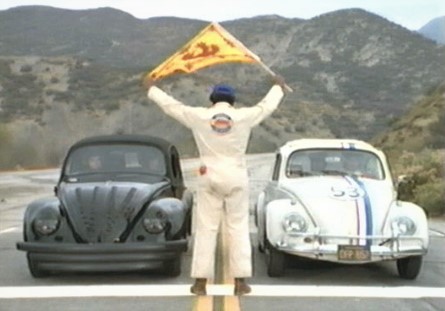
Two players. Two sides. One is light... one is dark.

As we’ve seen, Herbie may have gone through a few long periods of rest, but he never really went away. Though largely forgotten, Herbie’s adventures in television kept the little living car puttering around in the public consciousness, like a well-known acquaintance always hovering in the background. Disney, both under Ron Miller and later Michael Eisner, knew that they still had a popular character on their hands, and wouldn’t let the opportunity to use him slip by; they just needed a few small-screen pit-stops to ensure the little old car would be ready for his inevitable big-screen victory lap.

Friday, April 13, 2018

The Straight Story

One of the most surprising moments in Disney’s live-action canon comes from a gentle, G-rated film about an old man traveling across the American Midwest on a riding mower. The two credits which open the film, fading in and out of the screen in succession, state the following:

Walt Disney Pictures presents

A Film by David Lynch

WHAT!?! David Lynch did a Disney movie!? Am I dreaming or something!? But it’s true - there exists a family-friendly film released by Disney, made by the man who brought dancing, backwards-talking dwarfs to primetime television and provided Dennis Hopper with the immortal exclamation “Heineken!? Fuck that shit! Pabst Blue Ribbon!!!” While Lynch’s film was an independent production that wasn't filmed under Walt Disney Pictures’ supervision, it was still picked up for worldwide distribution by the “house of mouse” following a well-received showing at the 1999 Cannes Film Festival. Let’s take a look, then, at one of the oddest but most poetic films in Disney’s film library, 1999’s The Straight Story.

The Lawnmower Man

Lynch, the infamous filmmaker behind such disturbingly surreal masterworks as Eraserhead (1977), Blue Velvet (1986) and Mulholland Dr. (2001), seems like the least likely name one would expect to pop up in a film fronted by Walt Disney Pictures' castle logo. The director’s own brief, calamitous dalliance with mainstream Hollywood is well-documented: after turning down an offer to direct 1983’s Return of the Jedi (J.W. Rinzler’s 2013 book The Making of Return of the Jedi features a humorous recollection of Lynch’s, in which he developed a massive headache whilst Star Wars creator George Lucas tried describing Ewoks to him during the initial pitch,) Lynch took on the unenviable task of adapting Frank Herbert’s 1965 sci-fi tome Dune into a big-budget genre picture for Italian producer Dino De Laurentiis. Lynch’s idiosyncratic and independent style immediately clashed with De Laurentiis, who wanted a more straightforward space adventure film that could potentially launch a successful franchise. The resulting 1984 film was a confusing mishmash of styles, like an expensive art-house production over-stuffed with weird special effects and wrung through one too many test-audiences.

Definitely not Twin Peaks...

The strangeness of The Straight Story within Lynch’s own filmography (insomuch that it’s the only one that’s not strange) lies somewhat in it’s genesis. The film is based on the true story of then 73-year old Alvin Straight who, his eyes and legs too impaired to keep his driver’s license, traveled 240 miles on a riding lawnmower in 1994 to visit his estranged brother (who’d recently suffered a stroke.) Film editor and producer Mary Sweeney, Lynch’s collaborator since Blue Velvet (and who would later go on to marry him, from May to July(!) of 2006,) was immediately attracted to the story of the stubbornly independent individual. After Steel Magnolias producer Ray Stark (who’d pictured the story as a vehicle for Paul Newman) lost the filming rights in 1998, Sweeney promptly picked them up. Recruiting friend and collaborator John Roach, she adapted Straight’s story into her first screenplay. Lynch, fresh off the lukewarm reception of his beguiling 1997 neo-noir Lost Highway, was given the script in hopes that he would share notes or suggestions with Sweeney. Instead, he was so taken with the story that he decided to direct the film himself - making The Straight Story the first (and so far only) movie that he had no part in writing.

Obviously Lynch recognized something special in the story of one man’s extremely slow journey across miles and miles of rural US farmland. Though not a flashy or particularly exciting story, Lynch threw himself wholeheartedly into this ode to the Midwest with a sort of relaxed assuredness that shows in the finished film.

A kind of languidly-paced road picture, everything in The Straight Story is done with the utmost care and attention to artistic detail. Citing the film as his “most experimental movie,” Lynch opted to shoot the film along the actual route taken by Straight, and to do so in chronological narrative order. As a result, the entire production feels as if it grows into itself as the film rolls on, the deliberate pacing making viewers feel as if they’ve joined the wizened character on his unique trip. This pacing never feels unnecessarily drawn-out, however, as viewers are treated to Straight’s impressions of the various locations he putters by, rather than being presented with some kind of idealized travelogue. Lynch and Sweeney allow not only each scene, but each moment to play out naturally and unrushed. A wonderful example of this comes in a scene where Alvin, having set up camp by the side of the road one night, is joined by a young, pregnant hitchhiker (played by Anastasia Webb.) The initially awkward, near silent dialogue between the two plays out as one imagines a conversation between a bitter young runaway and a stubborn old man would, each opening up about their lives a little after sizing the other up for a while.

Keep your eye on the doughnut, not on the hole...

Much of the reason the film works as well as it does is due to it’s unique ensemble of actors. Most obviously (and importantly,) the casting of veteran actor and former stuntman Richard Farnsworth as Alvin was immensely inspired. While well-known names such as James Coburn, John Hurt and Gregory Peck were tossed around, it seems that the lesser-known Farnsworth was always the filmmakers’ top choice for the role. Initially reluctant to take on the part (he had to be reassured the film was free of the foul language and “depravity” of Lynch’s prior works,) the 79-year old actor accepted the role out of admiration for the real Alvin Straight. Afflicted with terminal metastatic prostate cancer that had spread to his bones, Farnsworth suffered from paralysis of the legs, leading him (and his character) to walk with the aid of two canes. Years of experience, paired with physical pain and the full awareness of his own mortality, lends Farnsworth’s portrayal an authenticity not seen even in veteran “marquee” actors. Every line of dialogue sings with sincerity, and every action (from forming a wide smile during a rainstorm to shakily mounting his riding mower) is deeply felt. Lynch shoots Farnsworth with a painter’s eye, finding fascination in the way the sunlight plays across the well-worn features of his seasoned lead actor’s face.

Spacek doesn't wish to discuss the shower scene from Carrie again...

Besides Farnsworth, the rest of the cast shines in a number of more limited roles. Chief among them is Sissy Spacek, playing Alvin’s mentally-challenged adult daughter, Rose. A difficult role that could’ve been abused as an Oscar-baiting, method-acting showcase (or, in a different kind of film, insensitively played for cheap laughs,) Spacek - like Farnsworth - imbues her character with a quiet dignity, her expressive eyes betraying a deep well of emotion that’s absent from her more expository dialogue. Also of note is the late (and dearly missed) Harry Dean Stanton, who puts in a very brief appearance as Alvin’s brother, Lyle, at the film’s conclusion. Though only onscreen for a few minutes, Stanton carries the heavy emotional lifting of the two characters’ reunion, his deeply-lined face flushed with years of regret upon realizing that his brother drove hundreds of miles on a piece of lawn-care equipment to see him.

How's about a cup of Good Mornin' America?

Technically The Straight Story doesn’t feel out of place in Lynch’s filmography, thanks to the presence of many of his frequent collaborators. Cinematographer Freddie Francis, who’d worked on The Elephant Man (1980) and Dune, shoots the wind-blown cornfields of Iowa and Wisconsin with a kind of unshowy grandeur. Composer Angelo Badalamenti (who turned cool jazz sinister on Twin Peaks) tries his hand at a twangy, folksy score punctuated by his trademark lush string arrangements. Like the film itself, the music is simple but poetic, complimenting the onscreen action rather than distracting from it. Leaving the heavier emotional themes to play during otherwise silent shots of characters staring wistfully into the distance, Badalamenti’s  music sometimes brought Lynch to tears during the editing of the film. Also of note (as it is in all of Lynch’s productions) is the film’s fantastic sound design. From the insect hum accentuated winds that pervade the fields of grain, to the startlingly aggressive sounds of thunderstorms and behemoth big-rigs that blast down the highway, the aural world created by Lynch (who’s been his own sound designer since 1992’s Twin Peaks: Fire Walk With Me) is truly immersive.

Tweedledee and Tweedledum are here to fix your mower!

While it’s easy to see this G-rated film as an outlier in Lynch’s body of work, there are still several moments that point at his absurd sense of humor. At one point on his journey Alvin encounters a desperately upset woman (played by Barbara E. Robertson) who’s accidentally hit and killed a deer - and apparently has done so every single week along this particular stretch of road (that she has to take as part of her 40-mile commute.) After she drives off in an exasperated huff, Alvin decides to pull the deer off the road and cut it up for food, since he's running low on his supply of braunschweiger. He’s shown later cooking up deer meat on an open fire, glancing nervously over his shoulder as a number of obviously-on-purpose fake deer watch from nearby, accusingly. In another scene, while traveling down a steep hill, the brakes on Alvin’s mower go out. The terror is palpable as the elderly man attempts to steer his out-of-control machine to a safe stop without killing himself, the camera rapidly shifting perspectives and speeds while the sounds of the road and roaring mower raise to incredible, almost jet-engine-like intensity.

Sadly Bambi's fate mirrors that of his mother ...

What remains somewhat unique in the famed filmmaker’s oeuvre is the development of Alvin’s character over the course of the film. The stubbornly stoic Straight doesn’t necessarily change much during the film, beyond letting go of his pride in order to make amends with his brother - though Farnsworth’s performance certainly reveals moments of long-forgotten wonder as Alvin encounters new people and places along his journey. However, the further he goes along his way, the more Alvin opens up to those he meets - and the audience slowly forms a full picture of him. Perhaps initially seen as a stubborn old coot, by the time Alvin reaches his final destination we are aware of the guarded history behind his tired eyes. Alvin is transformed into a fully-formed, deeply flawed human being, haunted by past demons but wiser for accepting them. This is perhaps the biggest clue that this wasn’t a film penned by Lynch, who’s not a believer in the idea of a “character arc” - instead seeing his characters as a part of a wider artistic vision (or, at the most basic level, as interesting patterns of light and shadow burned into his film stock.)

Burns bright forever. No more blue tomorrows.

The Straight Story was released to select theaters in October of 1999, and apparently few flocked to see it. Already a tightly budgeted film made for a bit less than $10 million, the limited-release film made back $6.2 million in North America, and it’s gross in the rest of the world was apparently so small that it counts for less than 1% of it’s total earnings. This meager take, while not unusual for an independently-produced film, means that the it's never been one that Disney had anything to do with after it’s theatrical run and follow-up DVD release (my own current copy is a Japanese-produced Blu-ray, since Disney doesn’t have any interest in producing an HD upgrade.) This is unfortunate, since this is unquestionably a great film. While neither the best film associated with Disney (though I’d easily put in within the top ten) nor Lynch’s greatest work, this is still a film that deserves to be seen and appreciated. Luckily, Lynch is a well-enough known artist with a rather large following, so the film is in little danger of disappearing into obscurity anytime soon.

A symbol of my individuality.

While the film may’ve been seen as a financial disappointment at Disney, it was an immediate hit amongst critics. As noted above, it was rapturously received at Cannes, receiving a standing ovation and a nomination for the festival’s Palme d’Or award (which it lost to Jean-Pierre & Luc Dardenne’s Rosetta.) Along with the film’s numerous nominations and wins at smaller awards venues, Farnsworth was nominated for the Academy Award for Best actor - at 80 the oldest actor to receive the honor (until this past year, when 88-year old Christopher Plummer was nominated for Ridley Scott’s All The Money in the World.) Farnsworth lost to Kevin Spacey for his role in Sam Mendes’ American Beauty, interestingly the same (now disgraced) actor whom Plummer replaced in the aforementioned Scott film. Tragically, the following year the pain from his cancer grew too much for the actor to bear, and Farnsworth committed suicide at his ranch in New Mexico. He was interned at the Forest Lawn Memorial Park in the Hollywood Hills, next to his wife, Margaret, whom had passed 15 years prior.

Amongst the critics who heaped praise upon the film was famed reviewer Roger Ebert, who gave the film a “4 out of 4” rating (and a “Thumbs Up” on his Roger Ebert & The Movies program.) This is notable, since this was the very first positive review the well-known critic had ever given to a David Lynch-directed movie. He'd condemned his breakthrough film Blue Velvet with an infamous “1 out of 4” review, in which he stated “scenes of stark sexual despair … (are surrounded) with a story that’s marred by sophomoric satire and cheap shots.” Though Lynch’s reputation amongst the film industry’s so-called “critical establishment” had always been hit-or-miss, The Straight Story marked something of a late-career turning point. His following film, 2001’s Mulholland Dr., would go on to even greater critical and financial success, being named one of the new millennium's best films in a number of critical polls. Even Ebert gave it a “4 out of 4” rating in his contemporary review, stating that Lynch had "been working up toward Mulholland Dr. all of his career, and now that he’s arrived there I forgive him Wild at Heart and even Lost Highway."


Perhaps this was an important factor, if not the whole point, behind Lynch’s decision to make The Straight Story: to show the world (and his detractors) that he was, and always had been, a skilled filmmaker and highly expressive artist. In doing so, he proved that he could make great motion picture art without his trademark incomprehensible horrors or darkly phantasmagorical visuals. Sometimes even great artists need to pull back from their own artifice to show just what they’re capable of. For David Lynch, this “straight story” seemed to be just what was needed to make his Hollywood dreams come true.


And we, the audience, are like the dreamer.


The dreamer who dreams and lives inside the dream.


But who is the dreamer?


... now it's dark ...


" ... "


“Ha-llo, Gaston. I yam th’ Slepiing Baeyooty.”


" ... "


“Whare I yam from, all th’ burds singk wurds … and dere’s al-wayss myuzic loopss in th’ yair.”


“Uuuuuuuuuuuhhhh ...”


“Brake-kingk nyoows: that LaFou broo yoo lyke iss com-ink beck in sty-yul.”


“No one’s … as confused as Gaston.”


“Watch yout fer my cussin. She lukes ex-act-lee lyke Mary Pop-ins.”


“I’m actually planning to woo and marry Belle.”


“Eye feel lyke I no her … but som-thymes, eye fall assleeep. Iss-nit two dream-me?”


" ... "


“I yam ... fase carr-acterr …”


TOALLWHOCOMETOTHISHAPPYPLACEWELCOME


“Ehm … escusez moi?”


“Giff me-yall yoor Dowl Whiyp (pineapple and sorrow).”


“When I was a lad, I ate … uuughhghghgggg!”


-POP-

-SCHLUPP-

“Eee-lek-tri-call parr-raid.”


“High-ya toots. Let’z rock!”

"Wow, duk, wow."

Fastpass distribution has closed for the day ... judy ...


Friday, March 30, 2018

A Bug's Life

Watch where you step! Today we’re going to take a brief look at Pixar’s sophomore outing, 1998's A Bug’s Life.

A more memorable way to spend 95 minutes?

The artists at Pixar Animation Studios really had their work cut out for them following the splash made by their first full-length movie, Toy Story. Actually, splash may not a big enough word to describe the tremendous impact the instant-classic had on the film industry … maybe a “huge kerploosh?” Having been first thought up in a 1994 lunch meeting between Pixar founders John Lasseter, Andrew Stanton, Pete Doctor and Joe Ranft (the same discussion which brought about plans for Monsters, Inc. and Finding Nemo,) their next film would shift focus from living plastic toys to another simple-to-render subject, the world of insects. Originally inspired by the fable of “The Grasshopper and the Ants” (until Stanton and Ranft realized that an actual grasshopper would simply take the food he wants,) A Bug’s Life tells the story of an independently-minded ant named Flik (voiced by The Kids in the Hall’s Dave Foley,) who unwittingly hires a troupe of “circus bugs” to help protect his hive from a group of marauding grasshoppers, led by the villainous Hopper (a sinister Kevin Spacey.)

"Deeply inappropriate drunken behavior"

A quick note: I realize that this film includes not one, but two powerful Hollywood players whose reprehensible behaviour has recently come to light (Lasseter and Spacey.) Readers familiar with some of my other articles (such as The Devil and Max Devlin with Bill Cosby) would probably expect me to work this into my review; but to be honest I’m pooped from my ramblings on race issues in last week’s Dumbo article. Since I’m trying to keep this review brief, if it’s all the same I’m going to lay off the heavy topics this time around.

Still with me? Thanks.

Expanding the scope from Toy Story, A Bug’s Life tells a story about little creatures on a large scale. Spaces like burrows under trees or grassy knolls become huge, sweeping vistas that stretch out for (simulated) miles. The natural world, when seen through the eyes of our tiny heroes, becomes a very dangerous place, where even a gentle spring rain can bring fear and destruction. Perhaps taking a cue from Honey, I Shrunk The Kids, the bug’s world is (literally) littered with gigantic items from the human world - creating a number of clever visual gags (such as P.T. Flea’s (John Ratzenberger) circus traveling around in a “Circus Animal” cracker box.) The “bug city,” a miniature metropolis created from garbage underneath a mobile home, is a cornucopia of gags piled one atop the other.

Ah, Bugopolis ... the 'Big Turd'

The cast is made up almost entirely of familiar voices, containing perhaps more celebrity voices than any other Pixar production before or since (‘B’ and ‘C’-list celebrities maybe, but well-known nonetheless.) Besides Foley as the heroic Flik, we have Seinfeld's Julia Louis-Dreyfus, comedienne Phyllis Diller, actress Edie McClurg (forever the “You’re fucked” lady from Planes, Trains and Automobiles,) a pre-Heroes Hayden Panettiere and Bullwhip Griffin himself, Roddy McDowall, leading the ant colony; the aforementioned Kevin Spacey and Richard Kind (in the first of his many Pixar roles) as the lead grasshoppers; plus Denis Leary, Frasier’s David Hyde Pierce, Lost In Space’s Dr. Smith, Jonathan Harris, Blazing Saddles’ Madeline Kahn, popular character actress Bonnie Hunt and Everybody Loves Raymond’s Brad Garrett making up the ragtag band of circus bugs. Whew! Despite the relative “star power” of this cast (who all put in fine performances, by the way,) none of the characters really make as lasting an impression as the cast of Toy Story managed three years prior. The sole exception, however, turns out to be Pixar’s story supervisor Joe Ranft, who steals the show as the German-accented voice of Heimlich the caterpillar (doing his best Sergeant Schultz impression.) Ranft’s memorably silly character would go on to inspire one of the Disney’s most bizarrely lame theme park attractions, which we’ll look at in a future “Theme Park Rundown” entry (should I ever get around to writing it.)

I know nuzzink!

Like everything Pixar did until they dared to slap faces onto motor vehicles, A Bug’s Life was the darling of the critical community, garnering near-universal acclaim - though much tempered when compared, again, to the reception granted their first film. Besides being the follow-up to Toy Story, A Bug’s Life likely got an extra publicity boost thanks to the release of Dreamworks’ first animated release, the similarly bug-themed Antz. Produced by Disney refugee Jeffrey Katzenberg, Antz was rumored to have been rushed through production in order to beat Pixar’s pending release date (interestingly, Antz was moved ahead of Dreamworks Animation’s originally-planned first feature, The Prince of Egypt.) An ugly and very public feud was stirred up between Katzenberg and Pixar, with John Lasseter and Pixar founder Steve Jobs insisting that Katzenberg had stolen their story from his time as Walt Disney Pictures’ creative chairman. Katzenberg naturally denied this, claiming that the idea for Dreamworks’ film originated from a proposed film called Army Ants, which had been pitched to Disney’s animation studio in 1988. Deepening divisions between all parties involved, in the end both films did well critically and financially, since Dreamworks’ film was aimed at a somewhat older audience than Pixar’s family-friendly feature.

Oh the pain...

When all’s said and done, A Bug’s Life is only okay. A pleasantly entertaining film that keeps your interest for the entirety of it’s runtime, once the credits (set to the tune of Randy Newman’s sprightly “Time of Your Life,” which - like all the music in this film - sounds like it was left over from the Toy Story recording sessions) stop rolling, the whole thing is quickly forgotten. Bereft of memorable characters and containing a familiar, slight storyline that still manages to take longer than it should to play out, A Bug’s Life feels like a placeholder - a scant snack to tide audiences over until they could be given another helping of the gang from Andy's room.

Na-na na-na na-na na-na na-na na-na - Bird Man!

The unfortunate truth is that no matter how well made Pixar’s follow-up to Toy Story turned out, there was no way it was going to have the same meteoric impact as it’s predecessor. At this point, Pixar wasn’t the household name it would become, either: the success of Toy Story was viewed by the general public mostly as a triumph for Disney (a distinction CEO Michael Eisner was in no hurry to dispel, naturally,) and it would take another few hits before people started taking notice of the Emeryville, California-based animation studio that was generating such a run of high-quality entertainment.

I'm like a bird, I wanna fly away...