Showing posts with label Animated. Show all posts

Friday, May 18, 2018

Lady and The Tramp


Me: Maybe they had an emergency in the kitchen?

me: Well, maybe … have you heard any commotion or anything back there?

Me: No … well, at least we’ve had some time to peruse the menu.

me: We’ve had a long time to peruse it - that’s the problem.

Me: Okay, I know. Anything look good to you?

me: Sure, a few things. They claim to have the best spaghetti in town. Want to try it?

Me: I don’t know … I always feel weird ordering spaghetti in a restaurant.

me: Why?

Me: I don’t know … it’s such a basic thing, isn’t it? I feel like I could throw together a spaghetti dinner myself without much fuss. Why waste a night out?

me: Well, yeah. If you whipped up some quick spaghetti, it probably wouldn’t be as good as pasta from a real Italian restaurant, though?

Me: I suppose not.

me: Unless you made the sauce from scratch?

Me: Yeah, maybe - but I wouldn't. Anyway, I’m not convinced this is a “real Italian restaurant,” to be honest.

me: How so?

Me: I don’t think the staff is Italian.

me: The owner sounded Italian…

Me: Yeah, but that chef ...

me: You mean Joe?

Me: Yeah. He didn’t sound Italian. He sounded like Mr. Smee putting on a bad accent. “Joe” isn’t even an Italian name, is it?

me: Hmm … now that you mention it, he did seem a little vaudeville. He sounds kind of like the White Rabbit.

Me: White Rabbit?

me: Yes … Alice in Wonderland?

Me: Oh, right.


me: So …

Me: So?

me: … are we going to talk about the cats?

Me: <sighs heavily> I don’t know …

me: Seems like it can’t be avoided, unfortunately.

Me: <groans> I know, I know …

me: Well?

Me: It’s just … there’s so much else to talk about …

me: Yes, that’s true … but …

Me: … and I feel like all I do any more is complain. There’s so much good stuff going on …

me: It is very pretty to look at.

Me: Yes, exactly. Can’t we talk about that?

me: Sure, of course.

Me: …

me: … Well?

Me: "Well” what?

me: Go ahead and talk about all the “good stuff.”

Me: I … there’s a … look, it’s not like I don’t want to …

me: Uh-huh …

Me: … it’s just … I don't know. They've been making animated movies for 18 years by this point, right?

me: Right.

Me: So does it even need to be pointed out that it looks great? Shouldn't that be a given?

me: It was their first widescreen one.

Me: … Well, that's true. You could tell they weren't used to it: some of the close-up's are framed weird.

me: There you go.

Me: Hey, no need to patronize me. I don't need help reviewing a Disney movie by this point.

me: Oh, really?

Me: Yes, really. Why the sarcasm?

me: Listen, the only reason we’re doing this is because you're having problems coming up with something to say - again - and you wanted time to talk it through …

Me: I know, I know.

me: Honestly. First it was writer's block over some jive-talking crows, and now the same thing because of some stupid cartoon cats …

Me: It's not just the cats. The cat thing I was prepared for. But there's more …

me: More?

Me: I didn't really want to get into this already …

me: Get into what?

Me: … I thought it could wait until Cinderella, or Alice in Wonderland …

 me: ??

Me: The … look, they made five animated movies in the '50's. I've never been crazy about most of them.

me: You haven't? But they're classics … like, all of them.

Me: Yeah, yeah … Cinderella saved the animation studio, people love Alice in Wonderland and Peter Pan. I used to think Lady and The Tramp was one of Disney's better films …

me: What about Sleeping Beauty?

Me: I've always liked Sleeping Beauty. I still do. It's like the studio built up enough comfort food points over the decade to try something overtly artistic, and it bit Walt in the ass. After that he focused on Disneyland and let the animation studio go into a creative tailspin in the '60s.

me: What about the others? Cinderella, Peter Pan, etc.?

Me: I really can't ... it's just that after seeing so many of their movies from the '40s …

me: The "package films?"

Me: Yeah - the ones no one seems to like and Disney itself wants to ignore …

me: Well?

Me: They were … even when they weren't good, like the "Bongo" half of Fun and Fancy Free, or most of Melody Time … at least they were interesting.

me: <nods> Go on …

Me: Isn't it intrinsically better that they were trying new things out instead of going with what people wanted to see? I mean, The Adventures of Ichabod and Mr. Toad is mostly great, and The Three Caballeros is fantastic …

me: Yes - you won't shut up about that one …

Me: Fine, fine. But the thing is these ones from the '50s that everyone loves … they're just so …

me: Dull?

Me: Yes. They're so safe, and predictable … it's frustrating.

me: Mm-hmm.

Me: I've felt that way for a while. But now there's more to it … it’s like a perspective thing, you know?

me: Okay …

Me: It’s just all so … I don't know. Middle class?

me: <snickers> Well, what do you expect? That’s the name of the game, right?

Me: Yes, yes.

me: That’s who Disney caters to. You knew that going in.

Me: <sighs> That wasn't always the case, though. You can still tell by how different something like Fantasia is from Peter Pan, or how Swiss Family Robinson is different from The Island at the Top of the World.

me: Well, tastes change over time. Studios can't survive by doing the same thing forever - even if what they're doing is artistically valid.

Me: Obviously. It's just tougher to get through some era's than others. The creativity seems to ebb and flow like crazy. It's hard to keep a continuous line of criticism going when things are all over the place.

me: Don’t forget the nostalgia.

Me: <rubbing head in hands> Christ, I know. It’s just … it’s different, now.

me: Yes ... yes, it is. Like they say, the memory cheats.

Me: Who … who says that?

me: Who said that. It’s not important.

Me: <shrugs>


me: <sighs> Is anyone going to take our order?

Me: I haven’t even seen anyone since we got our drinks. I’m starving.

me: Looks like you’re going to need more Chianti soon.

Me: Not to mention breadsticks. I’ll … we’ll give them a few more minutes.

me: Fine …


me: <whispering> You know … it’s just a cartoon.

Me: Now that’s not fair. I mean, yes, but … but that’s what I do.

me: Yeah, but … does it matter?

Me: “Does it matter?” Well, I don’t know. Does anything?

me: Of course it does.

Me: And … and sometimes it’s just easier to ignore the bad things when everything else is good …

me: Okay …

Me: I'd always enjoyed Lady and The Tramp before - even with the stupid dated "herro kitty" routine. But now it's … I don’t know. I’m sorry.

me: You have nothing to apologize for …

Me: But I feel like I do.

me: Why?

Me: I’m a … well, not apologize, but … I feel like I should …

me: … what?

Me: I’m not sure … be ashamed?

me: Ashamed?

Me: Or something ... guilty! That’s it! I feel guilty.

me: For what?

Me: For … well, it’s … it’s hard to say …

me: Take your time ...

Me: I guess ... I guess I feel like I should point things out because I feel guilty. I don't know why, I just do.

me: <sighs>

Me: Besides ... there’s a … a precedent now.

me: “A precedent?”

Me: Yes.

me: How so?

Me: Well … it’s not like I can ignore what I've said before.

me: Go on …

Me: I very well can’t chide something one week and then ignore the same problem thereafter.

me: Well … why not?

Me: “Why not?” Are you suggesting I change my methods?

me: Well … no, nothing like that. But you can’t go on like this.

Me: <sighs> I know. But even ignoring the cats, and the bad Italian, and the myriad of other horrendous accents, it's not like this is a great love story.

me: It's a '50s cartoon movie about talking dogs. Were you expecting Blue Valentine?

Me: No, of course not. I wasn't even expecting All That Heaven Allows. It's just that when your central story gets overshadowed by pantomime Fu Manchu cats or barbershop dog-howling, you've got problems.

me: Can't argue with that.

Me: <shakes head> It's ... this was the first time I've watched this movie and could honestly care less about what was going on. I got -zero- entertainment value, absolutely no pleasure while watching.

me: Wow.

Me: <nods> I wasn't expecting that. I feel like I'm subconsciously rebelling against the status quo.

me: Mm-hmm ...

Me: Like you said, tastes change. I don't know ... when I get more pleasure from watching Jonathan Winters make an ass of himself in some shit TV special than I do watching a certified classic ... maybe the problem's with me?

me: It's tricky.

Me: <nods> It's not the first time I've called out something beloved a piece of crap - and it won't be the last.

me: So is that what you think of this one?

Me: ... yes.

me: You're prepared to go on record and admit that you vehemently disagree with the majority of your intended readership?

Me: I am, and I will always be. Lady and The Tramp smells like wet dog. There, I said it.

me: You'll be called a bad fan. You'll get derisive comments.

Me: <shrugs> Well ... I have to be honest. What else can I do?


Me: You know, this is ridiculous. No one's been to our table. I’m going back there to find out what the hell’s going on.

me: Alright.

Me: <gets up and walks out>


me:  . . . .


Me: <returns> Holy shit!

me: What? What’s going on?

Me: They … they’re serving dogs!

me: Wh … what do you mean? They’re cooking dogs!?

Me: No, no! They’re serving them dinner!

me: ?

Me: They’ve dropped everything, set up a little table in the back alley, and they're serving spaghetti and meatballs to a pair of strays.

me: … what?

Me: Joe and the owner are singing to them. Like it’s a goddamned date night for dogs out there!

me: You’re kidding! With all these hungry diners in here!?

Me: I know! This is ridic … wait, where are the others?

me: Don’t know. Let’s just go and eat somewhere else.

Me: <sighs> I guess you’re right. I can’t stomach this place anymore.

me: There’s a place nearby serving Siamese food.

Me: It’s Thai - you mean Thai food.

me: <sighs> If you want. Come on. <exits>

Me: <hesitates at the door> It’s just … I keep coming back here … it’s where I am … I can’t seem to leave … I’ll probably just stay here …


Friday, March 30, 2018

A Bug's Life

Watch where you step! Today we’re going to take a brief look at Pixar’s sophomore outing, 1998's A Bug’s Life.

A more memorable way to spend 95 minutes?

The artists at Pixar Animation Studios really had their work cut out for them following the splash made by their first full-length movie, Toy Story. Actually, splash may not a big enough word to describe the tremendous impact the instant-classic had on the film industry … maybe a “huge kerploosh?” Having been first thought up in a 1994 lunch meeting between Pixar founders John Lasseter, Andrew Stanton, Pete Doctor and Joe Ranft (the same discussion which brought about plans for Monsters, Inc. and Finding Nemo,) their next film would shift focus from living plastic toys to another simple-to-render subject, the world of insects. Originally inspired by the fable of “The Grasshopper and the Ants” (until Stanton and Ranft realized that an actual grasshopper would simply take the food he wants,) A Bug’s Life tells the story of an independently-minded ant named Flik (voiced by The Kids in the Hall’s Dave Foley,) who unwittingly hires a troupe of “circus bugs” to help protect his hive from a group of marauding grasshoppers, led by the villainous Hopper (a sinister Kevin Spacey.)

"Deeply inappropriate drunken behavior"

A quick note: I realize that this film includes not one, but two powerful Hollywood players whose reprehensible behaviour has recently come to light (Lasseter and Spacey.) Readers familiar with some of my other articles (such as The Devil and Max Devlin with Bill Cosby) would probably expect me to work this into my review; but to be honest I’m pooped from my ramblings on race issues in last week’s Dumbo article. Since I’m trying to keep this review brief, if it’s all the same I’m going to lay off the heavy topics this time around.

Still with me? Thanks.

Expanding the scope from Toy Story, A Bug’s Life tells a story about little creatures on a large scale. Spaces like burrows under trees or grassy knolls become huge, sweeping vistas that stretch out for (simulated) miles. The natural world, when seen through the eyes of our tiny heroes, becomes a very dangerous place, where even a gentle spring rain can bring fear and destruction. Perhaps taking a cue from Honey, I Shrunk The Kids, the bug’s world is (literally) littered with gigantic items from the human world - creating a number of clever visual gags (such as P.T. Flea’s (John Ratzenberger) circus traveling around in a “Circus Animal” cracker box.) The “bug city,” a miniature metropolis created from garbage underneath a mobile home, is a cornucopia of gags piled one atop the other.

Ah, Bugopolis ... the 'Big Turd'

The cast is made up almost entirely of familiar voices, containing perhaps more celebrity voices than any other Pixar production before or since (‘B’ and ‘C’-list celebrities maybe, but well-known nonetheless.) Besides Foley as the heroic Flik, we have Seinfeld's Julia Louis-Dreyfus, comedienne Phyllis Diller, actress Edie McClurg (forever the “You’re fucked” lady from Planes, Trains and Automobiles,) a pre-Heroes Hayden Panettiere and Bullwhip Griffin himself, Roddy McDowall, leading the ant colony; the aforementioned Kevin Spacey and Richard Kind (in the first of his many Pixar roles) as the lead grasshoppers; plus Denis Leary, Frasier’s David Hyde Pierce, Lost In Space’s Dr. Smith, Jonathan Harris, Blazing Saddles’ Madeline Kahn, popular character actress Bonnie Hunt and Everybody Loves Raymond’s Brad Garrett making up the ragtag band of circus bugs. Whew! Despite the relative “star power” of this cast (who all put in fine performances, by the way,) none of the characters really make as lasting an impression as the cast of Toy Story managed three years prior. The sole exception, however, turns out to be Pixar’s story supervisor Joe Ranft, who steals the show as the German-accented voice of Heimlich the caterpillar (doing his best Sergeant Schultz impression.) Ranft’s memorably silly character would go on to inspire one of the Disney’s most bizarrely lame theme park attractions, which we’ll look at in a future “Theme Park Rundown” entry (should I ever get around to writing it.)

I know nuzzink!

Like everything Pixar did until they dared to slap faces onto motor vehicles, A Bug’s Life was the darling of the critical community, garnering near-universal acclaim - though much tempered when compared, again, to the reception granted their first film. Besides being the follow-up to Toy Story, A Bug’s Life likely got an extra publicity boost thanks to the release of Dreamworks’ first animated release, the similarly bug-themed Antz. Produced by Disney refugee Jeffrey Katzenberg, Antz was rumored to have been rushed through production in order to beat Pixar’s pending release date (interestingly, Antz was moved ahead of Dreamworks Animation’s originally-planned first feature, The Prince of Egypt.) An ugly and very public feud was stirred up between Katzenberg and Pixar, with John Lasseter and Pixar founder Steve Jobs insisting that Katzenberg had stolen their story from his time as Walt Disney Pictures’ creative chairman. Katzenberg naturally denied this, claiming that the idea for Dreamworks’ film originated from a proposed film called Army Ants, which had been pitched to Disney’s animation studio in 1988. Deepening divisions between all parties involved, in the end both films did well critically and financially, since Dreamworks’ film was aimed at a somewhat older audience than Pixar’s family-friendly feature.

Oh the pain...

When all’s said and done, A Bug’s Life is only okay. A pleasantly entertaining film that keeps your interest for the entirety of it’s runtime, once the credits (set to the tune of Randy Newman’s sprightly “Time of Your Life,” which - like all the music in this film - sounds like it was left over from the Toy Story recording sessions) stop rolling, the whole thing is quickly forgotten. Bereft of memorable characters and containing a familiar, slight storyline that still manages to take longer than it should to play out, A Bug’s Life feels like a placeholder - a scant snack to tide audiences over until they could be given another helping of the gang from Andy's room.

Na-na na-na na-na na-na na-na na-na - Bird Man!

The unfortunate truth is that no matter how well made Pixar’s follow-up to Toy Story turned out, there was no way it was going to have the same meteoric impact as it’s predecessor. At this point, Pixar wasn’t the household name it would become, either: the success of Toy Story was viewed by the general public mostly as a triumph for Disney (a distinction CEO Michael Eisner was in no hurry to dispel, naturally,) and it would take another few hits before people started taking notice of the Emeryville, California-based animation studio that was generating such a run of high-quality entertainment.

I'm like a bird, I wanna fly away...


Friday, March 23, 2018

Dumbo

Well well - long time, no see.

Ladies and gentlemen, boys and girls, welcome to the big top! Step right up, as today we feature a look at a beloved little film focusing on a precocious pachyderm with enormous ears! We direct your attention to the center ring, for a frank (and frankly rambling) discussion of 1941’s Dumbo!

I think that shit just kicked in, Timothy...

In 1939 Kay Kamen, the head of Walt Disney Productions’ merchandise licensing (and the man responsible for bringing the Mickey Mouse watch to the world in 1933,) showed Walt Disney a prototype of a toy called a Roll-A-Book. A simple storytelling device similar to a panorama, the toy contained a little story told in 8 drawings of a big-eared baby circus elephant named Dumbo. Taken more with the story than the Roll-A-Book, Walt purchased the rights to the tale, which was written by Helen Aberson and illustrator Harold Pearl. At the same time, riding high off the success of 1937’s Snow White and the Seven Dwarfs, the studio had put most of that film’s profits back into the productions of Pinocchio, Fantasia, and Bambi. These films were complex, costly projects that took the artistic lessons learned from their first feature and expanded upon them, creating some of the finest achievements in the art of filmed animation. However, the closure of European box offices following the outbreak of what would become World War II meant that Pinocchio and Fantasia, both released in 1940, would not make back their high production costs. To recoup some of these losses (and help get Bambi finished for it’s 1942 release,) it was decided to upgrade their planned Dumbo short into a full-length, budget-minded feature - and to have it finished and out before the end of 1941.

The only work Hyacinth Hippo could get after Fantasia bombed...

While certainly not poorly made, Dumbo’s hastened production does show in the finished film - especially when compared to its lavishly-assembled siblings. The overall animation has a simplified, almost flat appearance - a more “cartoony” look, if you will. This design choice applies to nearly all elements of the film. The character designs look like they came straight from one of the studio’s Mickey Mouse cartoon shorts, lacking the shaded look of Pinocchio or the drawn-from-life movements of Snow White and her evil Queen. Even the length of the film reflects its hurried nature, as Dumbo clocks in at a tidy 64 minutes - nearly an hour shorter than its immediate predecessor, Fantasia (though it loses the award for Disney’s shortest feature to 1942’s slight Saludos Amigos.)

Change my pitch up - smack my bitch up...

Perhaps to make up for (or distract from) Dumbo’s budgetary restrictions, the filmmakers seemingly doubled-down on high emotion to carry the film. Viewers are instantly sympathetic to the little elephant with the oversized ears (how can we not be!?! Look at those blue eyes! Those giant ears on the cute wittle baby! #Adorbz!), and our blood boils when the haughty elephant matriarchs insult Dumbo and his poor mother, the nearly mute Mrs. Jumbo (cue the lecherous principle from Forrest Gump: “Is there a Mr. Jumbo, Mrs. Jumbo?”) Proceeding scenes of Dumbo getting his bath and playing with his mother overload the film with a severe case of cuteness, striking a particularly poignant chord with those who’ve raised young children. Within minutes of screentime, Mrs. Jumbo is in a red-eyed furor as she spanks the living crap out of a human kid who’s bullied her little calf, causing a riot to break out under the big top. Before you can catch your breath, Dumbo is crying outside his mother’s “Mad Elephant” cage as the sob-inducing “Baby Mine” croons over the soundtrack with gentle assertiveness. Meanwhile, comedy is supplied by a bumbling stork (Disney mainstay Sterling Holloway again,) a pompous ringleader (Herman Bing,) wacky “woikin’-stiff” clowns and Dumbo’s wise-cracking Jiminy Cricket-substitute, Timothy Mouse (Edward Brophy) - who doesn’t show up until nearly halfway through.

I'm not real enough for you, Billy?

That Dumbo makes an unabashed play at emotion isn’t a bad thing in and of itself - the best art is arguably that which appeals to emotion as much as reason, if not more so. But this roller coaster of drama, swinging wildly from histrionic melodrama to wacky comedy, is built upon such a miniscule storyline that it barely holds up. So much intensity is packed into Dumbo’s short running time that there’s little time to breathe and register everything going on. No doubt this came as a result of the story’s limited “eight drawings” origin, and suggests that Disney’s artists weren’t afforded time to fill in the gaps of the story as much as they should have.

Oh the Feels!

I will give the filmmakers massive kudos, however, for the "Pink Elephants on Parade" sequence. Despite the scene being completely inconsequential to the rest of the story (or maybe because of it,) Dumbo’s drunken dream is an explosion of crazed creativity in the middle of an otherwise middling movie. A feverish nightmare of color, shape, and numerous forms of “technicolor pachyderms” floating across the screen (or, in one memorable moment, marching around the film-frame itself,) the whole bizarre bit seems like an outburst of pent-up inventiveness that wouldn’t be seen again until the climax of 1944’s The Three Caballeros (and wouldn’t manifest after that until the appearance of Aladdin’s Genie in 1992.) By far the greatest of Disney’s few truly “WTF” moments, this endlessly re-watchable segment makes even the most bored adult viewer take notice, and has been utilized many times over the years for TV clip-compilations and even theme park extravaganzas.

Nine, ten - never sleep again...

Before I close, I would be remiss if I didn’t attempt to tackle a brief discussion of the elephant in the room (no pun intended … well, maybe a little): the crows. Anthropomorphic animals that play an important part in the film’s resolution (it now strikes one as odd that the film’s main gimmick - an elephant flying - doesn’t occur until 10 minutes before the end,) that the group of blackbirds is portrayed as unambiguously African American has led to some (admittedly minor) controversy in the years following Dumbo’s release. In his famously inflammatory 1968 tome The Disney Version: The Life, Times, Art and Commerce of Walt Disney, author and film historian Richard Schickel argued that their portrayal was clearly an example of black stereotyping. For me, watching the film with an eye toward historical context, that conclusion doesn’t seem so clear-cut. Or maybe it does?

You were only waiting for this moment to arrive...

If you’ll permit me a bit of rambling: besides a multitude of personal issues and “life occurrences” since last October, one of the reasons this blog hasn’t had a new entry in over 4 months was due to my inability (or perhaps unwillingness) to grapple with this review. Astoundingly, trying to write about a little cartoon movie about a put-upon pachyderm seems to have opened some door in my mind; a door to a beguiling wrestling match between reason and emotion concerning the portrayal and treatment of race throughout Disney’s body of works. As longtime readers (you poor souls) have likely gleaned, I’m a Caucasian man with a fairly strong liberal inclination (recall the acquisition of my “white card” back in my Tarzan review - oh how clever,) which I point out basically as an excuse for my hesitation to discuss race in art. For some reason I feel that it simply isn’t my place to properly address, and - as the ghosts of many deleted and re-written examples of this very paragraph attest - I seem grossly ill-equipped to do so.

And yet, here I go.

While watching Dumbo for this review, I tried to think how one can frame the whole concept of prejudice in older movies. Personally, I’ve never gotten the impression that Disney (neither the man nor the collective group of artists who worked for him) were racists in the strictest sense. In the film, the group of crows are portrayed as independent, free-thinking characters who are sympathetic to Dumbo when few others are; they are sarcastic, to be sure, but nothing in their dialogue or performance come across as offensive at face-value; they lack, for example, any of the subservient “Stepin Fetchit”-like behavior one associates with stereotypical performances seen in film at the time. While most of the crows were voiced by African American performers (members of the popular Hall Johnson Choir,) the “lead” crow was, unfortunately, voiced by a white actor (Jiminy Cricket voice-actor Cliff Edwards) putting on a “black voice.” Though it was common for white actors to portray other ethnicities at the time, it’s still unfortunate (though at least we don’t have to see any actors “darked up” like we would’ve in a live-action production.) It should also be pointed out that Edwards’ character, while unnamed in the film, was internally referred to as “Jim Crow,” referencing either theater-actor Thomas Rice’s “blackface” character from the late 1800s, or the nickname for a number of southern post-civil war segregation laws that remained in place into the 20th century (or likely both, since one was nicknamed after the other.)

Desegregation at work...

Now, given the time period in which these filmmakers lived and worked, to me the naming of this character (and again, not an official character name outside the studio) comes off as a distasteful joke, rather than an intentional slur. Honestly, I think much of the work from Disney at this time (and lots of “golden age” Hollywood, really) can be labelled racially or culturally insensitive, rather than flat-out racist. But given that all art can be read and judged subjectively (regardless of any credence one puts toward artistic intention,) does this distinction matter? Could one objectively call something “racist” if there’s an honest lack of harmful intention? Should one cast Dumbo (or even, to take a more polarizing example, Song of the South) under the same umbrella as D.W. Griffith’s The Birth of a Nation - an important piece of cinematic history that is also intentionally and unquestionably racist? Perhaps not, but certainly one shouldn’t exonerate one intolerant work because it’s “less intolerant” than another. Besides, the absence of intent doesn’t negate effect; just because no harm was meant doesn’t mean no harm resulted.

Was I personally offended watching the crows cavort with Dumbo? Not offended, per se, though I admit to feeling a twinge of discomfort. But again, I’m a middle-aged white guy who's had a pretty easy go at life, so what does my opinion matter? Should it?

Then again, would the opinion of an African American viewer hold more water in this case - or to the very presence of truth in claims of prejudice in a work of art? This may seem to be an obvious (if grossly oversimplified) “yes,” but again the specter of subjectivity raises its head: how many African American individuals would it take to declare something “officially” racist? To use a pertinent example, in 2017 recently-appointed “Disney Legend” Whoopi Goldberg proclaimed that the crows from Dumbo were in fact not racist stereotypes; she instead believes Disney should represent the characters more through merchandise, “because those crows sing the song in Dumbo that everybody remembers” (referring to the "When I See an Elephant Fly" number - indeed the most memorable song from the film.) To use Ms. Goldberg’s opinion as the final word, however, would be falling back on the “proof by example” fallacy, wherein one uses one or a few anecdotal examples as proof of a generalized conclusion: "Look! There's a black person who's okay with it, so it must not be racist!"

This whole thing's giving me a headache...

Then there’s the relative question of time. Were the crows considered racist in 1941 - to African Americans, or anyone else? Heck, Schickel (a white male, by the way) was adequately offended enough in 1968 to declare them stereotypes. Does something seen initially as harmless become (or become recognized as) questionable, and finally offensive over time? This is feasibly true, as attitudes and tastes change almost as rapidly as the weather. Even the idea of racism itself can alter over time; hence Schickel found the Dumbo crows offensive in 1968, but it would be years before any popular dialogue opened up about the (arguably far more offensive) portrayal of “Injuns” in 1953’s Peter Pan. Hell, the jury still seems to be out on the Siamese cats in 1955’s Lady and the Tramp.

On a side-note: this seems to point to an interesting line of “stratified racism” (my term, since I can’t seem to find an “official” designation,) wherein prejudice against one ethnic group takes precedence over another, over time. In other words, the phenomenon of the portrayals of some groups being recognized as problematic before others. As an example: in 1989 Spike Lee’s magnificent Do The Right Thing was setting the cinema world afire with heated discussions of ongoing racial tension between whites and blacks in America - while on television, Caucasian actor Hank Azaria was cast to voice the Indian character Apu on The Simpsons. Largely uncommented on for years outside of the Indian-American community, this backward-looking example of “brown face” casting seems to have finally come into the public discourse several years after the fact, thanks to such commentators as comedian Hari Kondabolu in his 2017 documentary The Problem with Apu.

And in this specific case, the whole thing probably wouldn’t even have become a topic of discussion if Fox would've let the damn show die a dignified death 20 years ago … but I digress.

The recent influx of millennials re-evaluating cultural artifacts of the so-called ‘enlightened age’ of my own youth has led to such “revelations” as the character James Bond being sexist (uhm .... this is a surprise?) or TV’s Friends being insensitive to the LGBT community. Hell, when I was young it was seen as “revolutionary” simply to feature gay, bisexual or transgendered characters at all. That doesn’t take away from viewer’s impressions at this moment in time, however. And if we want to stay on the temporal train a bit longer, there are things that I find offensive today that I wouldn’t have when I was younger (and vice-versa.) As I alluded earlier, my most recent viewing of Dumbo left me a bit uneasy when watching the scenes with the crows, but when I was a kid I could honestly care less - even when I actually did recognize that the characters were being presented explicitly as African American.

So does the film’s insensitive handling of race alter my personal opinion of it? Not a whole lot, no. While the presence of prejudice or offensive material in art can sometimes put me off (I’m looking your way again, Parent Trap,) such is not always the case - as long as I recognize the piece as a work of art, and not an obvious piece of advertising or propaganda (though I guess those are more or less the same thing.) If it is in fact a work of art, as far as I’m able define it, I prefer to judge a work on its individual merits. Like anyone, of course, my own opinions sometimes fit hand-in-glove with whatever public kudos a work merits, sometimes not (Kurosawa’s Ran is a film held in high artistic regard, and it’s also one of my favorites – while Hitchcock’s classic Vertigo has always struck me as intensely overrated.) The same applies to art that’s held in high esteem for its importance to race relations - Lee’s previously-mentioned Do The Right Thing has recently become one of my favorite movies, while I struggled through Ellison’s tedious writing style in his seminal Invisible Man.

Regardless of all the disparate issues it brought about in this discussion, for me Dumbo is - as it always has been - a pretty unremarkable entry in Disney’s animated cannon. I know this is not a popular opinion, as the ongoing ubiquity of the character proves (which we’ll hopefully look at in a future “Theme Park Rundown.”) Not one of the movies I owned or watched often growing up, I was more familiar with “the little elephant with the big ears” through merchandising and the live-action Dumbo’s Circus program, which ran on The Disney Channel in the mid-’80s. Not Disney’s best effort at the time (but far from their worst,) Dumbo often feels like the rushed production it was. One can’t help but wonder how great a film could’ve been produced with a little more time and care. 

Enough talk. I need a bath...


Monday, October 30, 2017

The Adventures of Ichabod and Mr. Toad

Up next in our trilogy of Halloween reviews is the last film Disney released in the lean 1940s, and a film that may be their best “package film” of the era (The Three Caballeros notwithstanding, of course.) It’s 1949's The Adventures of Ichabod and Mr. Toad!

Don't lose your head

Shortly after the release of Snow White and the Seven Dwarfs, Walt Disney was pitched a possible full-length animated film treatment of Kenneth Grahame’s 1908 story The Wind in the Willows. Despite Walt’s reservations that such a film couldn’t live up to Snow White (or the other productions in the works, Pinocchio and Fantasia,) the studio optioned the story in June of 1938, and a basic script was completed in early 1941. Though it was a budget production (like that year’s Dumbo,) Walt nevertheless had some of his best animators at work on the film. More than half an hour of animation was completed when production stalled, following the closure of overseas box-offices when World War II broke out. It was soon halted altogether, after the US military commandeered the studio following Pearl Harbor. In the following years, Disney released a series of inexpensively-produced “package films,” starting with Saludos Amigos in 1942. Already believing their Wind in the Willows adaptation to be below par, animators resumed production in 1945 with the intention of making it part of a package film. The hastily finished film was slated to be matched up with Mickey and the Beanstalk (which instead ended up in 1947’s Fun and Fancy Free) and an adaptation of Roald Dahl’s The Gremlins (which, despite being written with the intention of Disney adapting it, was soon abandoned) under the title Three Fabulous Characters.  Around the same time, work had begun on creating a full-length adaptation of Washington Irving’s short story The Legend of Sleepy Hollow, and the animators behind that production were having trouble padding the story out to fill a feature's running time. In 1947 the decision was made to pair up the two wayward productions, and the composite film was named The Adventures of Ichabod and Mr. Toad, to focus on the two central characters.

I'm cuckoo for Cocoa Puffs!

The abridged and re-arranged version of Grahame’s tale fills the first half of the composite film. It focuses on the exploits of wealthy gadabout J. Thaddeus Toad and his friend's attempts to clean up his various messes. The Mr. Toad character (voiced by prolific English character-actor Eric Blore) is one of Disney’s most memorable, though he seemingly gets by more from name recognition than anything else (and that's primarily due to the reputation of his theme park attraction, Mr. Toad’s Wild Ride - but that's an article for another day.) An irresponsible rake, Toad’s various “manias” put himself, his friends, and his fortune in constant jeopardy. Yet his unabashed zeal for adventure does begin to grow on you as the film progresses. It sometimes feels as if the filmmakers are daring us not to like their animated anti-hero, like some kind of anthropomorphic Barry Lyndon (and yes, I just related the main character from a Stanley Kubrick movie to a talking frog; that's how I roll.) By the time we’ve reached the manic brawl at Toad Hall (not to be confused with the “rumble in the jungle”,) we can’t help but root for him and his put-upon pals to win the day.

The weasels practice their synchronized swan dive...

The filmmakers’ concerns over the quality of their Wind in the Willows adaptation seems to be unfounded, as I found it to be both entertaining and extremely well made. In fact there are a handful of segments, such as the one set during a frosty Christmas Eve in a fog-drenched London, where the artwork could sit comfortably amongst some of the studio's finest output. The character animation, purposefully more cartoonish than realistic, rivals not only their ‘40s output but also much that would come in the following decade. And while the animators were obviously not going for the carefully shaded quasi-realism of Disney’s first three features, the kinetic energy on display breathes life into every character, both animal and human. Between the lively animation, frenetic pacing and a number of shared voice actors, Mr. Toad feels something like a run-up to 1951’s Alice In Wonderland (and personally, I find this to be a much more enjoyable film than that later, more fondly remembered one.)

A chill in the air...

While this first portion is an underrated gem of animation, I can’t say that I feel the same about the back half of the film (with one exception, which we’ll get to shortly.) For most of it’s running time the Ichabod section carries on in a rather pedestrian manner, as the town’s uber-lanky new schoolmaster, Ichabod Crane, avails himself of the townspeople’s goodwill and generosity (as well as much of their food.) Soon he falls for a shapely young woman named Katrina, who is the daughter of a wealthy farm-owner. His main rival for her affections is local town braggart Brom Bones (sort of a less-threatening Gaston prototype,) who is driven to jealousy by his repeated failed attempts to one up Ichabod. While it becomes fairly obvious that Katrina is playing Ichabod and Brom against one another, we are still not completely sympathetic to the schoolmaster, as his own intentions are shown to not be completely honorable, either (he has as much an eye for Katrina as he does for her father’s successful farm.) While it appears that Ichabod may end up the victor in their little contest, everything changes following the town’s annual Halloween party; there, Brom relates the local legend of the dreaded Headless Horseman that rides every year, seeking a new head to replace his missing one.

Now I ain't sayin' she's a gold digger...

Much about the “Sleepy Hollow” segment differs significantly from Mr. Toad, pointing to the stitched-together nature of the film. For one thing, Toad and his co-stars are all voiced by individual actors, whereas here the limited speaking parts are all covered by the narrator, velvet-voiced crooner Bing Crosby. Otherwise, much of the story is portrayed in pantomime. Crosby’s involvement with the film was obviously a big selling point: witness his name writ large upon the original release poster, tempting audiences to “Hear Bing Sing!” And sing he does, as Ichabod includes three Bing-belted ballads, compared to the single lightweight “Merrily On Our Way” from Mr. Toad. Crosby’s even allows to get in a few of his trademark “bah-buh-buh-buumms” during Ichabod’s singing-lessons, delivered to a group of swooning village girls. The narration itself, much like the boogie-woogie styled songs, is somewhat more laid back and of-the-moment than that from Mr. Toad (which is provided by British actor and Hollywood's preferred Sherlock Holmes, Basil Rathbone,) with Crosby referring to the main character as “ol' Ichy” a few times.

HOLY FUCKING SHIT!!

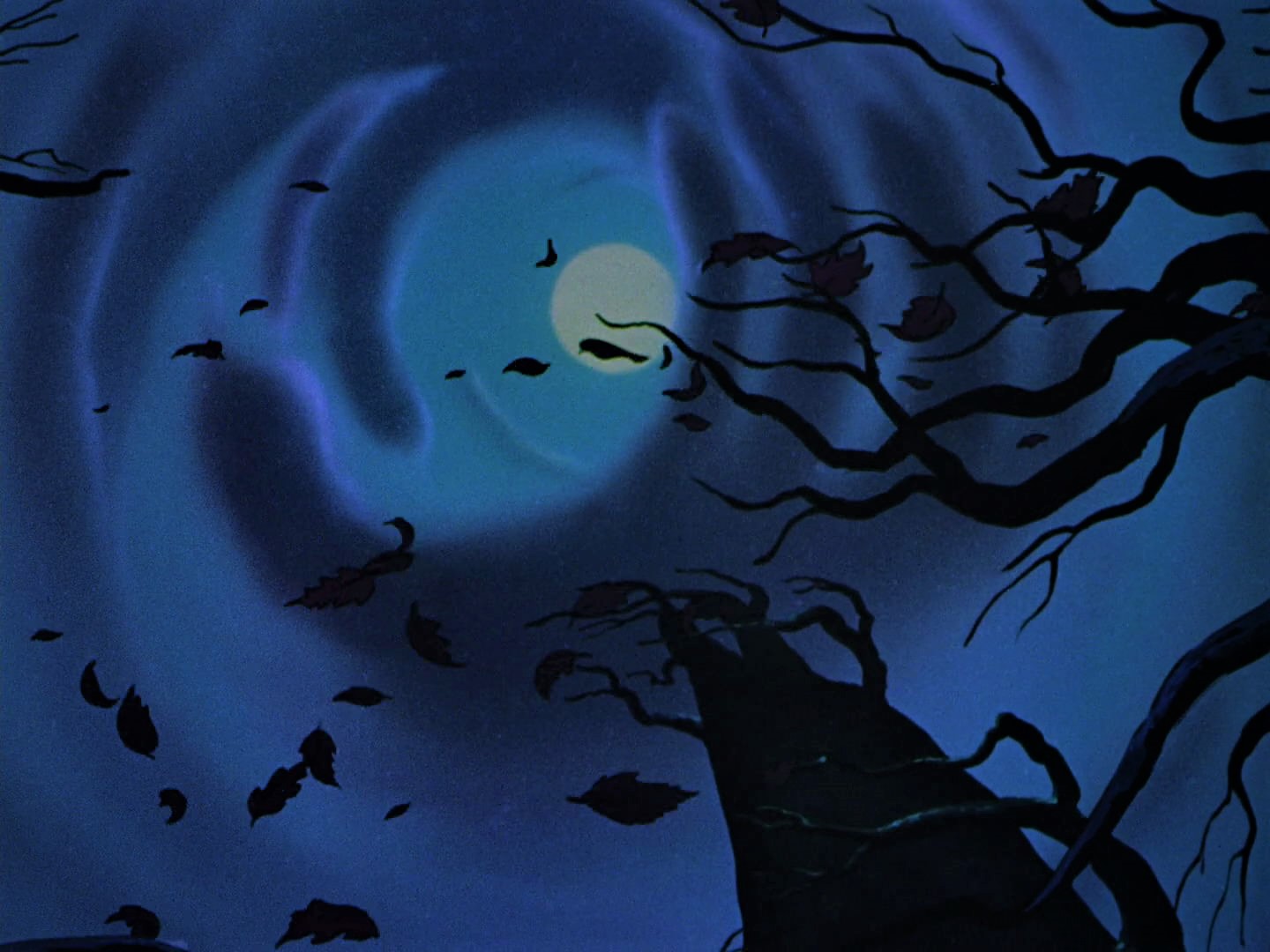
While the segment feels as if it would’ve been perfectly at home as a portion of 1948’s Melody Time (or even as an extended short-feature,) in it’s penultimate scene Ichabod suddenly elevates itself to one of the pinnacles of Disney’s early animation. The main reason The Adventures of Ichabod and Mr. Toad is remembered today (and the entire point of discussing the film right before Halloween) is for the climactic scene of Ichabod’s flight through the Hollow. Not since their 1937 Silly Symphony short “The Old Mill” have Disney’s artists been able to achieve such a sense of intangible dread as they do when Ichabod nervously makes his way home through the moonlit woods - the slow clip-clop of his horse’s hooves echoing amidst a growing chorus of nocturnal animal cries. The character’s growing unease turns to panic as every sound and shadow seems to hide unseen horrors, relief coming briefly as he realizes that what he thought was the sound of an approaching rider was merely cattails smacking against a log. Then suddenly the real Headless Horseman appears, a vision of dead-serious animation meant to scare the bejeezus out of both Ichabod and the audience. The sense of foreboding from moments ago turns to sheer terror, as Disney lets loose the closest their animated films have ever gotten to pure gothic horror. While several moments in the ensuing chase are played for laughs (mostly due to Ichabod’s frantic, bug-eyed horse,) the overall impression left by this sequence is one of edge-of-your-seat fright as Ichabod makes a desperate charge toward the covered bridge (which marks the limit of the Horseman’s haunting grounds.) The whole nail-biting sequence comes to a startling end as, upon crossing the bridge, Ichabod turns back just in time to see the Horseman’s jack-o-lantern head flying towards him (towards us!), engulfing the screen in flames as it presumably smashes against it’s target.

Pumpkin spice hype gets more aggressive every year...

The following closing scenes reveal that Brom and Katrina end up marrying each other, which seems to suggest that the Headless Horseman was actually Brom in disguise (though it's left wonderfully ambiguous.) It's also heavily implied that Ichabod survived his ordeal, likely settling down with a wealthy widow someplace - but audiences could hardly care less. The sudden and unrelenting nature of the “Headless Horseman” scene is what sticks with one the most. The sight of the terrifying rider hoisting his flaming jack-o-lantern skyward while careening through a darkened cemetery is an instantly iconic image, and has burned itself into many an impressionable young Disney fan’s mind. Thanks to repeated showings of the film around Halloween (or sections of it, since The Adventures of Ichabod and Mr. Toad was more often than not presented as two separate features until the DVD age,) including as part of perennial TV favorite Disney’s Halloween Treat, generations have been terrified by the adaptation of Irving’s short story.

A bad moon a-risin'

Though Walt Disney Productions is often remembered as going through a slump during the 1940s, it’s through memorable and masterfully-realized moments like this that the legendary animators showed what great heights their art form was still capable of achieving - even on a limited budget.

Thursday, October 19, 2017

The Jungle Book

Welcome to the jungle, we’ve got Bears and Snakes. That’s right - in honor of this luminous Diwali, let’s take a brief break from TV reviews and look back to a fondly-remembered fan favorite, 1967’s The Jungle Book.

Just like the Coppertone ads!

Adapting Rudyard Kipling’s collection of Mowgli stories (published in 1894,) original screenwriter Bill Peet chose to keep the story and tone of the script close to Kipling’s original adventure yarn. His changes mostly involved cleaning up the structure (so that Mowgli’s return to the “man village” came at the end of the film) and adding the character of King Louie - a domineering, threatening figure in his draft. Walt Disney, however, had other plans. Having taken a “hand’s-off” approach while tending to other projects around the company, Walt was disappointed with the studio's previous pair of animated films (1961’s One Hundred and One Dalmatians and 1963’s The Sword in the Stone,) and therefore decided to be more directly involved with their latest effort. Walt’s first order of business was to demand that the story be lightened up, as he felt the script was too dark a film for family audiences. Peet, a longtime “storyman” who’d worked on Snow White and the Seven Dwarfs, Fantasia, Dumbo, The Three Caballeros, So Dear to My Heart and many others, refused to make the changes Walt insisted on. He pointed out the studio’s legacy of films featuring dark elements that balanced out the light ones; imagine, for example, a Snow White without her flight through the forest or an evil Queen. Walt, however, put his foot down. Peet walked, leaving the studio for good.

Bastard from a basket!

If Walt wanted a bright, chipper film, he certainly got one. Despite a few instances of what can best be described as “light peril,” Disney’s Jungle Book goes down like a sugary soft drink that’s lost it’s fizz. The new script by Larry Clemmons, Walt’s hand-picked replacement for the departed Peet, is as entertaining as it is boiler-plate.

That’s not to say The Jungle Book is a bad movie, of course, just not a great one. There’s much to like, including the performance of it’s voice-cast. Notably, it's here that we first see Disney filling it’s cast with well-known celebrity voices, a practice that would become only too prevalent in the coming years. Though not appearing until more than a third of the way into the film, Phil Harris’ Baloo the Bear steals the whole show - and with good reason. Cast after meeting Walt at a party, the comedian brings a great amount of warmth to Mowgli's mentoring “Papa Bear," like a big cuddly Falstaff. Not to be outdone, musician Louis Prima brings his crazed stage persona to the role of Orangutan King Louie, scat-singing his way through “I Wanna’ Be Like You” with manic abandon (his Curly Howard-like “N’yaar-Raar” growl halfway through the song makes me chuckle every time.) British actor George Sanders makes a late-film impression as the villainous Tiger Shere Khan, whose strong chin was modeled after the actor's own features. Some old friends are here as well, such as Sebastian Cabot playing the Panther Bagheera (the calm center of the film,) and Sterling Holloway, whose sing-song vocal brings a squeamish pedophile-like quality to his performance as the Snake, Kaa. Filling out the cast is the director’s son, Bruce Reitherman, as young Mowgli, and Clint Howard as the little Elephant son of Colonel Hathi (voiced by J. Pat O’Malley.)

You want a popsicle? My tree's full of popsicles.

Upon this most recent viewing, I couldn’t help but notice that all of the “sophisticated” animals - Bagheera, Shere Khan, the Elephants and the Wolves - were all portrayed with British accents. Perhaps a nod to the Imperial rule of Kipling’s time in India, it’s contrasted to the American voices given to such free-wheeling characters as Baloo and King Louie. It’s also noteworthy (if that’s the word) that not a single voice - including that of Mowgli - is provided by an Indian actor (or even given an Indian accent.) Heck, this makes 1994’s The Lion King (with it’s handful of African-American actors amongst the main cast) sound downright progressive in comparison!

Baloo's happy ending.

Many people credit The Jungle Book for it’s lively music, and for the most part I find the songs - penned by Walt’s go-to team of Robert and Richard Sherman - enjoyable, if not especially memorable. The exception is the Phil Harris-sung “Bare Necessities,” which is the real standout. Remarkably this memorable number is the only song not written for the film by the Sherman brothers, but by Terry Gilkyson, who also penned the half-awful title song for The Three Lives of Thomasina - and who was removed from the project along with Bill Peet for writing music that was “too dark” for Walt’s liking. On the other end of the spectrum is the lousy “That’s What Friends Are For,” sung in the film by a foursome of Vultures said to be modeled after The Beatles. If the animators were going for a parody of the “fab four,” however, they ended up with characters that appeared closer to a sitcom’s idea of what a mop-topped “British invasion” group looks like (if you’ve ever seen the the episode of Gilligan’s Island featuring a fake band called The Mosquitos, you’ve got the picture.) The song itself, however, sounds like straight-up barbershop, so I’m really not sure what the filmmakers were going for - ‘cause what they got was crap.

Blackbird singing in the dead of night...

I’d like to make special mention of the score written by George Bruns, whose work for Disney earned him four Academy Award nominations (unfortunately not this film.) Bruns’ use of gently-bowed strings and low woodwinds help to create a brooding sense of mystery that is sadly lacking from the rest of the production. If there are any fans of Exotica music reading (think Tiki bars rather than World Music,) I can’t recommend a listen to Bruns’ album Moonlight Time in Old Hawaii enough. Recorded as one of his many side projects (George Bruns and the Hawaiian Strings,) the album is one of the most evocative examples of the genre I’ve encountered, bettering more popular titles by artists like Martin Denny and Arthur Lyman. Sadly, the album never seems to have made it to CD or digital, so I’ve provided a link to a remastered recording of the original LP in the title (kindly provided by my favorite blogger, FoxxFur.)


Dance monkey, dance!

A favorite film for many, that The Jungle Book is held in such high regard by the general public while similar, concurrent efforts from the studio are looked down on, is a bit mystifying. While not great films, both The Sword in the Stone and 1973’s Robin Hood are funnier, for example. The solidifying of The Jungle Book’s reputation as a “Disney Classic” can be traced back to it’s original release, when 99% of the (largely-positive) reviews all made mention of Walt Disney’s recent death - and were likely carried on the goodwill of the beloved filmmaker’s passing. Over the years, besides being praised for it’s character design and music, the biggest point of discussion regarding the film is that is it was “THE LAST MOVIE WALT DISNEY MADE” - or, more accurately, the last film released that Walt was involved in - or, even more accurately, the last animated movie he was involved in (the actual last film Walt involved himself in was The Happiest Millionaire, but that period-musical is far less perpetually marketable than a talking animal picture.) For me, though, The Jungle Book sits comfortably amidst a period of Disney animation that I like to call the “Saturday morning cartoon” era, when visual spectacle and artistic ambition took a backseat to budget. Partially due to the disappointing returns of 1959’s Sleeping Beauty, as well as the continued cash-drain of both Disneyland and the burgeoning “Florida Project,” the introduction of the time and money-saving xerography process seemed to dictate the overall direction the studio would take for the next two decades.

KHAAAAAAAANNNN!!!!

Perhaps no other individual can best be singled-out as central to the animation studio’s artistic leveling-off than director Wolfgang Reitherman - one of Walt’s so-called “nine old men.” An animator with the company since 1934, “Woolie” rose through the ranks and was promoted to chief animation director, starting with One Hundred and One Dalmatians. Under his direction, the studio’s output became safer, blander, and (mostly) more cost-effective. So afraid of artistic risk was Reitherman that he became a champion of re-using animation; all of the examples of “traced-over” sequences found in The Jungle Book, Robin Hood, The Rescuers and others came as a direct result of Reitherman’s belief that the Disney artists follow what had worked before. Apparently he thought the contemporary animators (many of whom had been at the studio for years) were incapable of animating a Wolf-cub’s walk cycle (having them trace over animation of Dalmatian puppies,) or that Maid Marian should dance exactly like Snow White did in 1937. The infuriating thing about this is that re-drawing the same animation was not only artistically stifling, but also more time-consuming than coming up with new drawings (per interviews with long-time animator Floyd Norman.) The great irony here, of course, is that the more Disney tried to “do it like the past,” the further and further they got away from the artistic heights of their “golden age.”

So next time a girl gives you the play,
just remember my rhyme and get the hell away

In all honesty, it’s easy to hang the lazy re-use of animation solely on Reitherman’s shoulders; however to place full responsibility for the studio’s downward spiral on him may be scapegoating. Financial pressures from both within and without the company put a lot of strain on the animation unit, and frankly it’s a minor miracle that the company kept the department running and producing films at all. The bigger disappointment for me is the “make it safe” attitude of Walt Disney himself. By this late point in his life, Walt was a long way from the dynamic young filmmaker who rallied a ragtag group of artists into creating a feature-length animated movie against incredible odds, or who was willing to gamble his company’s financial well-being on an experimental film set to classical music. Walt’s instruction to the Shermans to give their music a “lightness, a ‘Disney’ touch” is as startling as it is disappointing, indicating a man who’d grown to accept the fact that his signature has been bastardized into a corporate logo. No longer focused on the output of his studio, the very bedrock upon which his company was built, Walt’s vision had by this point shifted from visual entertainment to something else. Walt had his dwindling eye set on a goal far loftier than cartoons, or films, or even theme parks - something that would prove to be both revolutionary and ultimately impossible.