Showing posts with label 1930s/40s. Show all posts

Friday, March 23, 2018

Dumbo

Well well - long time, no see.

Ladies and gentlemen, boys and girls, welcome to the big top! Step right up, as today we feature a look at a beloved little film focusing on a precocious pachyderm with enormous ears! We direct your attention to the center ring, for a frank (and frankly rambling) discussion of 1941’s Dumbo!

I think that shit just kicked in, Timothy...

In 1939 Kay Kamen, the head of Walt Disney Productions’ merchandise licensing (and the man responsible for bringing the Mickey Mouse watch to the world in 1933,) showed Walt Disney a prototype of a toy called a Roll-A-Book. A simple storytelling device similar to a panorama, the toy contained a little story told in 8 drawings of a big-eared baby circus elephant named Dumbo. Taken more with the story than the Roll-A-Book, Walt purchased the rights to the tale, which was written by Helen Aberson and illustrator Harold Pearl. At the same time, riding high off the success of 1937’s Snow White and the Seven Dwarfs, the studio had put most of that film’s profits back into the productions of Pinocchio, Fantasia, and Bambi. These films were complex, costly projects that took the artistic lessons learned from their first feature and expanded upon them, creating some of the finest achievements in the art of filmed animation. However, the closure of European box offices following the outbreak of what would become World War II meant that Pinocchio and Fantasia, both released in 1940, would not make back their high production costs. To recoup some of these losses (and help get Bambi finished for it’s 1942 release,) it was decided to upgrade their planned Dumbo short into a full-length, budget-minded feature - and to have it finished and out before the end of 1941.

The only work Hyacinth Hippo could get after Fantasia bombed...

While certainly not poorly made, Dumbo’s hastened production does show in the finished film - especially when compared to its lavishly-assembled siblings. The overall animation has a simplified, almost flat appearance - a more “cartoony” look, if you will. This design choice applies to nearly all elements of the film. The character designs look like they came straight from one of the studio’s Mickey Mouse cartoon shorts, lacking the shaded look of Pinocchio or the drawn-from-life movements of Snow White and her evil Queen. Even the length of the film reflects its hurried nature, as Dumbo clocks in at a tidy 64 minutes - nearly an hour shorter than its immediate predecessor, Fantasia (though it loses the award for Disney’s shortest feature to 1942’s slight Saludos Amigos.)

Change my pitch up - smack my bitch up...

Perhaps to make up for (or distract from) Dumbo’s budgetary restrictions, the filmmakers seemingly doubled-down on high emotion to carry the film. Viewers are instantly sympathetic to the little elephant with the oversized ears (how can we not be!?! Look at those blue eyes! Those giant ears on the cute wittle baby! #Adorbz!), and our blood boils when the haughty elephant matriarchs insult Dumbo and his poor mother, the nearly mute Mrs. Jumbo (cue the lecherous principle from Forrest Gump: “Is there a Mr. Jumbo, Mrs. Jumbo?”) Proceeding scenes of Dumbo getting his bath and playing with his mother overload the film with a severe case of cuteness, striking a particularly poignant chord with those who’ve raised young children. Within minutes of screentime, Mrs. Jumbo is in a red-eyed furor as she spanks the living crap out of a human kid who’s bullied her little calf, causing a riot to break out under the big top. Before you can catch your breath, Dumbo is crying outside his mother’s “Mad Elephant” cage as the sob-inducing “Baby Mine” croons over the soundtrack with gentle assertiveness. Meanwhile, comedy is supplied by a bumbling stork (Disney mainstay Sterling Holloway again,) a pompous ringleader (Herman Bing,) wacky “woikin’-stiff” clowns and Dumbo’s wise-cracking Jiminy Cricket-substitute, Timothy Mouse (Edward Brophy) - who doesn’t show up until nearly halfway through.

I'm not real enough for you, Billy?

That Dumbo makes an unabashed play at emotion isn’t a bad thing in and of itself - the best art is arguably that which appeals to emotion as much as reason, if not more so. But this roller coaster of drama, swinging wildly from histrionic melodrama to wacky comedy, is built upon such a miniscule storyline that it barely holds up. So much intensity is packed into Dumbo’s short running time that there’s little time to breathe and register everything going on. No doubt this came as a result of the story’s limited “eight drawings” origin, and suggests that Disney’s artists weren’t afforded time to fill in the gaps of the story as much as they should have.

Oh the Feels!

I will give the filmmakers massive kudos, however, for the "Pink Elephants on Parade" sequence. Despite the scene being completely inconsequential to the rest of the story (or maybe because of it,) Dumbo’s drunken dream is an explosion of crazed creativity in the middle of an otherwise middling movie. A feverish nightmare of color, shape, and numerous forms of “technicolor pachyderms” floating across the screen (or, in one memorable moment, marching around the film-frame itself,) the whole bizarre bit seems like an outburst of pent-up inventiveness that wouldn’t be seen again until the climax of 1944’s The Three Caballeros (and wouldn’t manifest after that until the appearance of Aladdin’s Genie in 1992.) By far the greatest of Disney’s few truly “WTF” moments, this endlessly re-watchable segment makes even the most bored adult viewer take notice, and has been utilized many times over the years for TV clip-compilations and even theme park extravaganzas.

Nine, ten - never sleep again...

Before I close, I would be remiss if I didn’t attempt to tackle a brief discussion of the elephant in the room (no pun intended … well, maybe a little): the crows. Anthropomorphic animals that play an important part in the film’s resolution (it now strikes one as odd that the film’s main gimmick - an elephant flying - doesn’t occur until 10 minutes before the end,) that the group of blackbirds is portrayed as unambiguously African American has led to some (admittedly minor) controversy in the years following Dumbo’s release. In his famously inflammatory 1968 tome The Disney Version: The Life, Times, Art and Commerce of Walt Disney, author and film historian Richard Schickel argued that their portrayal was clearly an example of black stereotyping. For me, watching the film with an eye toward historical context, that conclusion doesn’t seem so clear-cut. Or maybe it does?

You were only waiting for this moment to arrive...

If you’ll permit me a bit of rambling: besides a multitude of personal issues and “life occurrences” since last October, one of the reasons this blog hasn’t had a new entry in over 4 months was due to my inability (or perhaps unwillingness) to grapple with this review. Astoundingly, trying to write about a little cartoon movie about a put-upon pachyderm seems to have opened some door in my mind; a door to a beguiling wrestling match between reason and emotion concerning the portrayal and treatment of race throughout Disney’s body of works. As longtime readers (you poor souls) have likely gleaned, I’m a Caucasian man with a fairly strong liberal inclination (recall the acquisition of my “white card” back in my Tarzan review - oh how clever,) which I point out basically as an excuse for my hesitation to discuss race in art. For some reason I feel that it simply isn’t my place to properly address, and - as the ghosts of many deleted and re-written examples of this very paragraph attest - I seem grossly ill-equipped to do so.

And yet, here I go.

While watching Dumbo for this review, I tried to think how one can frame the whole concept of prejudice in older movies. Personally, I’ve never gotten the impression that Disney (neither the man nor the collective group of artists who worked for him) were racists in the strictest sense. In the film, the group of crows are portrayed as independent, free-thinking characters who are sympathetic to Dumbo when few others are; they are sarcastic, to be sure, but nothing in their dialogue or performance come across as offensive at face-value; they lack, for example, any of the subservient “Stepin Fetchit”-like behavior one associates with stereotypical performances seen in film at the time. While most of the crows were voiced by African American performers (members of the popular Hall Johnson Choir,) the “lead” crow was, unfortunately, voiced by a white actor (Jiminy Cricket voice-actor Cliff Edwards) putting on a “black voice.” Though it was common for white actors to portray other ethnicities at the time, it’s still unfortunate (though at least we don’t have to see any actors “darked up” like we would’ve in a live-action production.) It should also be pointed out that Edwards’ character, while unnamed in the film, was internally referred to as “Jim Crow,” referencing either theater-actor Thomas Rice’s “blackface” character from the late 1800s, or the nickname for a number of southern post-civil war segregation laws that remained in place into the 20th century (or likely both, since one was nicknamed after the other.)

Desegregation at work...

Now, given the time period in which these filmmakers lived and worked, to me the naming of this character (and again, not an official character name outside the studio) comes off as a distasteful joke, rather than an intentional slur. Honestly, I think much of the work from Disney at this time (and lots of “golden age” Hollywood, really) can be labelled racially or culturally insensitive, rather than flat-out racist. But given that all art can be read and judged subjectively (regardless of any credence one puts toward artistic intention,) does this distinction matter? Could one objectively call something “racist” if there’s an honest lack of harmful intention? Should one cast Dumbo (or even, to take a more polarizing example, Song of the South) under the same umbrella as D.W. Griffith’s The Birth of a Nation - an important piece of cinematic history that is also intentionally and unquestionably racist? Perhaps not, but certainly one shouldn’t exonerate one intolerant work because it’s “less intolerant” than another. Besides, the absence of intent doesn’t negate effect; just because no harm was meant doesn’t mean no harm resulted.

Was I personally offended watching the crows cavort with Dumbo? Not offended, per se, though I admit to feeling a twinge of discomfort. But again, I’m a middle-aged white guy who's had a pretty easy go at life, so what does my opinion matter? Should it?

Then again, would the opinion of an African American viewer hold more water in this case - or to the very presence of truth in claims of prejudice in a work of art? This may seem to be an obvious (if grossly oversimplified) “yes,” but again the specter of subjectivity raises its head: how many African American individuals would it take to declare something “officially” racist? To use a pertinent example, in 2017 recently-appointed “Disney Legend” Whoopi Goldberg proclaimed that the crows from Dumbo were in fact not racist stereotypes; she instead believes Disney should represent the characters more through merchandise, “because those crows sing the song in Dumbo that everybody remembers” (referring to the "When I See an Elephant Fly" number - indeed the most memorable song from the film.) To use Ms. Goldberg’s opinion as the final word, however, would be falling back on the “proof by example” fallacy, wherein one uses one or a few anecdotal examples as proof of a generalized conclusion: "Look! There's a black person who's okay with it, so it must not be racist!"

This whole thing's giving me a headache...

Then there’s the relative question of time. Were the crows considered racist in 1941 - to African Americans, or anyone else? Heck, Schickel (a white male, by the way) was adequately offended enough in 1968 to declare them stereotypes. Does something seen initially as harmless become (or become recognized as) questionable, and finally offensive over time? This is feasibly true, as attitudes and tastes change almost as rapidly as the weather. Even the idea of racism itself can alter over time; hence Schickel found the Dumbo crows offensive in 1968, but it would be years before any popular dialogue opened up about the (arguably far more offensive) portrayal of “Injuns” in 1953’s Peter Pan. Hell, the jury still seems to be out on the Siamese cats in 1955’s Lady and the Tramp.

On a side-note: this seems to point to an interesting line of “stratified racism” (my term, since I can’t seem to find an “official” designation,) wherein prejudice against one ethnic group takes precedence over another, over time. In other words, the phenomenon of the portrayals of some groups being recognized as problematic before others. As an example: in 1989 Spike Lee’s magnificent Do The Right Thing was setting the cinema world afire with heated discussions of ongoing racial tension between whites and blacks in America - while on television, Caucasian actor Hank Azaria was cast to voice the Indian character Apu on The Simpsons. Largely uncommented on for years outside of the Indian-American community, this backward-looking example of “brown face” casting seems to have finally come into the public discourse several years after the fact, thanks to such commentators as comedian Hari Kondabolu in his 2017 documentary The Problem with Apu.

And in this specific case, the whole thing probably wouldn’t even have become a topic of discussion if Fox would've let the damn show die a dignified death 20 years ago … but I digress.

The recent influx of millennials re-evaluating cultural artifacts of the so-called ‘enlightened age’ of my own youth has led to such “revelations” as the character James Bond being sexist (uhm .... this is a surprise?) or TV’s Friends being insensitive to the LGBT community. Hell, when I was young it was seen as “revolutionary” simply to feature gay, bisexual or transgendered characters at all. That doesn’t take away from viewer’s impressions at this moment in time, however. And if we want to stay on the temporal train a bit longer, there are things that I find offensive today that I wouldn’t have when I was younger (and vice-versa.) As I alluded earlier, my most recent viewing of Dumbo left me a bit uneasy when watching the scenes with the crows, but when I was a kid I could honestly care less - even when I actually did recognize that the characters were being presented explicitly as African American.

So does the film’s insensitive handling of race alter my personal opinion of it? Not a whole lot, no. While the presence of prejudice or offensive material in art can sometimes put me off (I’m looking your way again, Parent Trap,) such is not always the case - as long as I recognize the piece as a work of art, and not an obvious piece of advertising or propaganda (though I guess those are more or less the same thing.) If it is in fact a work of art, as far as I’m able define it, I prefer to judge a work on its individual merits. Like anyone, of course, my own opinions sometimes fit hand-in-glove with whatever public kudos a work merits, sometimes not (Kurosawa’s Ran is a film held in high artistic regard, and it’s also one of my favorites – while Hitchcock’s classic Vertigo has always struck me as intensely overrated.) The same applies to art that’s held in high esteem for its importance to race relations - Lee’s previously-mentioned Do The Right Thing has recently become one of my favorite movies, while I struggled through Ellison’s tedious writing style in his seminal Invisible Man.

Regardless of all the disparate issues it brought about in this discussion, for me Dumbo is - as it always has been - a pretty unremarkable entry in Disney’s animated cannon. I know this is not a popular opinion, as the ongoing ubiquity of the character proves (which we’ll hopefully look at in a future “Theme Park Rundown.”) Not one of the movies I owned or watched often growing up, I was more familiar with “the little elephant with the big ears” through merchandising and the live-action Dumbo’s Circus program, which ran on The Disney Channel in the mid-’80s. Not Disney’s best effort at the time (but far from their worst,) Dumbo often feels like the rushed production it was. One can’t help but wonder how great a film could’ve been produced with a little more time and care. 

Enough talk. I need a bath...


Monday, October 30, 2017

The Adventures of Ichabod and Mr. Toad

Up next in our trilogy of Halloween reviews is the last film Disney released in the lean 1940s, and a film that may be their best “package film” of the era (The Three Caballeros notwithstanding, of course.) It’s 1949's The Adventures of Ichabod and Mr. Toad!

Don't lose your head

Shortly after the release of Snow White and the Seven Dwarfs, Walt Disney was pitched a possible full-length animated film treatment of Kenneth Grahame’s 1908 story The Wind in the Willows. Despite Walt’s reservations that such a film couldn’t live up to Snow White (or the other productions in the works, Pinocchio and Fantasia,) the studio optioned the story in June of 1938, and a basic script was completed in early 1941. Though it was a budget production (like that year’s Dumbo,) Walt nevertheless had some of his best animators at work on the film. More than half an hour of animation was completed when production stalled, following the closure of overseas box-offices when World War II broke out. It was soon halted altogether, after the US military commandeered the studio following Pearl Harbor. In the following years, Disney released a series of inexpensively-produced “package films,” starting with Saludos Amigos in 1942. Already believing their Wind in the Willows adaptation to be below par, animators resumed production in 1945 with the intention of making it part of a package film. The hastily finished film was slated to be matched up with Mickey and the Beanstalk (which instead ended up in 1947’s Fun and Fancy Free) and an adaptation of Roald Dahl’s The Gremlins (which, despite being written with the intention of Disney adapting it, was soon abandoned) under the title Three Fabulous Characters.  Around the same time, work had begun on creating a full-length adaptation of Washington Irving’s short story The Legend of Sleepy Hollow, and the animators behind that production were having trouble padding the story out to fill a feature's running time. In 1947 the decision was made to pair up the two wayward productions, and the composite film was named The Adventures of Ichabod and Mr. Toad, to focus on the two central characters.

I'm cuckoo for Cocoa Puffs!

The abridged and re-arranged version of Grahame’s tale fills the first half of the composite film. It focuses on the exploits of wealthy gadabout J. Thaddeus Toad and his friend's attempts to clean up his various messes. The Mr. Toad character (voiced by prolific English character-actor Eric Blore) is one of Disney’s most memorable, though he seemingly gets by more from name recognition than anything else (and that's primarily due to the reputation of his theme park attraction, Mr. Toad’s Wild Ride - but that's an article for another day.) An irresponsible rake, Toad’s various “manias” put himself, his friends, and his fortune in constant jeopardy. Yet his unabashed zeal for adventure does begin to grow on you as the film progresses. It sometimes feels as if the filmmakers are daring us not to like their animated anti-hero, like some kind of anthropomorphic Barry Lyndon (and yes, I just related the main character from a Stanley Kubrick movie to a talking frog; that's how I roll.) By the time we’ve reached the manic brawl at Toad Hall (not to be confused with the “rumble in the jungle”,) we can’t help but root for him and his put-upon pals to win the day.

The weasels practice their synchronized swan dive...

The filmmakers’ concerns over the quality of their Wind in the Willows adaptation seems to be unfounded, as I found it to be both entertaining and extremely well made. In fact there are a handful of segments, such as the one set during a frosty Christmas Eve in a fog-drenched London, where the artwork could sit comfortably amongst some of the studio's finest output. The character animation, purposefully more cartoonish than realistic, rivals not only their ‘40s output but also much that would come in the following decade. And while the animators were obviously not going for the carefully shaded quasi-realism of Disney’s first three features, the kinetic energy on display breathes life into every character, both animal and human. Between the lively animation, frenetic pacing and a number of shared voice actors, Mr. Toad feels something like a run-up to 1951’s Alice In Wonderland (and personally, I find this to be a much more enjoyable film than that later, more fondly remembered one.)

A chill in the air...

While this first portion is an underrated gem of animation, I can’t say that I feel the same about the back half of the film (with one exception, which we’ll get to shortly.) For most of it’s running time the Ichabod section carries on in a rather pedestrian manner, as the town’s uber-lanky new schoolmaster, Ichabod Crane, avails himself of the townspeople’s goodwill and generosity (as well as much of their food.) Soon he falls for a shapely young woman named Katrina, who is the daughter of a wealthy farm-owner. His main rival for her affections is local town braggart Brom Bones (sort of a less-threatening Gaston prototype,) who is driven to jealousy by his repeated failed attempts to one up Ichabod. While it becomes fairly obvious that Katrina is playing Ichabod and Brom against one another, we are still not completely sympathetic to the schoolmaster, as his own intentions are shown to not be completely honorable, either (he has as much an eye for Katrina as he does for her father’s successful farm.) While it appears that Ichabod may end up the victor in their little contest, everything changes following the town’s annual Halloween party; there, Brom relates the local legend of the dreaded Headless Horseman that rides every year, seeking a new head to replace his missing one.

Now I ain't sayin' she's a gold digger...

Much about the “Sleepy Hollow” segment differs significantly from Mr. Toad, pointing to the stitched-together nature of the film. For one thing, Toad and his co-stars are all voiced by individual actors, whereas here the limited speaking parts are all covered by the narrator, velvet-voiced crooner Bing Crosby. Otherwise, much of the story is portrayed in pantomime. Crosby’s involvement with the film was obviously a big selling point: witness his name writ large upon the original release poster, tempting audiences to “Hear Bing Sing!” And sing he does, as Ichabod includes three Bing-belted ballads, compared to the single lightweight “Merrily On Our Way” from Mr. Toad. Crosby’s even allows to get in a few of his trademark “bah-buh-buh-buumms” during Ichabod’s singing-lessons, delivered to a group of swooning village girls. The narration itself, much like the boogie-woogie styled songs, is somewhat more laid back and of-the-moment than that from Mr. Toad (which is provided by British actor and Hollywood's preferred Sherlock Holmes, Basil Rathbone,) with Crosby referring to the main character as “ol' Ichy” a few times.

HOLY FUCKING SHIT!!

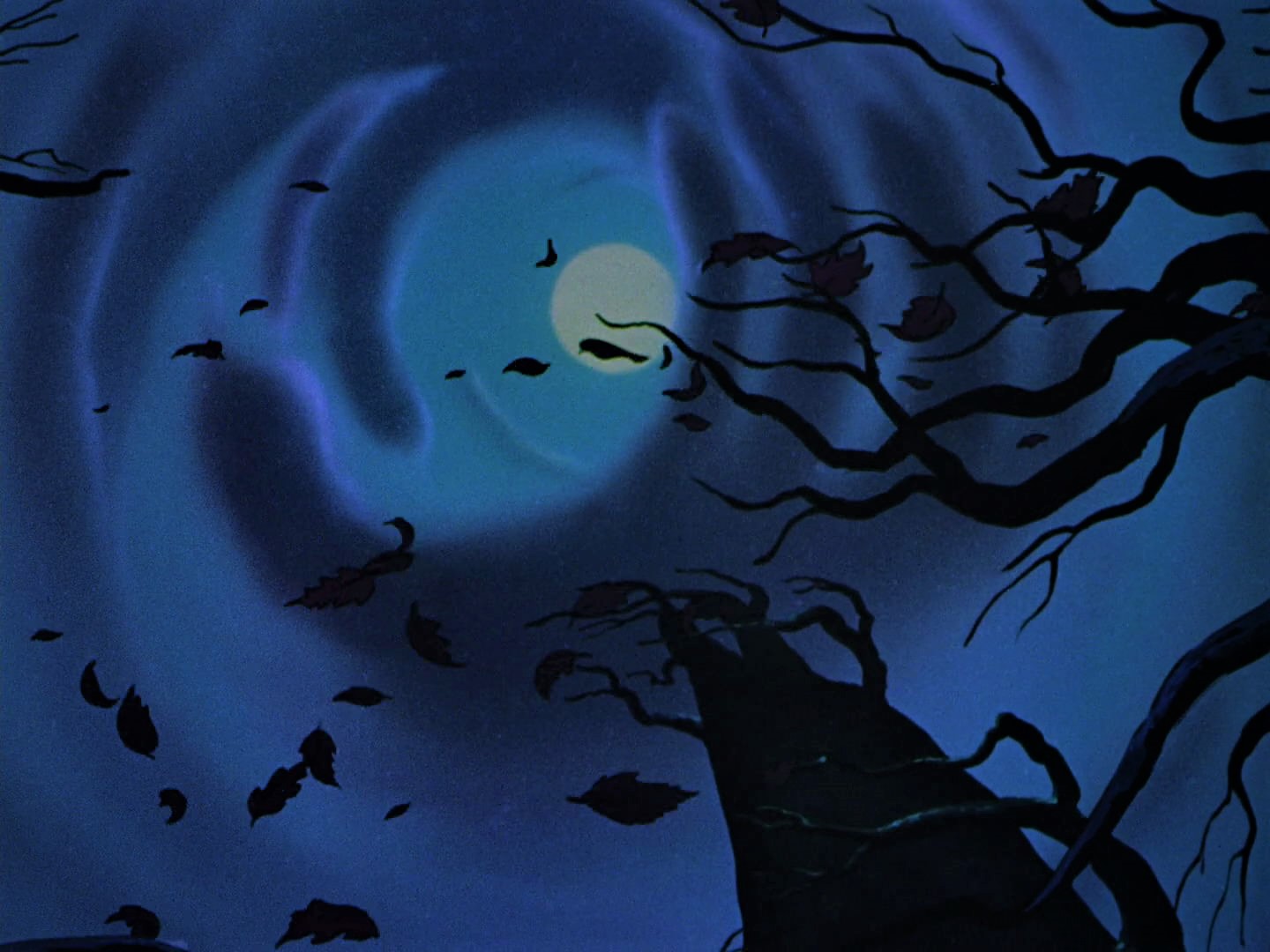
While the segment feels as if it would’ve been perfectly at home as a portion of 1948’s Melody Time (or even as an extended short-feature,) in it’s penultimate scene Ichabod suddenly elevates itself to one of the pinnacles of Disney’s early animation. The main reason The Adventures of Ichabod and Mr. Toad is remembered today (and the entire point of discussing the film right before Halloween) is for the climactic scene of Ichabod’s flight through the Hollow. Not since their 1937 Silly Symphony short “The Old Mill” have Disney’s artists been able to achieve such a sense of intangible dread as they do when Ichabod nervously makes his way home through the moonlit woods - the slow clip-clop of his horse’s hooves echoing amidst a growing chorus of nocturnal animal cries. The character’s growing unease turns to panic as every sound and shadow seems to hide unseen horrors, relief coming briefly as he realizes that what he thought was the sound of an approaching rider was merely cattails smacking against a log. Then suddenly the real Headless Horseman appears, a vision of dead-serious animation meant to scare the bejeezus out of both Ichabod and the audience. The sense of foreboding from moments ago turns to sheer terror, as Disney lets loose the closest their animated films have ever gotten to pure gothic horror. While several moments in the ensuing chase are played for laughs (mostly due to Ichabod’s frantic, bug-eyed horse,) the overall impression left by this sequence is one of edge-of-your-seat fright as Ichabod makes a desperate charge toward the covered bridge (which marks the limit of the Horseman’s haunting grounds.) The whole nail-biting sequence comes to a startling end as, upon crossing the bridge, Ichabod turns back just in time to see the Horseman’s jack-o-lantern head flying towards him (towards us!), engulfing the screen in flames as it presumably smashes against it’s target.

Pumpkin spice hype gets more aggressive every year...

The following closing scenes reveal that Brom and Katrina end up marrying each other, which seems to suggest that the Headless Horseman was actually Brom in disguise (though it's left wonderfully ambiguous.) It's also heavily implied that Ichabod survived his ordeal, likely settling down with a wealthy widow someplace - but audiences could hardly care less. The sudden and unrelenting nature of the “Headless Horseman” scene is what sticks with one the most. The sight of the terrifying rider hoisting his flaming jack-o-lantern skyward while careening through a darkened cemetery is an instantly iconic image, and has burned itself into many an impressionable young Disney fan’s mind. Thanks to repeated showings of the film around Halloween (or sections of it, since The Adventures of Ichabod and Mr. Toad was more often than not presented as two separate features until the DVD age,) including as part of perennial TV favorite Disney’s Halloween Treat, generations have been terrified by the adaptation of Irving’s short story.

A bad moon a-risin'

Though Walt Disney Productions is often remembered as going through a slump during the 1940s, it’s through memorable and masterfully-realized moments like this that the legendary animators showed what great heights their art form was still capable of achieving - even on a limited budget.

Monday, May 29, 2017

Victory Through Air Power

So far we’ve looked at a number of forgotten filmic curios amidst discussions of more familiar Disney movies. Today we’ll be taking a quick look at what may be the oddest film produced by Walt Disney Productions: 1943’s Victory Through Air Power.


Based upon the 1942 book by Russian expatriate Major Alexander P. de Seversky, the movie is basically an illustrated (or rather animated) lecture, in which de Seversky (who appears in the film) spells out his theories regarding the importance of an airborne fighting force in the currently-raging World War. Walt Disney had read de Seversky’s book and, his righteous patriotism inflamed, immediately began production on a filmed version, paying for the endeavor personally. Besides being a case of “putting his money where his mouth was,” this self-funding may have been necessary due to the studio’s poor cash-flow at the time (noted in previous posts.) Production was pushed ahead at a feverish pace, as Disney felt the speed by which he could present de Seversky’s message was of the utmost importance. Aimed primarily at government officials and military decision-makers, it’s somewhat surprising (especially from today’s perspective) that such a work of persuasive propaganda, created at the behest of the head of a major movie studio, would even get made - let alone released to the public.

The film opens with a lengthy “History of Aviation” segment, which presents a humorous look at the progression of aeronautics. Much like the lightweight “Cold-Blooded Penguin” sequence which opens the otherwise manic The Three Caballeros, this segment orients the audience to expect the airy style of humor associated with the studio’s cartoon shorts - making the serious feature that follows all the more impactful. Despite it’s silly humor, this opening segment is fascinating nonetheless, as it presents viewers with some interesting historical tidbits. For example: did you know that the very first airplane developed for the U.S. military was designed and built by the Wright brothers? Well, now you know … and knowing’s half the battle.

Only vun ving? Very interestink...

For the live-action sequences, in which de Seversky addresses the camera directly, Disney chose H.C. Potter to direct. Potter was a respected working-director whose previous credits included 1941’s Helzapoppin (a film whose title I attempt to inject into as many conversations as possible,) and Disney felt it best to have an already established "Hollywood man" to assist non-actor de Seversky in his performance. It seems like it paid off, since the heavily-accented de Seversky comes across as quite natural; he is kept moving around the small set (meant to look like a military office, one assumes,) frequently gesturing with his hands and making steady emphases to keep from drifting into droning monotony.

Victory Through Power Suits

It helps, of course, that de Seversky is backed up by animated maps and charts created by some of Disney’s foremost artists. Direction of the animated sequences was spread amongst three of the studio's best visualists: James Algar, Clyde Geronimi and Jack Kinney. As a result of the film’s rushed production, much of the animation on display is more limited than in the studio's other features. The clear and direct animation, however, actually helps to break down and illustrate the sometimes complex concepts of military strategy and supply-lines to audiences; de Seversky’s points are not only made comprehensible, but all the more persuasive.

The Americas are blocked in by a yellow daisy and an evil Trivial Pursuit piece

It also doesn’t hurt that Disney, clearly all-in with the arguments presented, has no problems “fanning the flames” of a nation at war. Viewers are therefore presented with a short animated summary of the war up to that point, which portrays the German military machine as a foreboding monster ploughing mercilessly over much of Europe. Despite continued attacks from the occupied mainland, England is portrayed as bravely holding back the machine with its dedicated Royal Air Force. This sequence is capped off by a brief but potent animated reenactment of the Japanese attack on Pearl Harbor - which surely would’ve struck a raw nerve in the minds of the U.S. audience.

As the discussion proceeds, the associated imagery slowly becomes more fanciful. Once the film has adequately demonstrated the futility of ground assaults against a well-defended perimeter surrounding the enemy’s centers of military production (demonstrated by a circular “hub-and-spoke” metaphor - curiously, an idea that would later well-serve the design of Disneyland,) a number of possible “flying fortress” prototypes are demonstrated. The strength and ferocity which dramatizes some of these possible “Axis-destroyers” is sometimes alarming - such as the large bomb that would be designed to strike fault-lines below the surface of an enemy city, creating a factory-destroying earthquake. It’s no surprise that the British Royal Navy, impressed with the film’s demonstration of a concrete-breaching bomb that could potentially destroy German U-boat pens, soon developed its own 4,500-pound “bunker buster” - nicknamed “the Disney bomb.”

Ka-boom!

The final sequence of the film, unaccompanied by narration (though preceded with a “ra-ra” final rally from de Seversky,) dramatically imagines an air-powered U.S. armed force striking at the well-defended island of Japan. As the repeated air-strikes intensify, the island nation (and it’s far-reaching military force) morph into a giant Octopus, it’s tentacled limbs stretching over the Pacific. The air-forces soon change into a screaming Bald Eagle (naturally,) which strikes at the Octopus with it’s gleaming talons until the beast lays dead. The Japanese war machine now a smoking wreck, the Eagle flies back across the sea, coming to rest atop a high-flying U.S. flag, ending the film on a not-so-subtle bit of patriotic propaganda. The animation on display in this sequence reaches such a dark intensity, the closest parallel I can think of is Gerald Scarfe’s animation for Pink Floyd’s The Wall, produced decades later.

Gonna fly like an eagle...

Victory Through Air Power is a hard film to categorize (and review!), beyond the fact that it’s non-narrative; part history lesson, part propaganda film, and part persuasive essay, the film is one few have seen or heard of. During its theatrical releases in 1943 and ‘44 (and making the rounds in the United States and British war offices,) the film was received rather poorly by an uninterested public. Though the “History of Aviation” segment was later shown separately as a short-feature, the film in it’s entirety would go unseen for decades, outside of the occasional print surfacing in film-study courses or at underground animation festivals. It wasn’t until 2004 that Disney officially released the film on DVD, as part of its “Walt Disney Treasures” line of collector’s releases (accompanied by an introduction by the ever-hyperbolic Leonard Maltin, who claims that the film “changed FDR’s way of thinking” about air power - despite the fact that the U.S. had decided to pursue long-range bombing two months before Roosevelt saw the movie.)

Unlike most of Disney’s other animated (or mostly-animated) features, however, this “odd duck”  was made for specific and time-sensitive purpose, rather than timeless entertainment.

USA! USA! USA!

Friday, May 5, 2017

The Three Caballeros

¡Hola damas y caballeros! On this beautiful Cinco de Mayo, let’s hop on our magic sarapes and take a deranged trip to Mexico, in 1944’s The Three Caballeros!

The Three Caba-leer-os

Following the success of 1942’s Saludos Amigos, Walt Disney Productions received many requests from representatives of Latin American countries seeking representation in a follow-up production. Disney’s artists were quick to comply, creating a second “package film” that featured the Galapagos Islands, Uruguay and Brazil - but focusing primarily on Mexico. Perhaps feeling liberated following the settlement of the 1941 artists strike and subsequent unionization of the studio (and taking advantage of an increasingly despondent and absent Walt,) the remaining animators let loose a number of artistic and emotional frustrations on this latest project. The results are truly a sight to behold: rather than focus on straight-forward storytelling or charming characters, The Three Caballeros instead pushed boundaries of technical wizardry and go-for-broke artistic spectacle. Awaiting a straightforward travelogue like Saludos Amigos, what met expectant audiences was instead one of the most abstract, manic and bizarre productions Disney’s animation department ever produced.

Sex, Ducks and Videotape

Please forgive the overly-long plot summary that follows; I think it’s important for anyone who hasn't seen the film to get an idea of how bonkers it gets.

I'm getting out before this movie gets weird...

The film is structured around Donald Duck (Clarence Nash, as always) opening up a large package of presents “from his friends in Latin America” on his birthday - stated as being on Friday the 13th. The film starts off tamely enough, with the brief “Cold-Blooded Penguin” segment. This story of a penguin who sails north along the coast of South America, seeking warmth in the Galapagos Islands, is your average Disney short-subject fodder. Featuring cartoon penguins and narration by good-ol’ Sterling Holloway, the opening seems like a missing Saludos Amigos segment. In all likelihood, this short was meant to simultaneously draw audiences in with it's cutesy cartoon story, and also lower their expectations. Likewise, the following "Little Gauchito" segment, which follows a young Uruguayan boy who befriends a flying burro while hunting for condors (NO!), is an entertaining though forgettable affair. Still, it has its moments, such as when the environments change around the characters whenever the forgetful narrator loses track of the story.

My little burrito

The film picks up steam when Saludos Amigos’ José Carioca returns (voiced again by José Oliveira,) emerging from a pop-up book and serenading Donald with the song "Have You Been to Bahia?" This sequence is a slow-paced respite, featuring some vibrant artwork displaying the serene and beautiful​ Brazilian coast. José and Donald are then transported into the book, where they take a fast-paced train ride through eye-popping oil-crayon-on-black “storybook” imagery. They emerge in Bahia, and partake in a lengthy song-and-dance routine with a live action Aurora Miranda (sister of Carmen.) It’s here where the technical razzle-dazzle kicks in, with the live actors and animated characters interacting pretty believably for a film of its age. It’s also here where Donald, after being kissed by Aurora, first starts showing his libido by jealously trying to whack her human suitors with a mallet; José has to tell Donald to cool off, stating “you are a wolf, my friend.” Two of the human suitors, meanwhile, face off for Aurora's affections and briefly transform into fighting gamecocks.

Aurora apparently only dates Gondoliers

José, who was able to magically transport Donald and himself to Bahia with ease, is shown to grow back to normal size once they leave the pop-up book. Donald, however, can’t perform so easily, and instead inflates himself into many bulbous, balloon-like shapes. It’s only after José shares some of his “black magic” that Donald can increase in size.

Donald Dick

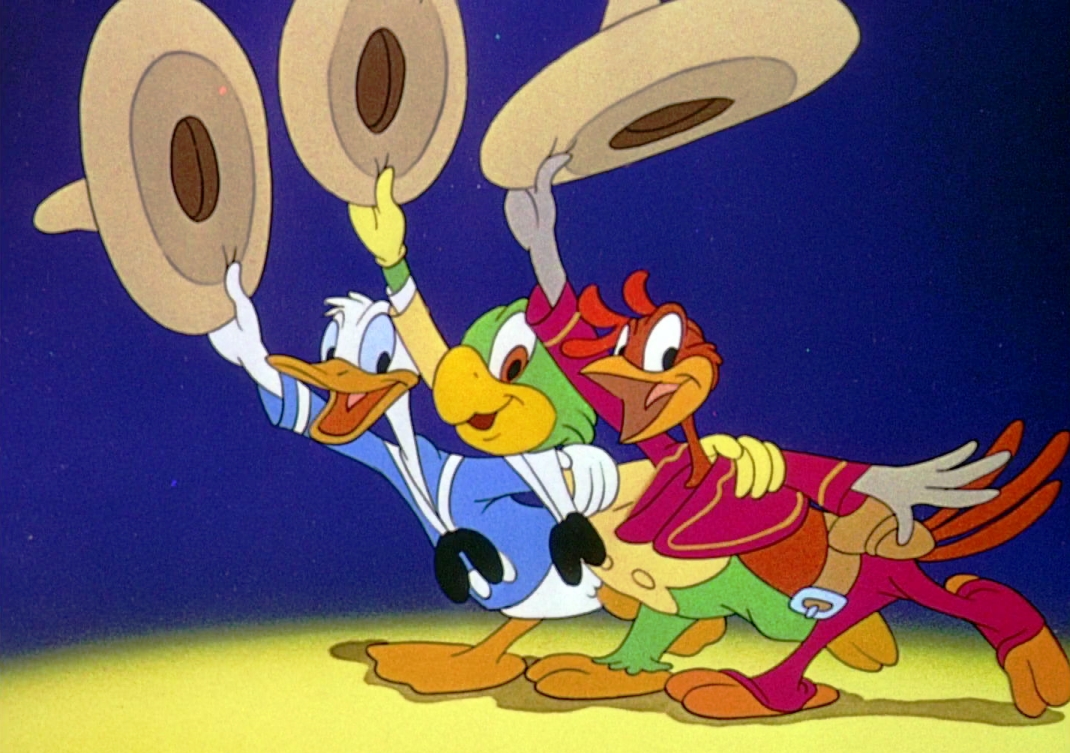
By now we’re 41 minutes into the film, and Donald is finally presented with his gift from Mexico. After a brief sequence in which the screen explodes into Mexican blanket-art patterns, out pops the red Rooster Panchito Pistoles (voiced by Joaquin Garay,) who fires off his guns, tosses the others a pair of sombreros, and declares they "are now three gay caballeros … yeeeeAAAAAAAAWWWW!!!!” What follows is the moment everyone's been anticipating from the start: the show-stopping title song - which may be the single most delirious sequence Disney’s ever made. Particularly zany is the song’s end, where Donald and José attempt to stop Panchito from sustaining the high note by rapidly dousing him with water, spraying him with bug-killer, throwing him in a coffin, sawing a hole in the floor, planting a hedge in front of him, setting it on fire, dumping garbage on him and finally threatening him with an axe and a cannon.

I think he swallowed the worm!

The film then rests a moment, as Panchito tells his fellow caballeros the story of "Las Posadas." This Mexican Christmas ritual is visualized by lovely paintings by artist Mary Blair, the flames on the children’s candles displaying the only onscreen animation. This portion segues into a song about Mexico City, represented in a series of impressionistic paintings (as opposed to the documentary-like footage which Saludos Amigos presented modern cities of South America with.)

The Small World children have escaped!

Panchito then presents Donald and José with a picture-book of Mexico, in which the photos come to life through live-action footage. The trio hop aboard a magical flying sarape, and travel into the book to tour Pátzcuaro and Veracruz (where Donald unsuccessfully tries to dance with more live women - until his wingmen José and Panchito assist him.) Next they fly to the sunkissed beaches of Acapulco, whereupon sighting a number of “bathing beauties” waving from the shoreline, Donald really looses his shit. He first uses the magic sarape as a dive-bomber, attempting to tackle the young women; then he chases the screaming sunbathers up and down the beach on foot, as they attempt to escape the clutches of the grab-ass duck (as he cries “come here, my little enchiladas!”) Panchito and José have to rip the “little wolf in ducks clothing” away from the beach, Donald inadvertently kissing José in the struggle. “Don' do that,” the parrot scolds.

C'mon, who wants to fuck a duck?

The final portion of the film is a freakish fever dream, in which Donald completely gives in to his raging hormones. Following an onscreen appearance by songstress Dora Luz performing the song “You Belong to My Heart,” the accompanying imagery mutates from a dreamy star-scape into visions of flowers, Donald buzzing around like a bee, pollinating some blossoms and diving headfirst into others (which is accompanied by a curiously ‘moist’ sound effect.) Women's faces appear in several of the flowers, and a random whispering male voice hisses “purdy girls, purdy girls, purdy girls” as Donald continues to pant and drool, his eyelids drooping heavily. Occasionally, disturbing doppelgängers of Donald, José and Panchito appear to disrupt the reverie, such as when their bodies appear atop pairs of shapely women's legs, the title song screeching on the soundtrack like a skipping, sped-up record.

Va-va-voom

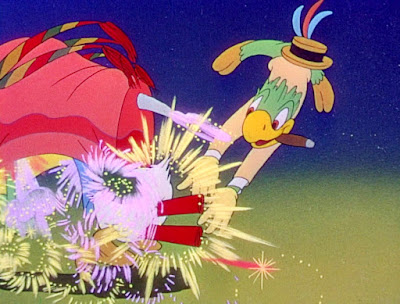
The action slows momentarily, as Donald dances with a young woman dressed like a Mexican charro. She uses a riding crop to make some noticeably phallic cacti sprout from the ground and begin marching in formation. Everything comes to a sudden and frenetic head as Donald stuffs himself inside a giant toy bull, and furiously attempts to gore his fellow caballeros. Panchito taunts him in a matador’s outfit while José splits into several tiny José’s, cheering him on. The film ends, rather suddenly, as José sticks dynamite up Donald’s butt, and the ensuing explosions make fireworks appear in the sky, writing-out “The End” in Spanish, Portuguese and English.

What what (in the butt)

If you got through all that, it’s clear that this movie goes increasingly bananas as it plays out. The film is filled with bizarre, metaphorically sexual imagery that builds and builds until the crazed release during the climax. The “female form” is present everywhere, always the target of the lascivious gaze of the male characters, filmmakers and assumed audience. Donald, acting as the id to José’s ego and Panchito’s superego, seems like he’s going through a confused sexual awakening; at one point he molds himself into a voluptuous feminine shape, until he's discouraged by José. His Latin friends, always suave and able to control magic that Donald can't seem to perform, alternately encourage and confound his libidinous behavior. It’s easy to imagine the whole thing as some kind of “Donald’s wet dream,” as we seem to continually move in and out of the duck’s mind - though it’s strange that this is attached to an examination of Latin American culture. Unless the whole travelogue motif is just a disguise for a Lost Weekend style tale of Donald’s wild and crazy vacation south of the border?

I freakin' looooove you, man ...

Beyond the crazy psychosexual imagery, The Three Caballeros sees Disney experimenting with the animated medium, sometimes breaking it’s own rules. At one point we’re introduced to the nutty Aracuan Bird, who pops in and out of the film - sometimes literally, as he is seen to run beyond the sprockets of the film reel itself, until pulled back by José’s umbrella. Up to this point, Disney had always paid fairly strict adherence to realist film conventions in their full-length features, insomuch as animated drawings can. Here, though, spatial relations are thrown out the window. Likewise, as the studio’s first full-on mixing of animation and live action, the filmmakers were not hesitant to go all-in, having Donald and his friends interact with live actors and props. The use of color is also notable, the artists mix of media and strikingly bold palette having seen no equal since Fantasia.

Cock-a-doodle-doo

As alluded to above, reaction to the film was pretty mixed. Audiences and critics alike were perplexed by what they were seeing. Many accused the studio of falling back on special effects to cover up weak storytelling. I’ve personally never understood why a primarily visual medium should be enslaved by storytelling conventions, especially when there’s such innovation involved. Some also objected to the films sexual dynamics. In fact, the statements of a few squeamish critics seem to be the earliest examples I can find of the “Disney brand” being one that should always be "safe" for young children. I don’t doubt that it was this film that made Walt sit up and take notice, putting a clamp down on “the boys” at the studio. After a few more so-so “package films,” Walt decided to put more time and money into the animated features of the 1950s, resulting in some well-produced and fondly remembered (though increasingly dull) productions.

Nectar of the Gods...

Many of the reasons the film was initially looked down upon are why I’ve come to appreciate The Three Caballeros so much. Going into the film, one expects a tame cartoon; it’s an old Disney movie with Donald Duck, after all. Instead, you’re slowly submerged into a surreal technicolor orgy of insanity. I first discovered this movie a couple years ago, and I find myself inexplicably drawn to it far more than other, more familiar animated films. Others can have their Peter Pan and Little Mermaid comfort foods - I’ve come to prefer this singularly bizarre artistic creation; one that revels in it’s own inappropriateness so much that you can’t help but stare, wondering just how the hell they got away with it.

¡Adios, amigos!

Thursday, May 4, 2017

Saludos Amigos

¡Buenos días, amigos! Let’s join a plane-full of Disney’s finest on an excursion to South America, and have a look at the first fruits of their south-of-the-border fun: 1942’s Saludos Amigos!
 
Brazil - where hearts are entertaining June...
 
The first of Walt Disney Productions’ “package films” (see my review of Make Mine Music, if you dare,) Saludos Amigos was the result of a South American “goodwill tour” sponsored by the U.S. State Department as part of their 1941-enacted Good Neighbor Policy. The United States had not yet entered World War II, but the government was eager to make nice with Brazil, Argentina, Chile and Peru - countries whose governments had ties with Nazi Germany - and the popularity of Walt Disney and his studio’s films made him a perfect ambassador. Saludos Amigos serves as something of a travelogue for those nations, showcasing footage of Walt and his team of artists traveling about and sampling some of the “local color” between short animated sequences. Also included before and after each segment is footage of Norm Ferguson, Frank Thomas, Mary Blair and other #DisneyLegends at work, interpreting the group's travels into works of art. The extent to which these scenes (and Walt’s inscrutable reactions to their efforts) are staged is debatable.
 
Well, it - ah ... it's not your worst work...
 
The first section takes us to Lake Titicaca (teehee!) for an extended look at the local marketplace. Following this is the first animated section, featuring Donald Duck (voiced as always by Clarence Nash) as a “celebrated American tourist.” As Donald familiarizes himself with Peruvian culture (and fights with a stubborn Llama, naturally,) we are also treated to some brilliantly colorful paintings of the region by Mary Blair. Beyond these artistic flourishes, the animated portions of the film feel very much like the typical animated shorts that Disney put out at the time, with a similar look, sound design and use of slapstick comedy. One can easily sense that these “package films” were made on the cheap, and Saludos Amigos especially gives one the impression that the studio planned on splitting the individual segments off into separate shorts later on. This is what they did, in fact, with each of the four animated portions later ending up playing ahead of various movie re-releases or on television.
 
Donald sits on his Titicacas
 
Next we are transported to Chile for the tale of Pedro, a young anthropomorphic airplane who's determined to make a dangerous flight to Mendoza, Argentina and back, in order to get the mail delivered. Though unmemorable, this section is still charming, and is notable as one of the earliest examples of Disney creating a humanized character out of a vehicle (it certainly wouldn’t be the last.) The film’s narrator, Fred Shields, pulls double duty in this section, providing the voices for all the airplane characters as well. Shields, whose voice is familiar as a narrator for several early Disney productions (as well as voicing Bambi’s father!), really gets into the drama in this section; when Pedro spirals off into a cloudbank, Shields screams out “Pedro! PEDROOOO!!! … he’s … gone …”
 
It's not a purse, it's a European Carryall!
 
A side-note here: famed Chilean writer and cartoonist René Ríos Boettiger (known by his nom de plume, Pepo) was reportedly very disappointed with this segment, finding it and the Pedro character poor representations of his home nation. He therefore created his own comic character, the most popular South American comic character and magazine, Condorito. Uh oh…
 
No, no - NO! Back in the damn car, Crawford!
 
Anyway, next up is another extended travelogue sequence, this time showcasing Buenos Aires, the cosmopolitan capital city of Argentina. At the time of release, the sight of a metropolitan city full of skyscrapers and fashionable residents came as something of a culture-shock to North American audiences, who only associated such “big cities” with Europe and the U.S. For the adjoining animated segment, however, Disney’s animators again opted to take us to the rural countryside, for a look at the culture of the Gauchos. Here we have Goofy (voiced by Pinto Colvig) as an American cowboy, transported from Texas to Argentina to have some wacky misadventures learning how to be a Gaucho. There are actually a few very funny moments in this part of the film, such as the Ostrich-like Rhea reacting to the narrator (“Did he say bolas?!? Caramba!!”) and when a lonely Goofy performs some of the native dances after putting his horse in a dress.
 
Magic mirror on the ground - who's the goofiest one around?
 
The film closes with a look at the Carnival in Rio de Janeiro, followed by an energetic animated sequence titled “Watercolor of Brazil,” which curiously gets it’s own separate credits sequence. Set to the familiar songs “Aquarelo do Brasil" and "Tico-Tico no Fubá,” the country’s rainforests and wildlife are “painted” on screen in lush watercolors. Before long, Donald Duck re-appears, and is introduced to cigar-chomping Brazilian parrot (and future fellow Caballero) José Carioca. Energetically voiced by (and based upon) Brazilian musician José Oliveira, the character - whom Donald insists on calling “Joe” - introduces the duck to the samba, and leads him on a quick tour of Rio’s nightlife. Just when the sequence picks up steam (and Donald begins to fall into the rhythm,) the film comes to an abrupt end.
 
Donald's South American wingman
 
Honestly, Saludos Amigos barely qualifies as a feature-length film - it clocks in at a tidy 42 minutes, a whole 20 minutes shorter than Disney’s next-longest feature, Dumbo. It’s hard to say for sure why this is the case, especially considering that there were more characters and sequences being worked on during production (some of which would end up in later “package films” and short-features.) Undoubtedly financial issues contributed; so over-extended were Disney’s finances at the time, the studio had to be given federal loan guarantees before the film's completion. I also don’t doubt that the well-documented 1941 animators strike (which not-so-coincidentally coincided with Walt’s goodwill tour) hurt the production of this film, and made the remaining artists spread their work out over several movies.
 
Paint-by-numbers?
 
While very much a watchable film (and sometimes quite funny,) Saludos Amigos feels insubstantial - low on originality and artistic ambition. A quick watch, one leaves the film feeling like they’ve just sat through a disposable TV special, rather than one of Disney's full animated features. While it’s not one of the more popular animated films these days, it was well-received both critically and financially upon it’s original release, ensuring that the inexpensive-to-produce “package films” would remain the norm for Disney through the rest of the decade. Luckily, it also drove further interest in explorations of Latin American culture amongst its audiences. Disney’s animators were quick to respond with another Latin-flavored “package film” - one that would take their artistic ambitions to wild, unhinged new heights.

Hasta la vista, Disney